
Insurance guide, not financial advice. Prices and policy terms come from public sources and change often, so check the details of your own policy. Last reviewed October 14, 2026. How we research
In this guide
- Quick answer
- What pet insurance costs per year
- The math with real vet bills
- The break-even point: how big a bill makes insurance pay
- Who pet insurance is worth it for, and who can skip it
- Is pet insurance worth it for cats, indoor cats and older dogs?
- Alternatives to pet insurance
- How to make pet insurance worth it
- The bottom line
- Frequently asked questions
- How we researched this article
- Sources
Quick answer
Pet insurance is worth it if a $3,000 to $8,000 vet bill would be hard for you to pay, and if you buy it before your pet has health problems. It won’t save you money on average. In 2025, US pet insurers paid out about 69 cents in claims for every dollar of premium, according to AM Best. What you’re buying is protection against the one big bill.
The math for an average dog: an accident-and-illness policy costs about $836 a year, according to the industry group NAPHIA. With a $250 deductible and 80% reimbursement, you need about $1,360 in covered vet bills in a year just to get back what you paid. One emergency surgery clears that easily. A healthy year doesn’t come close.
| Usually worth it if… | Probably not worth it if… |
|---|---|
| A $4,000 surprise bill would go on a credit card or mean saying no to treatment | You have $5,000 to $10,000 set aside for your pet and would rather keep the premiums |
| Your pet is young and healthy, so nothing is excluded yet | Your pet is older and already has the conditions most likely to need care |
| Your breed is prone to costly problems (knees, spine, bloat, cancer) | You wouldn’t choose surgery or cancer treatment anyway |
| You want to decide on treatment without looking at the price first | You’re mainly looking for help with checkups and vaccines |

What pet insurance costs per year
The average accident-and-illness policy costs $836 a year for a dog and $435 for a cat, or about $70 and $36 a month. These are 2025 averages across all US policies, published by NAPHIA in 2026.
| Type of plan | Dogs, per year | Cats, per year |
|---|---|---|
| Accident only | $190 | $112 |
| Accident and illness | $836 | $435 |
| Accident and illness with a wellness add-on | $1,414 | $859 |
Source: NAPHIA State of the Industry 2026 (2025 data).
Your price can be far from the average. Four things move it most:
- Breed. Insurers charge more for breeds with known health problems. Embrace’s sample prices for a 3-year-old in Texas (May 2025) ranged from $11.16 a month for a Chihuahua to $35.85 for a French Bulldog, on the same plan settings.
- Age. Most insurers raise prices as your pet gets older, on top of any yearly rate increase. Trupanion says its price doesn’t go up just because of age.
- Where you live. Vet prices vary by city, so premiums do too.
- Your deductible, reimbursement rate and annual limit. A higher deductible or a lower reimbursement rate cuts the premium; an unlimited plan costs more. See how pet insurance works.
The math below uses the NAPHIA averages. Get real quotes for your pet before you decide; the same calculation works with any price.
The math with real vet bills
In a year with a big bill, the average dog policy comes out thousands of dollars ahead. In a quiet year, you lose the premiums. The chart shows eight real-world years for a dog, using average US bills and the average policy price.
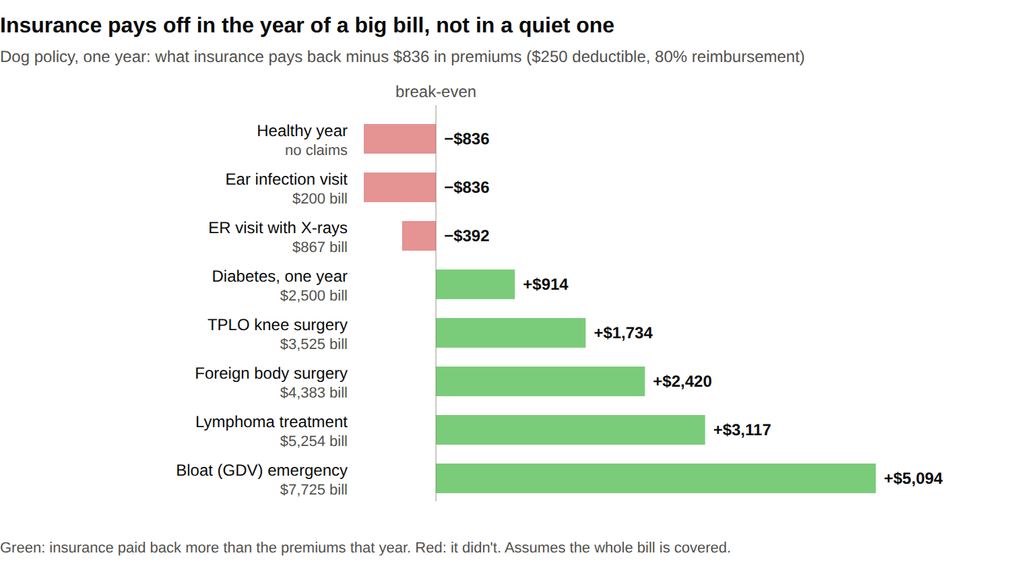
Look at the total you pay, not just the payout. Without insurance, the foreign body surgery costs you $4,383. With insurance, you pay $1,963 that year: $836 in premiums, 20% of the bill and the $250 deductible. In the healthy year, you pay $836 for nothing you can see.
Chronic illness repeats every year. Diabetes care can run upward of $2,500 a year, according to PetMD. If it starts after coverage begins, the policy keeps paying each year it renews, so the net gain repeats too. If it started before, it’s a pre-existing condition and isn’t covered.
For cats, the math is similar at a lower price. Lymphoma treatment for a cat averages $4,269, according to CareCredit. At $435 a year with the same deductible and reimbursement, a policy would pay back $3,165, about $2,730 more than that year’s premiums.
How we calculated: 80% of the bill, minus a $250 deductible (percentage first, then the deductible, as Healthy Paws and Lemonade do), minus $836 in premiums. Assumes the whole bill is covered and the annual limit isn’t reached. Exam fees aren’t covered by some insurers, which lowers the payout on small visits. Bills: CareCredit national averages (ER exam, ER X-rays, fluids and blood work; TPLO; foreign body surgery; lymphoma), Trupanion’s average ear infection claim plus a $95 exam, PetMD (diabetes) and Healthy Paws’ bloat example. For the full cost of each, see emergency vet costs, TPLO surgery, foreign body surgery and bloat surgery.
The break-even point: how big a bill makes insurance pay
In any one year, insurance pays for itself once your covered vet bills top this number: (yearly premium + deductible) ÷ reimbursement rate. For the average dog policy, that’s ($836 + $250) ÷ 0.80, or about $1,358. For the average cat policy, it’s ($435 + $250) ÷ 0.80, or about $856.
Use your own quote. With a $250 deductible and 80% reimbursement:
| Your yearly premium | Covered bills needed to break even that year |
|---|---|
| $400 | About $813 |
| $600 | About $1,063 |
| $836 (average dog) | About $1,358 |
| $1,200 | About $1,813 |
Our calculation: (premium + $250) ÷ 0.80.
Over a lifetime, the average owner pays in more than they get back. Ten years of the average dog premium cost $8,360 at today’s price, and more as your dog ages. In 2025, the average net loss ratio across US pet insurers was 69.1%, according to AM Best. In other words, about 69 cents of each premium dollar went to claims. That’s how insurance works: many owners pay for years with few claims, and that money pays for the owners who face a $7,000 surgery in year two. You’re paying not to be the owner with the big bill and no way to cover it.
Insurance vs. a savings account. If you put the average premium, about $70 a month, into savings instead:
| After… | Savings | What a foreign body surgery ($4,383) would leave you |
|---|---|---|
| 1 year | $836 | $3,547 short |
| 3 years | $2,508 | $1,875 short |
| 5 years | $4,180 | $203 short |
| 10 years | $8,360 | $3,977 left over |
Our calculation, ignoring interest.
Saving wins if the big bill never comes, or comes late. Insurance wins if it comes early, or more than once.
Who pet insurance is worth it for, and who can skip it
The deciding question isn’t whether your pet will get sick. It’s what you’d do if a $4,000 bill landed tomorrow. For many owners, the honest answer is that they couldn’t pay it in cash.
In an April 2026 Morning Consult survey of 1,542 pet owners for Healthy Paws:
- More than half said an unplanned vet bill under $1,000 would cause significant financial stress.
- About a third said they would decline care that cost less than $1,000.
- 24.1% had carried a credit card balance to pay for pet care.
- Insured owners were more likely to approve every recommended treatment: 47%, compared with 32% of uninsured owners.
The survey was paid for by an insurer, so read it with that in mind.
| Insurance usually makes sense if… | Self-insuring may make more sense if… |
|---|---|
| You don’t have $5,000 or more you could spend on your pet today | You keep a pet emergency fund of $5,000 to $10,000 and can refill it |
| Your pet is a puppy, kitten or young adult with a clean record | Your pet is a senior with the main conditions already excluded |
| Your breed has known costly problems (large dogs’ knees and hips, flat-faced breeds’ breathing, deep-chested dogs’ bloat) | You’d choose comfort care over surgery or chemotherapy |
| You have more than one pet, so the odds of a big bill each year add up | Your pet is low-risk and you’re comfortable taking the chance |
| You’d want specialist or emergency care at any hour | You’d rather keep the 31 cents of each premium dollar that doesn’t go to claims |
Older pets are the hardest case. Premiums usually rise with age, and anything your pet already has is excluded. Insurance can still cover new problems, such as cancer, that become more common with age, but the price can make the math tight. Do the break-even calculation with a real quote.
Is pet insurance worth it for cats, indoor cats and older dogs?
The same math gives different answers by pet: cats cost about half as much to insure, so a smaller bill pays the premium back, while an older dog pays more for the same cover. The table uses an 80% reimbursement and a $250 deductible, with the percentage applied first.
| Pet | Premium used | Bill that pays back a year of premium |
|---|---|---|
| Average cat | $435 a year (2025 average) | About $856 |
| Average dog | $836 a year (2025 average) | About $1,358 |
| Dog aged 3 | $41 a month ($492 a year) | About $928 |
| Dog aged 7 | $74 a month ($888 a year) | About $1,423 |
Sources: NAPHIA State of the Industry 2026 (2025 averages for accident-and-illness plans); Forbes Advisor 2026 price analysis ($5,000 limit) for the age examples. Our calculation: (premium + deductible) ÷ 80%.
Cats
For a cat, one dental visit with extractions or one surgery is usually enough to beat the premium. A routine cat dental cleaning averages about $375, and extractions typically run $600 to $1,200 for a visit with one tooth, and Cornell estimates that tooth resorption affects 20% to 60% of cats. Surgery to remove a swallowed object averages $2,367 for cats, and CareCredit puts lymphoma treatment at $4,269. Check dental cover first: it varies more than anything else between insurers (see does pet insurance cover dental and cat tooth extraction cost).
Indoor cats
Staying indoors lowers the risk of accidents, not of illness, so an indoor cat still needs illness cover if it needs insurance at all. In Nationwide’s 2025 claims data, none of the 10 most common cat claims was an accident. That makes an accident-only plan a poor fit for an indoor cat: it is cheap, but it leaves out dental disease, urinary and kidney problems and cancer.
Older dogs
For an older dog, insurance costs more and covers less, because anything it already has is excluded. In Forbes Advisor’s data, the average price rose from $41 a month at age 3 to $74 at age 7. It can still pay off for new problems that become more common with age, such as cancer or a torn cruciate ligament. Check the enrollment age first: Trupanion takes new pets under 14 and Embrace under 15, while Fetch and ASPCA set no upper age. Trupanion also says its price won’t rise just because your dog gets older. For the full comparison, see the best pet insurance for dogs, the best pet insurance for senior dogs and how pre-existing conditions work.
Alternatives to pet insurance
If full coverage doesn’t fit your budget, you still need a plan for the big bill. Here’s how the main options compare for a $4,000 emergency.
| Option | Yearly cost | Covers a $4,000 emergency? | The catch |
|---|---|---|---|
| Pet emergency fund | Whatever you save | Only once it has grown that big | Takes years to build; one bill can empty it |
| Accident-only insurance | About $190 for dogs, $112 for cats | Yes, if it’s an injury, and usually a swallowed object | Doesn’t cover illnesses such as cancer or diabetes, and may exclude cruciate tears |
| Wellness plan or add-on | About $578 more a year for dogs, $424 for cats | No | Pays for checkups and vaccines, not emergencies |
| CareCredit or other vet financing | Nothing until you use it | Yes, if you’re approved | CareCredit’s deferred interest charges all the interest back if you don’t pay in full in time |
| Charities and grants | Free | Rarely in full | Most grants are a few hundred dollars and need quick paperwork |
Sources: NAPHIA 2026 (plan prices; wellness = the difference between plans with and without it); CareCredit; RedRover.
Many owners combine two. A cheaper policy with a higher deductible plus a small savings fund for that deductible covers most situations. If you’d rely on financing, read how CareCredit’s deferred interest works first, and compare vet financing options. For help in a crisis, see financial assistance for vet bills.
How to make pet insurance worth it
The same pet can be a good or a bad deal depending on when you buy and how you set up the policy. These choices matter most.
- Enroll while your pet is young and healthy. Anything in the records before coverage, or during the waiting periods, can be excluded for life. Knee problems often have a longer wait; see does pet insurance cover TPLO. Getting a puppy? Here’s the best time to buy pet insurance and what waiting costs.
- Pick a deductible you could pay in cash tomorrow. A higher deductible lowers your premium every year. It only helps if you can actually pay it when the bill comes.
- Choose a limit that covers a bad year. A bloat emergency can cost $7,725 on its own. An annual limit of $10,000 or more, or unlimited, keeps one bad year from becoming two bills.
- Check what the policy leaves out. Exam fees, rehab, dental illness and hereditary conditions vary by insurer. A cheaper plan that skips exam fees pays less on every claim.
- Ask how the price changes with age. Most insurers raise premiums as pets get older. A policy that’s cheap at age 2 may cost much more at 10.
- Skip add-ons you won’t use. Do the math on a wellness add-on: it’s only worth it if the routine care it pays for costs more than the add-on.
- Stay put once a condition is covered. If you switch insurers, anything your pet has had becomes pre-existing with the new company.
Ready to compare plans? See the best pet insurance for dogs, or learn how deductibles, reimbursement and limits work.
The bottom line
Pet insurance isn’t a way to save money. It’s a way to make sure a $4,000 or $8,000 bill never decides your pet’s treatment. If you could pay that bill from savings today, you can reasonably skip it. If you couldn’t, buy a policy while your pet is young, choose a deductible you can afford and a limit that covers a bad year, and check the math with a real quote.
Frequently asked questions
Is pet insurance worth it?
It’s worth it if a $3,000 to $8,000 vet bill would be hard for you to pay and you buy before your pet has health problems. On average, owners pay in more than they get back, but insurance protects you in the year of a big surgery or illness.
How much does pet insurance cost per month?
The average accident-and-illness policy cost $836 a year for dogs and $435 for cats in 2025, or about $70 and $36 a month, according to NAPHIA. Your price depends on breed, age, location and the deductible and reimbursement you choose.
How big a vet bill do you need for pet insurance to pay off?
Divide your yearly premium plus your deductible by your reimbursement rate. For the average dog policy with a $250 deductible and 80% reimbursement, that’s about $1,358 in covered bills in a year.
Is it better to save money instead of buying pet insurance?
Saving wins if the big bill never comes or comes late. Saving the average premium of about $70 a month would take more than five years to cover a $4,383 foreign body surgery, so insurance is safer if a large bill could come early.
Is pet insurance worth it for an older dog or cat?
Sometimes. Premiums usually rise with age, and existing conditions are excluded, but a policy can still cover new problems such as cancer. Compare a real quote with the break-even formula before you buy.
Do pet insurance companies pay out less than they collect?
Yes, on average. In 2025, the average net loss ratio of US pet insurers was 69.1%, according to AM Best, meaning about 69 cents of each premium dollar went to claims.
What’s the cheapest way to protect against a big vet bill?
Accident-only insurance costs about $190 a year for dogs and $112 for cats, but it doesn’t cover illnesses. Many owners pair a cheaper policy with a higher deductible and a small savings fund.
How we researched this article
We used NAPHIA’s 2026 industry report for average premiums and AM Best’s August 2026 report for how much insurers pay out in claims. Vet bills are national averages from CareCredit’s 2025 cost study, Trupanion’s claims data, PetMD and Healthy Paws. Every payout in this article is our own calculation, applying the reimbursement percentage first and then the deductible, and assumes the whole bill is covered and the annual limit isn’t reached. Real policies differ in exclusions, exam-fee rules and price changes over time, so run the numbers with a real quote for your pet.
This page has no affiliate links, and no insurer pays to be mentioned.
Sources
- NAPHIA: State of the Industry Report 2026, average premiums
- AM Best: US pet insurance market segment report, August 3, 2026
- CareCredit: Emergency vet visit cost; Dog X-ray cost; Dog ACL surgery cost; Chemotherapy cost for dogs and cats; Veterinary procedure costs
- Trupanion: Commonly claimed conditions
- Healthy Paws: Common pet emergencies and costs; Love vs. Limits: the new economics of pet care (Morning Consult survey, April 2026)
- PetMD: Diabetes in dogs
- Embrace: How much is pet insurance?