
Insurance guide, not financial advice. Prices and policy terms come from public sources and change often, so check the details of your own policy. Last reviewed October 14, 2026. How we research
In this guide
Quick answer
Pet insurance usually goes up for three reasons: your pet got older, vet care got more expensive, and the insurer paid out more claims in your area. Your own claims usually aren’t the reason; Healthy Paws and Trupanion both say they don’t raise an individual’s premium for using the policy. The industry’s average dog premium rose about 12% from 2024 to 2025, so a double-digit increase isn’t unusual.
| Why your premium rose | How much it matters | Can you avoid it? |
|---|---|---|
| Your pet is a year older | Large for most insurers, especially after middle age | Not by switching once your pet has health history; Trupanion doesn’t raise rates for age alone |
| Vet prices rose | Vet services prices rose 6.5% in 2025 and over 50% since 2019 | No; it affects every insurer |
| More or bigger claims in your area | Varies by region and insurer | No; it’s based on the pool, not your pet |
| You changed your plan, ZIP code or added coverage | Depends on the change | Yes; check your renewal notice |
| Your own claims | None at Healthy Paws or Trupanion; ask your insurer | Not needed |
Sources: NAPHIA; US Bureau of Labor Statistics consumer price index for veterinarian services; Healthy Paws and Trupanion pricing statements, checked October 2026.
Before you switch insurers, check what you’d lose. A new policy would treat anything your pet has had as pre-existing. Often the smarter move is to change your deductible or reimbursement rate with the insurer you have.

How fast premiums are rising
Average pet insurance premiums rose about 12% in a single year. NAPHIA’s industry figures show the average accident-and-illness premium climbing from $749 to $836 for dogs and from $386 to $435 for cats between 2024 and 2025.
| Average accident-and-illness premium | 2024 | 2025 | Change |
|---|---|---|---|
| Dogs, per year | $749 | $836 | +11.6% |
| Cats, per year | $386 | $435 | +12.6% |
Source: NAPHIA State of the Industry reports 2025 and 2026. These are averages across all policies, including new ones, so they aren’t the same as the increase on any one renewal.
Insurers say the main driver is the cost of claims. Healthy Paws says its average claim reached about $392 in 2025, up nearly a third from 2020. When claims grow faster than premiums, insurers file higher rates with state regulators.
Some insurers are under more pressure than others. In 2025, the share of premiums paid out in claims (the loss ratio) ranged from 57.1% to 93.3% among the 10 largest pet insurance groups, according to AM Best, with an industry average of 69.1%. An insurer paying out close to what it collects has more reason to raise rates.
Reason 1: your pet is getting older
At most insurers, age is one of the biggest reasons a renewal costs more. Older pets get sick more often, and most insurers price that in every year. Embrace, for example, says most providers, itself included, “adjust rates annually to match that higher risk.”
| Dog’s age | Average monthly price, $5,000 limit | Average monthly price, no annual limit |
|---|---|---|
| 3 years | $41 | $64 |
| 5 years | $52 | $82 |
| 7 years | $74 | $114 |
Source: Forbes Advisor analysis of more than 478,000 quotes from 21 policies ($250 deductible, 80% reimbursement), verified August 2026. These compare different dogs at each age, not one dog’s renewals, but they show the pattern.
That’s an 80% rise between ages 3 and 7, before any general rate increase. Most of the jump comes after age 5.
Trupanion is the main exception. It says your rate “will not increase just because your pet gets older,” though it “may adjust for rising costs in care.” The trade-off, in its own words: “Your rate may start higher,” because it’s set for your pet’s expected lifetime of care.
For more on how age, breed and location set the price, see how much pet insurance costs.
Reason 2: vet care keeps getting more expensive
Your premium tracks the price of the care it pays for, and vet prices have been rising faster than general inflation. The consumer price index for veterinarian services rose 6.5% in 2025 and has climbed every year since 2020, with the biggest jumps in 2022 and 2023.
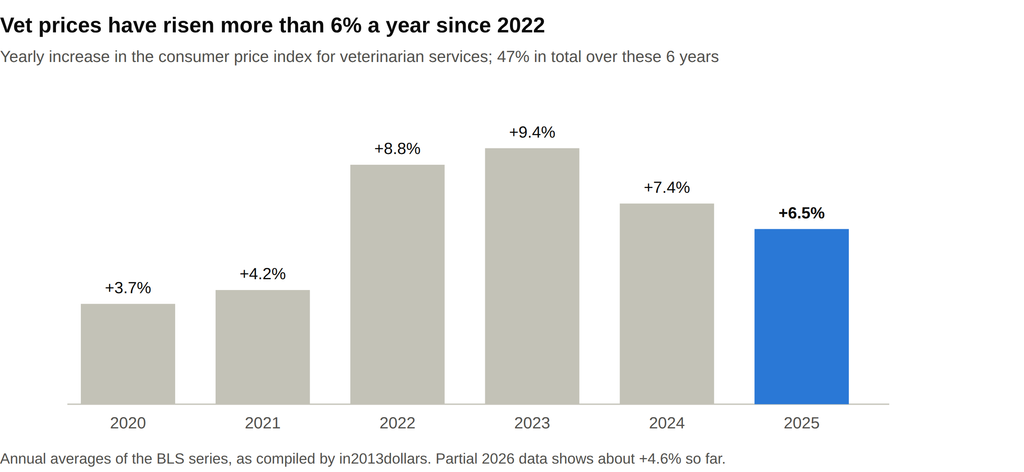
Why vet bills keep rising: Healthy Paws points to corporate consolidation of vet practices, owners choosing more advanced treatment, and tariffs on imported medicines and supplies. The American Veterinary Medical Association (AVMA) reported that vet practices’ revenue rose about 2.5% in 2025 even though visits fell about 3%, because prices went up.
Claims in your area matter too. Healthy Paws says its premiums reflect “the overall claims experience for the program within the region where the pet resides,” along with the cost of treatment advances, breed, gender and age. Rates are filed with state insurance regulators. If vets near you charge more, or pets in your area claim more, everyone’s premium there rises, whether or not your own pet made a claim.
Moving can change your price, too. A new ZIP code means a new rate. See the state-by-state comparison in how much pet insurance costs.
Why did my Trupanion rate go up?
Trupanion says it doesn’t raise rates because your pet gets older or because you made claims, so an increase almost always reflects the cost of vet care where you live. Its pricing promise says the rate “may adjust for rising costs in care,” which it tracks by location.
| What sets a Trupanion rate | Can it raise your rate later? |
|---|---|
| Breed, and your pet’s age when you enrolled | No: the starting price is set for the pet’s expected lifetime of care |
| Your pet getting older | No, according to Trupanion |
| Claims you make | No, according to Trupanion |
| Vet prices in your area | Yes: this is the main reason Trupanion rates rise |
| The deductible you choose | You control it: a higher deductible lowers the monthly price |
Source: Trupanion pricing promise and quote FAQ, checked October 2026.
What you can do about a Trupanion increase: ask Trupanion how a higher deductible would change your monthly price, since its deductible applies once per condition. Think twice before switching if your pet has had any health problem: a new insurer would treat it as pre-existing and exclude it. To check whether your new price is still reasonable, compare it with what pet insurance costs per month for a pet of the same age and breed.
Did my claims raise my premium?
At the insurers that say so publicly, no. It’s natural to suspect a big claim caused the increase, but the insurers we checked price by group, not by your pet’s claim history.
| Insurer | What it says about your own claims |
|---|---|
| Healthy Paws | “Premium increases are not based on your individual claim submissions.” |
| Trupanion | “You’ll never pay more just for using your coverage.” |
Sources: Healthy Paws FAQ; Trupanion pricing promise, checked October 2026.
Your claims still matter indirectly. If many pets in your area, or of your breed, make large claims, the insurer’s costs rise and so do everyone’s premiums in that group. Your claim is one small part of that pool.
If you’re not sure, ask. Call your insurer and ask, in writing, what drove this year’s increase: age, a general rate change, your location or a change you made to the policy. Insurers file their rates with state regulators, so they should be able to explain the factors.
Don’t avoid claims to keep your price down. At insurers that don’t price on individual claims, skipping a claim only costs you the reimbursement.
What to do when your premium goes up
Start by adjusting the policy you have. Switching insurers is the riskiest option once your pet has any health history.
| Option | How it lowers your premium | The trade-off |
|---|---|---|
| Raise your deductible | You take on more of each year’s first costs | Pick an amount you could pay in cash tomorrow |
| Lower your reimbursement rate (for example, 90% to 80%) | The insurer pays a smaller share of each bill | You pay more when you claim |
| Lower your annual limit | Less maximum coverage | A bad year could go over the limit |
| Drop add-ons you don’t use | Removes a wellness, exam-fee or dental add-on | Those costs come out of your pocket |
| Ask about discounts | ASPCA Pet Health Insurance, for example, takes 10% off for each additional pet | Not every insurer offers them |
| Switch insurers | A new quote may be cheaper today | Anything your pet has had becomes pre-existing, and new waiting periods start |
Before switching, check your pet’s records. If your pet has had any illness, injury or even a note about a symptom, a new insurer can exclude it. For a healthy young pet with a clean record, comparing quotes is reasonable; for a pet with history, the cheaper quote can cover much less. See pet insurance and pre-existing conditions and pet insurance waiting periods.
If full coverage is no longer affordable for a senior pet, ask your insurer about lowering the settings first. An accident-only plan is a last resort; see accident-only vs. accident and illness.
Plan for future increases. Premiums tend to rise every year as pets age and vet prices climb. When you compare insurers in the first place, ask how they price age; see the best pet insurance for dogs.
The bottom line
A higher renewal price usually reflects your pet’s age, rising vet costs and claims in your area, not your own claims. Read the renewal notice, ask the insurer what changed, and try adjusting your deductible, reimbursement rate or add-ons before you switch. If your pet has any health history, staying put usually protects you better than a cheaper quote.
Frequently asked questions
Why did my pet insurance go up?
Usually because your pet is a year older, vet prices rose, and claims in your area increased. Vet service prices rose 6.5% in 2025, and the industry’s average dog premium rose about 12% from 2024 to 2025.
Does pet insurance go up after a claim?
Not at Healthy Paws or Trupanion, which both say they don’t raise an individual’s premium for making claims. Claims across your area or breed can still push everyone’s rates up.
Does pet insurance go up every year?
At most insurers, yes, because of age and rising vet costs. Trupanion says its rate won’t rise just because your pet gets older, though it can rise with the cost of care.
How much does pet insurance go up with age?
In Forbes Advisor’s 2026 analysis, the average dog policy with a $5,000 limit rose from $41 a month at age 3 to $74 at age 7, about 80%.
Should I switch pet insurance if my premium goes up?
Only if your pet has no health history. A new insurer will exclude anything your pet has already had as pre-existing and start new waiting periods. Adjusting your deductible or reimbursement rate is usually safer.
How can I lower my pet insurance premium?
Raise the deductible, lower the reimbursement rate or annual limit, drop add-ons you don’t use, and ask about multi-pet discounts. Each lowers the price but means you pay more when you claim.
Is a 12% pet insurance increase normal?
It’s in line with the industry. NAPHIA’s average accident-and-illness premium rose 11.6% for dogs and 12.6% for cats from 2024 to 2025. Individual renewals can be higher, especially as pets age.
How we researched this article
Industry premium trends come from NAPHIA’s 2025 and 2026 reports and AM Best’s August 2026 market report. Vet price inflation comes from the US Bureau of Labor Statistics consumer price index for veterinarian services (annual averages, as compiled by in2013dollars) and AVMA reporting. Age-based prices come from Forbes Advisor’s 2026 analysis, used because insurers don’t publish comparable figures. Insurer policies on age and claims are quoted from Healthy Paws, Trupanion and Embrace, checked in October 2026.
Sources
- NAPHIA: State of the Industry Report 2026 highlights; State of the Industry 2025
- AM Best: US pet insurance market segment report, August 2026
- US Bureau of Labor Statistics, CPI for veterinarian services, via in2013dollars
- AVMA: Veterinarians report increasing price sensitivity, decreasing visits
- Healthy Paws: Frequently asked questions; The cost of veterinary care in 2025 and what to expect in 2026
- Trupanion: Our pricing promise
- Embrace: How much is pet insurance?
- Forbes Advisor: Average cost of pet insurance (verified August 2026)