
Insurance guide, not financial advice. Prices and policy terms come from public sources and change often, so check the details of your own policy. Last reviewed October 15, 2026. How we research
In this guide
Quick answer
Pet insurance costs about $70 a month for a dog and $36 for a cat, on average, for an accident-and-illness policy. Those are 2025 averages across all US policies, from the industry group NAPHIA. They rose about 12% in a year, from $62.44 and $32.21 a month in 2024. Accident-only plans cost far less, and adding wellness coverage nearly doubles the price. Below, we break down dog and cat insurance costs by insurer, breed, age and state, and what each price level covers.
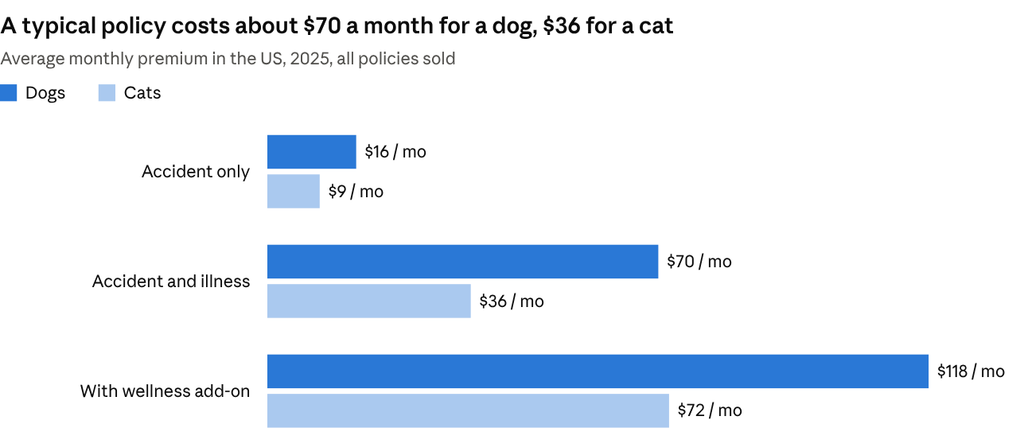
Many owners pay less than the average. Insurers’ own published averages are lower: Lemonade says its customers pay about $48 a month for dogs and $27 for cats, and Fetch about $35 and $22. Your price depends mostly on your pet’s breed, age and location, and on the deductible, reimbursement rate and annual limit you pick.
| Example | Typical monthly price |
|---|---|
| Young small mixed-breed dog, high deductible | About $12 to $20 |
| Average dog, $250 deductible, 80% reimbursement, $5,000 limit | About $56 |
| French Bulldog or Rottweiler, same settings | About $85 to $88 |
| 7-year-old dog, same settings | About $74 ($114 with no annual limit) |
| Average cat, same settings | About $24 |
Sources: NAPHIA State of the Industry 2025 and 2026; Lemonade; Fetch (January to November 2025); Embrace (May 2025 sample prices); Forbes Advisor analysis of more than 478,000 quotes from 21 policies (verified August 2026).

Prices by insurer
Several insurers publish what their customers pay on average. These figures aren’t a fair head-to-head comparison, because each insurer’s customers have different pets, locations and plan settings. They do show the range most owners actually pay.
| Insurer | Published average or example | Worth knowing |
|---|---|---|
| Lemonade | About $48 a month for dogs, $27 for cats; a 4-year-old Goldendoodle about $61 | Average prices vary by state from about $20 to $49 a month |
| Fetch | About $35 a month for dogs, $22 for cats (2025); French Bulldog about $71 | Exam fees are included, up to $250 a visit |
| Embrace | $20 to $70 a month for dogs, $10 to $30 for cats (2026) | Deductibles from $100 to $1,000 |
| Healthy Paws | Around $60 a month for dogs, $30 for cats | Annual limit of $5,000, $7,000 or unlimited |
| Trupanion | No published average | 90% reimbursement; price doesn’t rise just because your pet gets older |
| ASPCA Pet Health Insurance | No published average | 10% discount for each additional pet |
Sources: each insurer’s website, checked October 2026. Healthy Paws cites figures from Pawlicy Advisor.
The only way to compare fairly is to get quotes with the same settings. Use the same deductible, reimbursement rate and annual limit for every insurer, and check what each one leaves out, such as exam fees. See our picks for the best pet insurance for dogs.
Prices by breed and size
Breed is one of the biggest factors in your price. Insurers charge more for breeds with expensive, common health problems, such as the breathing, spine and skin issues of French Bulldogs, or the joint problems of many large breeds.

The pattern holds with lower deductibles, at higher prices. In Forbes Advisor’s 2026 analysis of 3-year-old dogs with a $250 deductible, 80% reimbursement and a $5,000 limit, a Dachshund averaged $35 a month, while a French Bulldog averaged $85 and a Rottweiler $88. Fetch’s own customers paid about $71 a month on average for French Bulldogs, $53 for German Shepherds and $30 for Shih Tzus.
Cat breeds vary less. Embrace’s sample prices for 3-year-old cats ranged only from $11.47 (Domestic Shorthair) to $14.26 (Maine Coon, Siamese, Bengal and others). At Fetch, Maine Coons averaged $35 a month and Domestic Shorthairs $24.
Mixed breeds are often cheaper. In Embrace’s samples, a small mixed-breed dog cost $12.42 a month, less than every purebred listed except the Chihuahua.
Prices by age
Age is the factor that changes your price the most over your pet’s life. Most insurers raise your premium as your pet gets older, on top of any general rate increase. Prices are similar for puppies and young adults, then climb, so putting off insurance for a young dog saves little: see when to get pet insurance. For older dogs, the best pet insurance for senior dogs depends on age limits as much as on price.
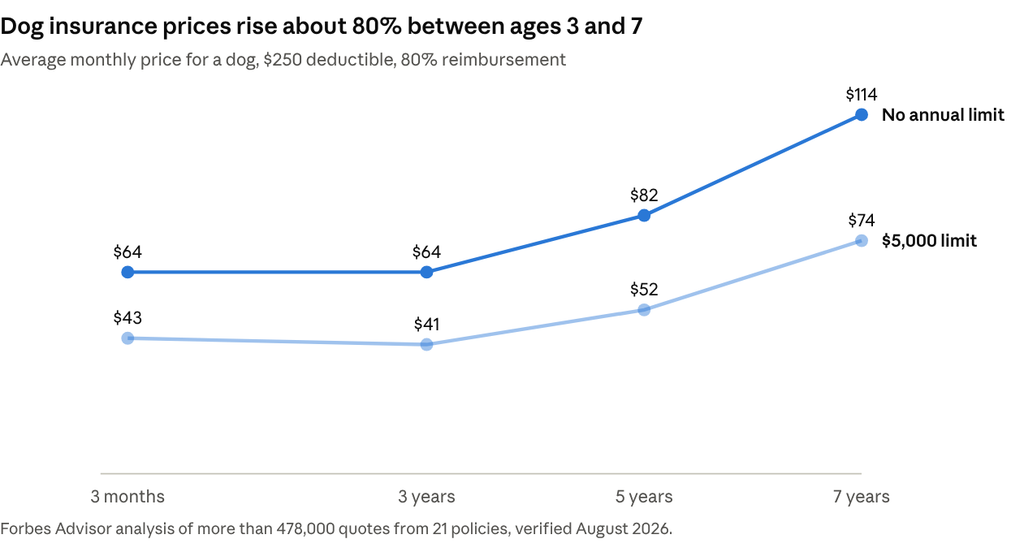
Cats follow the same pattern at lower prices. In the same analysis, a cat policy with no annual limit averaged $34 a month at 3 months and 3 years old, and $41 at 5.
What this means for you:
- The price you’re quoted today won’t last. Plan for your premium to rise as your pet ages, and ask the insurer how its prices change with age before you buy.
- Trupanion is the main exception. It says its price doesn’t go up just because your pet gets older, though it can still rise for other reasons, such as higher vet costs in your area. See why pet insurance goes up.
- Enrolling young still pays. The premium rises either way, but a pet insured young has fewer conditions excluded as pre-existing.
- Some insurers have age limits for new pets. Trupanion accepts pets before their 14th birthday and Embrace before 15; Fetch and ASPCA have no upper age limit.
If your premium jumped at renewal, age is usually one of the reasons, along with rising vet prices and the claims made in your area.
Prices by state
Where you live can double your premium. Insurers price by ZIP code because vet bills cost more in some places. In Forbes Advisor’s 2026 analysis of dog policies with a $5,000 limit, Oklahoma was cheapest at about $30 a month, followed by Arkansas and Missouri at $33. Connecticut was the most expensive at $63, with Washington, Arizona and Colorado close behind at about $61 to $63. Lemonade’s average prices vary by state from about $20 to $49 a month.
Embrace’s sample prices show the same spread for identical pets and plans:
| State | Puppy (6 months) | Dog (3 years) | Kitten (6 months) | Cat (3 years) |
|---|---|---|---|---|
| Georgia | $11.62 | $14.38 | $9.66 | $11.60 |
| Texas | $12.42 | $13.41 | $10.33 | $12.39 |
| Florida | $12.43 | $13.43 | $10.34 | $12.41 |
| Virginia | $13.58 | $14.67 | $11.29 | $13.55 |
| New Jersey | $15.90 | $17.17 | $13.23 | $15.86 |
| Pennsylvania | $15.98 | $17.27 | $13.29 | $15.96 |
| Maryland | $16.23 | $17.53 | $13.50 | $16.19 |
| California | $16.56 | $13.80 | $9.35 | $11.11 |
| Massachusetts | $18.37 | $19.85 | $15.28 | $18.34 |
Source: Embrace, May 2025. Small male mixed-breed dogs and male Domestic Shorthair cats; $5,000 annual limit, $1,000 deductible, 70% reimbursement.
Prices can also differ by ZIP code within a state. If you move, expect your premium to change.
How your plan settings change the price
The three choices you make when you buy (deductible, reimbursement rate and annual limit) can change the premium a lot. Embrace’s sample plan for a 3-year-old small mixed-breed dog in Texas, with a $1,000 deductible, 70% reimbursement and a $5,000 limit, cost $13.41 a month. The average 3-year-old dog in Forbes Advisor’s analysis, with a $250 deductible and 80% reimbursement, cost about $41. The pets and insurers differ, so it isn’t a like-for-like comparison, but it shows how wide the range is.
| Setting | Choose this to pay less each month | The trade-off |
|---|---|---|
| Deductible | A higher deductible, such as $500 or $1,000 | You pay more of each bill yourself before insurance starts paying |
| Reimbursement rate | 70% instead of 80% or 90% | You pay a bigger share of every covered bill |
| Annual limit | A set limit, such as $5,000, instead of unlimited | A bad year could go over the limit. A dog’s unlimited plan averaged $64 a month at age 3, versus $41 with a $5,000 limit |
| Add-ons | Skip wellness, exam-fee or dental add-ons you won’t use | Routine care and some exam fees come out of your pocket |
Sources: Embrace (May 2025); Forbes Advisor (August 2026).
Pick the deductible you could pay tomorrow, not the lowest premium. A cheap policy with a deductible you can’t afford doesn’t help when the bill arrives. For how the numbers work on a real claim, see how pet insurance works, and to check whether a policy pays off for you, see is pet insurance worth it?
How to pay less for pet insurance
You can often lower your premium without giving up protection against a big bill.
- Get at least three quotes with identical settings. Same deductible, reimbursement rate and limit, so you’re comparing prices, not plans.
- Raise the deductible to what you could pay in cash. The premium drops every month, and you keep coverage for the expensive emergencies.
- Choose 80% instead of 90%. You give up a small share of each bill for a lower monthly price.
- Match the limit to real bills. One emergency surgery can cost $4,000 to $8,000, so a $5,000 limit can be tight; but unlimited isn’t always needed for a small, low-risk pet.
- Ask about discounts. ASPCA Pet Health Insurance takes 10% off for each additional pet, and other insurers have their own discounts. Some employers also offer pet insurance as a benefit.
- Skip add-ons you won’t use. Wellness coverage adds a lot: on average, plans with wellness cost dogs $578 more a year in 2025.
- Enroll while your pet is young. You’ll pay a lower starting premium and avoid pre-existing exclusions. See pet insurance and pre-existing conditions.
- Consider accident-only coverage if money is tight. It averaged about $16 a month for dogs and $9 for cats in 2025, though it doesn’t cover illnesses.
Ready to compare? See our picks for the best pet insurance for dogs.
The bottom line
Expect to pay roughly $35 to $70 a month for a dog and $22 to $36 for a cat, and more for high-risk breeds and older pets. Your quote depends mostly on breed, age, ZIP code and the deductible, reimbursement rate and limit you choose. Get several quotes with the same settings, pick a deductible you can actually pay, and expect the price to rise as your pet ages.
Frequently asked questions
How much is pet insurance per month for a dog?
The average accident-and-illness policy cost about $70 a month for a dog in 2025, according to NAPHIA. Many owners pay less: Lemonade’s dog customers average about $48 and Fetch’s about $35.
How much is pet insurance per month for a cat?
About $36 a month on average for an accident-and-illness policy in 2025, according to NAPHIA. Lemonade’s cat customers average about $27 and Fetch’s about $22.
Why is my dog’s pet insurance so expensive?
Breed, age and location matter most. In Embrace’s samples, a French Bulldog cost about three times as much as a Chihuahua on the same plan, and prices for dogs rose about 80% between ages 3 and 7 in Forbes Advisor’s analysis.
Does pet insurance go up every year?
Usually. Most insurers raise premiums as pets age and as vet costs rise. Across the industry, the average dog premium rose about 12% from 2024 to 2025. Trupanion says its price doesn’t rise just because of age.
How much does accident-only pet insurance cost?
About $190 a year for dogs and $112 for cats in 2025, or roughly $16 and $9 a month. It covers injuries but not illnesses.
What’s the cheapest way to get pet insurance?
Choose a higher deductible and 70% or 80% reimbursement, compare quotes with the same settings, ask about multi-pet discounts and skip add-ons you won’t use. Enrolling young also helps.
Is pet insurance cheaper for cats than dogs?
Yes. The average accident-and-illness policy cost $435 a year for cats in 2025, about half the $836 for dogs.
How we researched this article
Industry averages come from NAPHIA’s State of the Industry reports for 2025 and 2026, which cover all policies sold in the US. Breed and state prices come from Embrace’s published sample quotes (May 2025), and insurer averages from Lemonade, Fetch, Embrace and Healthy Paws. Prices by age and by state come from Forbes Advisor’s analysis of more than 478,000 quotes from 21 policies, verified in August 2026; we used it where insurers don’t publish comparable figures. Monthly NAPHIA figures are the annual average divided by 12. We don’t sell insurance or collect quotes ourselves, so get real quotes for your pet before you decide.
Sources
- NAPHIA: State of the Industry Report 2026, average premiums; State of the Industry 2025 (2024 data)
- Embrace: How much is pet insurance?
- Lemonade: Pet insurance cost explained
- Fetch: Pet insurance prices by breed
- Healthy Paws: Navigating pet insurance costs
- ASPCA Pet Health Insurance: Is pet insurance affordable?
- Forbes Advisor: Average cost of pet insurance (verified August 6, 2026)