
Insurance guide, not financial advice. Prices and policy terms come from public sources and change often, so check the details of your own policy. Last reviewed October 28, 2026. How we research
In this guide
- Why the best time is before the first vet visit
- Your puppy’s first year: when coverage kicks in
- What waiting to insure your puppy can cost
- Is pet insurance cheaper if you buy it when your dog is young?
- How to time it: a checklist for new puppy owners
- What if your dog is already older?
- The bottom line
- Frequently asked questions
- How we researched this
The best time to get pet insurance for a puppy is the week you bring it home, before its first vet exam: most insurers accept puppies from 6 or 8 weeks old, and anything the vet notes before coverage starts is excluded for good. Waiting doesn’t make the policy much cheaper. In Forbes Advisor’s data, a 3-month-old puppy cost $43 a month and a 3-year-old dog $41, so a year’s delay saves about $516 in premiums while one swallowed sock can cost $4,383.
| Insurer | Youngest age to enroll | Wait before illnesses are covered |
|---|---|---|
| Trupanion | From birth | 30 days (none with an Exam Day Offer activated within 24 hours of a vet exam) |
| Embrace | 6 weeks | 14 days |
| Fetch | 6 weeks | Up to 15 days; no wait for accidents |
| Healthy Paws | 8 weeks | 15 days |
| ASPCA | 8 weeks | 14 days |
| Lemonade | 8 weeks | 14 days |
This guide is about timing: when to buy, what happens in your puppy’s first year, and what a few months’ delay can cost. If you’ve already decided to buy and want to compare insurers for a puppy, see our best pet insurance for dogs.
Why the best time is before the first vet visit
No major US insurer covers a condition that showed signs before the policy started or during its waiting period, and your puppy’s first exam is when those signs get written down. A heart murmur, a loose kneecap, an umbilical hernia, a skin problem or a bout of diarrhea noted at that visit can be excluded for the life of the policy, even if it later turns out to be minor.
That is why Embrace and Healthy Paws both tell owners to enroll as early as possible, and why the age limits work in your favor with a puppy: you can buy cover before there is any medical history at all. Some conditions that clear up can come back into cover after a symptom-free period, but chronic and hereditary problems usually can’t; the rules by insurer are in our guide to pre-existing conditions.
Two age rules are worth knowing before you shop:
- Hip dysplasia at Healthy Paws: it’s only covered if you enroll before your dog turns 6, and in most states it has a 12-month waiting period. That matters for large breeds: dog hip dysplasia surgery costs range from a few thousand dollars to $10,000 per hip.
- Orthopedic waits at Embrace and Fetch: about six months for knee, hip and spine problems in dogs, which can be shortened with an early vet exam. A puppy enrolled at 8 weeks is usually past them before the age when large breeds start showing joint problems.

Your puppy’s first year: when coverage kicks in
If you enroll at 8 weeks, illnesses are covered from about 10 weeks, before the vaccine series is even finished, and knee, hip and spine problems from about 8 months. Here is how a typical first year lines up with the insurance clock:
| Puppy’s age | What usually happens | What it means for insurance |
|---|---|---|
| 6–8 weeks | You bring your puppy home | Earliest enrollment at most insurers; get quotes before pick-up day |
| First days at home | First vet exam, about $95 nationally | Findings go into the record; enroll before this visit if you can |
| 6–16 weeks | Core vaccines, at least three doses 2 to 4 weeks apart | Routine care, not covered by accident-and-illness policies |
| About 10–12 weeks | Illness waiting periods (14 to 30 days) end | Infections, digestive problems and other illnesses are now covered |
| About 6 months | Spay or neuter surgery | Usually not covered, since it’s planned; budget for it separately |
| About 8 months | Orthopedic waits of about six months end | Knee, hip and spine problems are covered at Embrace and Fetch |
| Before age 6 | Last chance for Healthy Paws hip dysplasia cover | Matters most for large and giant breeds |
Vaccines, the first exam and spaying or neutering are predictable costs, so a standard policy doesn’t pay for them. Some insurers sell a wellness add-on for that; see pet insurance vs. wellness plans and whether pet insurance covers spaying and neutering. Surgery prices are in our guides to spaying a dog and neutering a dog.
What waiting to insure your puppy can cost
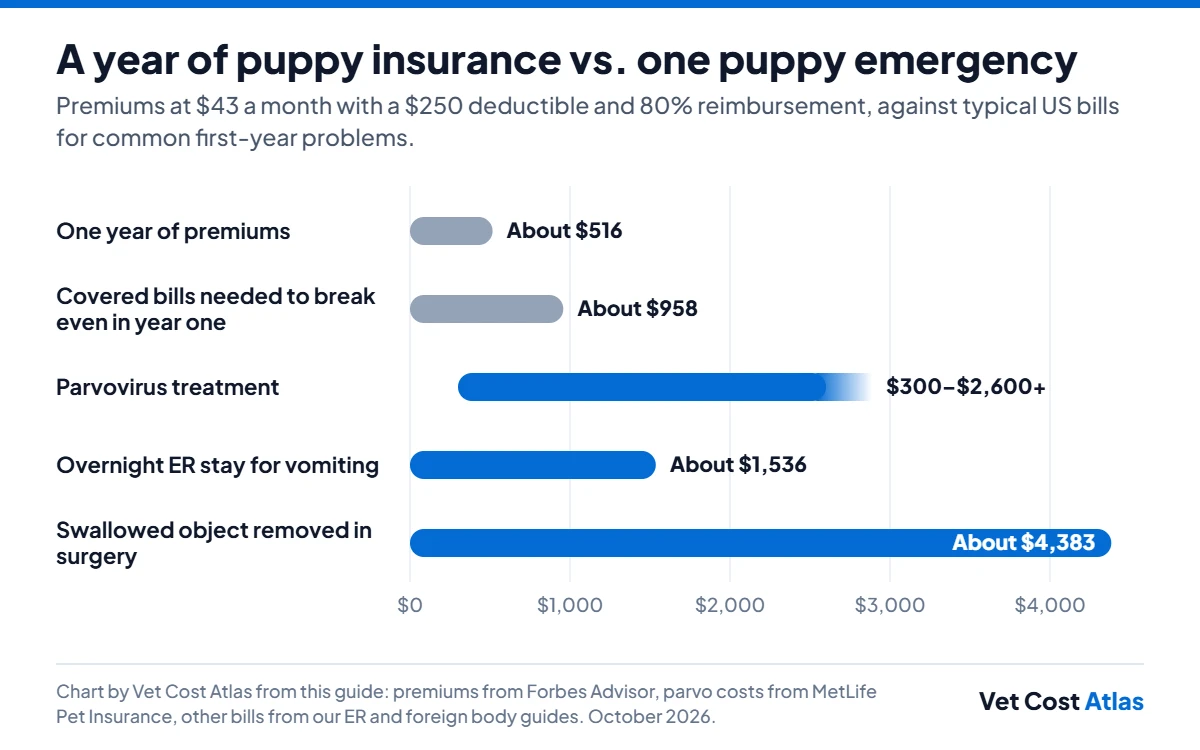
Putting insurance off for a year saves roughly $516 in premiums, while a single puppy emergency in that year typically costs $300 to $4,400 and is then excluded from any policy you buy later. Puppies chew, swallow things and catch infections before their vaccines are complete, so the first year is not a quiet one.
| What happens before you insure | Typical bill | What it means later |
|---|---|---|
| Parvovirus, treated at home or in hospital | About $300 to $2,600 or more | Paid out of pocket; complications can be excluded |
| Overnight ER stay for vomiting | About $1,536 | A recurrence of the same problem may be excluded |
| Swallowed object removed in surgery | About $4,383 | Paid out of pocket |
| Limping noted at a check-up | An exam and X-rays, a few hundred dollars | That knee or hip, and at some insurers both, can be excluded for life; a TPLO runs $3,500 to $6,000 per knee |
| Nothing happens | $0 | You saved about $516, but your puppy is now older and the waiting periods still have to run |
For the policy to pay for itself in your puppy’s first year, covered bills would need to pass about $958: a year of premiums at $43 a month plus a $250 deductible, divided by 80% reimbursement. One surgery clears that easily; a healthy year doesn’t. Our guide to whether pet insurance is worth it runs the same math for older dogs and cats.
Is pet insurance cheaper if you buy it when your dog is young?
Only a little at the start, but much cheaper than buying later: premiums are about flat from 3 months to 3 years and then rise quickly, roughly 80% between ages 3 and 7. These are Forbes Advisor’s average monthly prices for dogs:
| Dog’s age when priced | $5,000 annual limit | No annual limit |
|---|---|---|
| 3 months | $43 a month | $64 a month |
| 3 years | $41 | $64 |
| 5 years | $52 | $82 |
| 7 years | $74 | $114 |
Most insurers re-price your dog at each renewal as it ages, so buying young doesn’t lock in the puppy price. What it locks in is a clean record: everything that happens after the waiting periods is covered, instead of becoming a new exclusion. Trupanion is the exception on price; its pricing promise says the rate won’t rise just because your dog gets older. More on renewals in why pet insurance goes up, and prices by breed and state in how much pet insurance costs per month.
How to time it: a checklist for new puppy owners
Get quotes before pick-up day, start the policy as soon as your puppy is old enough, and use the first vet exam to shorten the waits rather than to start the record.
- Compare quotes a week or two before you bring your puppy home. You’ll need the breed, birth date and your ZIP code. Pick the settings now: see how the deductible, reimbursement rate and annual limit change the price.
- Enroll on the first day your puppy qualifies. That’s 6 weeks at Embrace and Fetch and 8 weeks at Healthy Paws, ASPCA and Lemonade. Waiting periods start on the policy start date, so every day earlier is a day sooner you’re covered.
- If your vet offers Trupanion’s Exam Day Offer, decide that day. It gives immediate coverage for new injuries and illnesses with no waiting period, but it must be activated within 24 hours of the exam. It isn’t available in New York.
- Book the first exam early, and ask about the orthopedic form. With Embrace, an orthopedic exam in the first 14 days ends the orthopedic wait with the illness wait. With Fetch, an exam within 180 days can waive the orthopedic wait for knee injuries. Details are in our guide to pet insurance waiting periods.
- Check your state’s rules. In the 16 states that have adopted the NAIC model law, accident waiting periods aren’t allowed and you get 15 days to return a new policy for a refund if you haven’t claimed.
- Keep the policy once the waits are over. Switching insurers restarts every waiting period and turns your dog’s history into pre-existing conditions.
What if your dog is already older?
It isn’t too late: the best time after puppyhood is now, while your dog is still healthy, because every year adds both premium and medical history. Most insurers accept dogs well into their teens; ASPCA and Fetch list no upper age limit. Expect anything already in your dog’s records to be excluded, and compare the insurers’ rules in our guide to the best pet insurance for dogs. If full cover is too expensive, an accident-only plan costs less and still pays for injuries and swallowed objects.
The bottom line
Buy pet insurance for a puppy as soon as it’s old enough to enroll, ideally before its first vet exam. The premium at 8 weeks is about what you’d pay at 3 years, so waiting saves little, while anything that happens or gets noted in the meantime stays excluded. Get quotes before you bring your puppy home, start the policy on the first eligible day, and use an early exam to shorten the orthopedic wait.
Frequently asked questions
When should I get pet insurance for my puppy?
As soon as your puppy is old enough to enroll, ideally before its first vet exam. Embrace and Fetch accept puppies from 6 weeks, Healthy Paws, ASPCA and Lemonade from 8 weeks, and Trupanion from birth.
What is the best age to get pet insurance?
Between 6 and 8 weeks, the youngest age most insurers accept. Premiums are about the same as at 3 years old, and your puppy has no medical history yet, so nothing is excluded as pre-existing.
Is it worth getting pet insurance for a puppy?
For most owners, yes, if a $1,500 to $4,500 emergency bill would be hard to pay. A year of cover costs about $516 at average prices, and puppies often swallow objects or catch infections before their vaccines are complete.
Does pet insurance cover puppy vaccines and spaying?
Not under a standard accident-and-illness policy, because they’re planned, routine costs. Some insurers sell a wellness add-on that pays a set amount toward vaccines, exams and sometimes spaying or neutering.
Can I get pet insurance after my puppy’s first vet visit?
Yes, but anything the vet noted at that visit, or any symptom before your policy starts or during its waiting period, can be excluded as pre-existing. Everything new after the waiting periods is covered.
How we researched this
We took minimum enrollment ages and waiting periods from the websites and help pages of six large US pet insurers (Trupanion, Embrace, Fetch, Healthy Paws, ASPCA Pet Health Insurance and Lemonade), checked in October 2026. Lemonade doesn’t state its minimum age on its own pages, so we used NerdWallet’s May 2026 review. Prices by age come from Forbes Advisor; parvo costs from MetLife Pet Insurance; the vaccine schedule from the American Animal Hospital Association; other bills from our own cost guides. The break-even figure is our own calculation. We have no quotes of our own, and terms vary by state and policy version, so check the policy document before you buy.
Sources
- Trupanion: Is my pet eligible?
- Trupanion: Exam Day Offers
- Veterinary Practice News: Trupanion offers enrollment at birth (2019)
- Embrace: Insure before or after spay or neuter?
- Embrace: Orthopedic waiting period
- Fetch: Dog insurance
- Healthy Paws: Puppy insurance
- ASPCA Pet Health Insurance: Compare plans
- Lemonade: Pet insurance FAQ
- NerdWallet: Lemonade pet insurance review (May 2026)
- Forbes Advisor: Average cost of pet insurance
- MetLife Pet Insurance: Parvo treatment cost
- AAHA: Canine vaccination guidelines
- NAIC: Pet Insurance Model Act
- CareCredit: Veterinary cost data