
Insurance guide, not financial advice. Prices and policy terms come from public sources and change often, so check the details of your own policy. Last reviewed October 1, 2026. How we research
In this guide
Quick answer
Pet insurance pays for the unexpected: accidents and illnesses. A wellness plan pays a fixed amount toward routine care you already expect, such as checkups, vaccines and dental cleanings. Insurance protects you from a $5,000 bill; a wellness plan mostly spreads $300 to $1,000 of routine costs into monthly payments. Most owners need insurance more. A wellness plan is worth adding only if you’ll use nearly everything it pays for.
| Pet insurance (accident and illness) | Wellness plan | |
|---|---|---|
| What it pays for | Injuries, illnesses, emergencies, surgery, cancer, chronic conditions | Exams, vaccines, dental cleaning, routine tests, parasite prevention, sometimes spay/neuter |
| How it pays | A percentage of the bill after a deductible, up to a yearly limit | A set amount per service, up to a yearly total |
| Typical cost | About $70 a month for a dog, $36 for a cat | About $10 to $40 a month as an add-on |
| Most it pays in a year | Often $5,000 to unlimited | Usually $250 to $1,200 |
| Waiting periods and pre-existing exclusions | Yes | Varies; check when the plan starts paying |
| Is it insurance? | Yes | Often not; Embrace calls its plan “not insurance” |
Sources: NAPHIA State of the Industry 2026 (insurance prices); Fetch, ASPCA Pet Health Insurance and Embrace wellness plan pages, checked October 2026.
How each one pays
Insurance and wellness plans pay in completely different ways, which is why one can’t replace the other.
Insurance pays a percentage of a covered bill. You pay the vet, send the claim, and the insurer reimburses, for example, 80% of the bill after your deductible. On a $4,383 surgery to remove a swallowed object, an 80% policy with a $250 deductible pays back about $3,256. On a routine checkup, it pays nothing, because routine care isn’t covered.
A wellness plan pays a set amount per service. Each item has its own yearly cap, and the plan pays up to that amount. Fetch’s Advantage plan, for example, pays up to $75 for a yearly exam, $80 for vaccines and $200 for a dental cleaning or spay/neuter. If your exam costs $95, you get $75; if your dog has surgery for a swallowed sock, the wellness plan pays nothing.
| Bill | Accident-and-illness insurance (80%, $250 deductible) | Wellness plan (Fetch Advantage) |
|---|---|---|
| Yearly exam ($95) | $0 (routine care) | $75 |
| Core vaccines ($150) | $0 | $80 |
| Dental cleaning ($388) | $0 | $200 |
| Swallowed object surgery ($4,383) | About $3,256 | $0 |
| Cancer treatment ($5,254) | About $3,953 | $0 |
Our calculations. Bills: CareCredit national averages; vaccines are rabies, DHPP, leptospirosis and Bordetella. Insurance assumes the deductible hasn’t been met that year.
Three kinds of wellness plans
- Insurer add-ons, such as Fetch Wellness or ASPCA’s preventive care, which you add to an insurance policy.
- Insurer memberships, such as Embrace Wellness Rewards, which Embrace describes as “not insurance” but a budgeting tool with a yearly allowance.
- Clinic plans, such as Banfield’s Optimum Wellness Plans, which bundle routine care at one chain of clinics for a monthly fee. They can’t be used at other vets.
What wellness plans cost
Wellness plans run from about $10 to $40 a month as insurance add-ons, and more for clinic plans. Across all US policies, plans that include wellness coverage cost dogs about $578 a year more than accident-and-illness plans without it, and cats about $424 more, according to NAPHIA’s 2026 report.
| Plan | Monthly cost | Most it pays in a year | Notes |
|---|---|---|---|
| Fetch Wellness Essentials | From $18 | $390 | Exam up to $50, vaccines $50, dental cleaning or spay/neuter $175 |
| Fetch Wellness Advantage | From $30 | $700 | Exam $75, vaccines $80, dental cleaning or spay/neuter $200 |
| Fetch Wellness Prime | From $40 | $1,200 | Exam $100, vaccines $125, parasite prevention $250, dental cleaning or spay/neuter $250 |
| ASPCA preventive care, Basic | $9.95 | $250 | Exam $50; no dental cleaning or spay/neuter |
| ASPCA preventive care, Prime | $24.95 | $450 | Dental cleaning or spay/neuter $150, most other items $25 each |
| Embrace Wellness Rewards | Not published | $300, $500 or $700 | Flexible allowance for routine care, not insurance |
| Banfield Optimum Wellness Plans | From $26.95 to over $100 | Bundled services at Banfield clinics | Forbes Advisor’s 2025 check: $42 a month for adult dogs, $71 for the senior plan, $69 enrollment fee |
Sources: Fetch (October 2026); ASPCA preventive care schedule (2023, the latest published); Embrace; Banfield; Forbes Advisor (March 2025). Prices vary by state, pet and plan level.
Watch the per-item caps, not just the yearly total. A plan that pays “up to $700” only pays that much if you use every category up to its limit. Many owners won’t use every category every year.
Does a wellness plan pay off? The math
A wellness plan pays off in a year when your dog gets a dental cleaning, and usually loses money in a year when it doesn’t. We priced a typical year of routine care for an adult dog at national averages and checked what each plan would pay back, item by item.
| Routine care for an adult dog | Average cost |
|---|---|
| Yearly exam | $95 |
| Vaccines (rabies, DHPP, leptospirosis, Bordetella) | $150 |
| Heartworm test | $71 |
| Fecal test | $58 |
| Blood work (CBC and chemistry panel) | $268 |
| Subtotal without a cleaning | $642 |
| Dental cleaning | $388 |
| Total with a cleaning | $1,030 |
Source: CareCredit / Synchrony national averages. Parasite prevention isn’t included; it would add to what the plans pay back, especially Fetch Prime, which pays up to $250 for it.
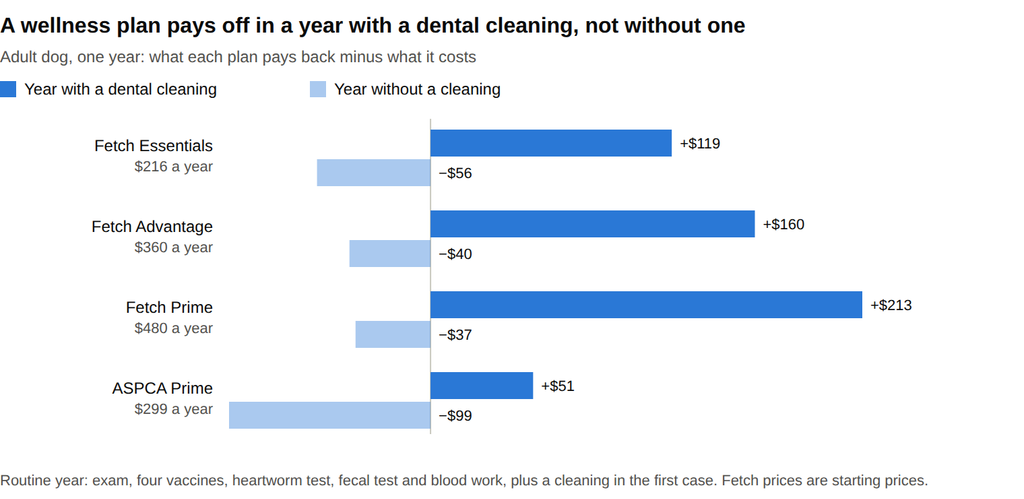
Why the plans fall short without a cleaning: each item’s cap is lower than what it costs. Fetch Essentials, for example, pays $50 toward a $95 exam and $20 toward $268 of blood work. The dental cleaning is the one item big enough to tip the math.
What it means for you:
- If your vet recommends a yearly cleaning, a wellness plan can come out ahead by $50 to $210 a year.
- If your dog doesn’t need cleanings every year, you’ll likely pay more into the plan than you get back. Saving the monthly amount yourself does the same job.
- In a puppy or kitten year with a spay or neuter, plans can pay off because the surgery counts toward the same benefit as a cleaning. See does pet insurance cover spay and neuter?
For what routine visits cost in the first place, see how much a vet visit costs and dog blood work costs.
When you need both, one or neither
Start with the bill you couldn’t handle, not the one you pay every year. An unexpected $4,000 surgery is the risk insurance exists for. Routine care is predictable, so a wellness plan is a budgeting choice, not protection.
| Your situation | What usually makes sense |
|---|---|
| A $3,000 to $8,000 emergency would be hard to pay, and routine care fits your budget | Insurance only. Pay routine costs yourself or set aside a monthly amount. |
| You’d struggle with both a big bill and the yearly routine costs | Insurance plus a wellness plan, if you’ll use most of the plan; it turns routine costs into a steady monthly payment. |
| Puppy or kitten year with vaccines, a spay or neuter and a microchip | Both can make sense, since a first year uses most wellness categories. Review the wellness plan at the first renewal. |
| Adult pet that needs a dental cleaning every year | A wellness plan can pay for itself on top of insurance. |
| You have $5,000 to $10,000 set aside for your pet | Neither may be necessary, though insurance still protects against the rare very large bill. |
| Senior pet that can’t get new full coverage | An accident-only plan, plus savings for routine and illness care. See accident-only vs. accident and illness. |
Don’t choose a wellness plan instead of insurance. A wellness plan can’t help with a cancer diagnosis or an emergency surgery, and those are the bills that force hard choices. If your budget only allows one, choose insurance. See is pet insurance worth it? and how much pet insurance costs.
Check before you combine plans: some insurers only sell their wellness plan as an add-on to their own policy, and clinic plans like Banfield’s only work at that clinic chain.
The bottom line
Pet insurance and wellness plans do different jobs: insurance protects you from the big unexpected bill, and a wellness plan spreads out routine costs. If you can only afford one, choose insurance. Add a wellness plan only when the numbers work for your pet, usually in a puppy’s first year or when your vet recommends a dental cleaning every year.
Frequently asked questions
What’s the difference between pet insurance and a wellness plan?
Pet insurance pays a percentage of unexpected bills for accidents and illnesses, after a deductible. A wellness plan pays set amounts toward routine care, such as exams, vaccines and dental cleanings, up to a yearly total.
Is a wellness plan the same as pet insurance?
No. A wellness plan doesn’t cover accidents or illnesses, and some aren’t insurance at all; Embrace calls its Wellness Rewards plan a non-insurance membership.
Is a pet wellness plan worth it?
Only if you’ll use most of what it pays for. In our math for an adult dog, plans came out $50 to $210 ahead in a year with a dental cleaning, but $37 to $99 behind in a year without one.
How much does a pet wellness plan cost?
About $10 to $40 a month as an insurance add-on. Fetch Wellness starts at $18, $30 or $40 a month, and ASPCA’s preventive care was $9.95 or $24.95 in its latest published schedule. Clinic plans such as Banfield’s cost more.
Do I need both pet insurance and a wellness plan?
You need insurance more. Add a wellness plan only if routine costs are hard to budget and you’ll use most of the plan, such as in a puppy’s first year or for a pet that needs yearly dental cleanings.
Does pet insurance cover vaccines and checkups?
Not standard accident-and-illness insurance. Routine care like vaccines, exams and cleanings is covered only through a wellness plan or add-on.
Can I use a wellness plan at any vet?
Insurer wellness plans, such as Fetch’s or ASPCA’s, generally work at any licensed vet. Clinic plans, such as Banfield’s Optimum Wellness Plans, only work at that clinic chain.
How we researched this article
We compared the published benefit schedules and prices of wellness plans from Fetch, ASPCA Pet Health Insurance and Embrace, and Banfield’s clinic plans, in October 2026. ASPCA’s schedule is the latest one it publishes (2023), and Fetch’s prices are starting prices, so check current figures with a quote. Routine care costs are CareCredit national averages, and insurance prices come from NAPHIA’s 2026 report. The payback math is our own: for each plan, we applied its per-item caps to a typical year of routine care for an adult dog.
Sources
- Fetch: Wellness plans
- ASPCA Pet Health Insurance: Preventive care options (2023); Preventive care coverage
- Embrace: Wellness Rewards
- Banfield: What is a preventive care package?
- Forbes Advisor: Banfield wellness plan review and pricing (March 2025)
- NAPHIA: State of the Industry Report 2026 highlights
- CareCredit: Veterinary exam and procedure costs; Cat and dog teeth cleaning cost