
Cost guide, not veterinary advice. Prices are typical US ranges from public sources and vary by clinic and region. Last reviewed October 1, 2026. How we research
In this guide
Quick answer
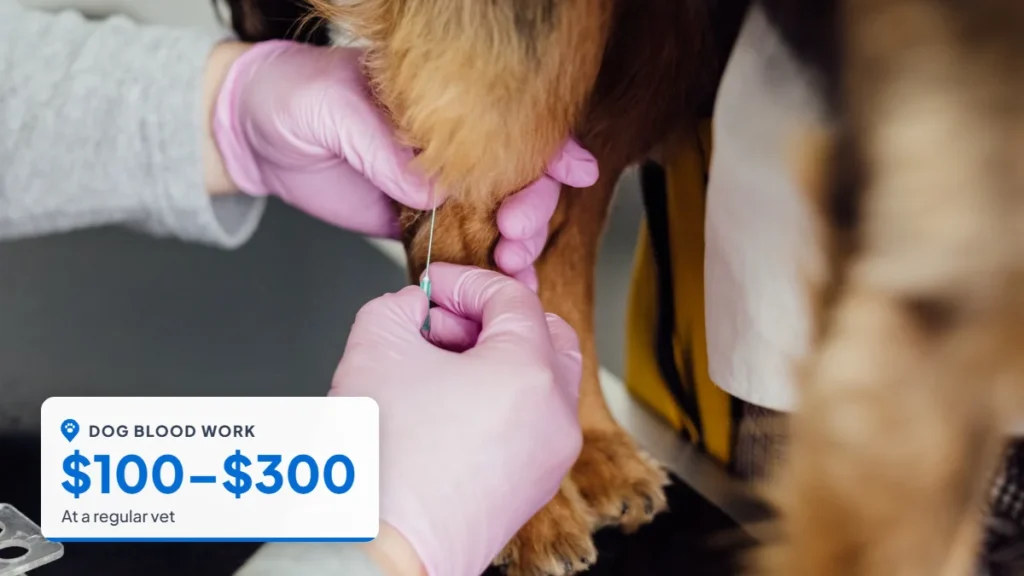
Dog blood work usually costs $100 to $300 at a regular vet. The national average is $104 for a complete blood count (CBC) and $164 for a chemistry panel, so the pair most vets order together comes to about $268, plus the exam fee. Senior screens add a urine test and a thyroid test. Low-cost clinics can run a CBC and chemistry panel for under $100.

| What your vet is checking | Typical cost |
|---|---|
| Routine wellness panel (CBC and chemistry) | $100 to $268 |
| Senior screen (CBC, chemistry, urinalysis and thyroid) | $150 to $300 as a bundle; $400 or more if each test is billed separately |
| Pre-anesthetic panel before surgery or a dental cleaning | $65 to $200 |
| Yearly heartworm test | $30 to $71 |
| Blood work at an emergency hospital | Usually more than at your regular vet |
Sources: CareCredit 2025–2026 cost study; Webvet 2026 price ranges; Lowcountry Pet Wellness Clinic (North Charleston, SC) and Houston Humane Society price lists, checked October 2026.
What each test checks
Most “blood work” is two tests run from one sample: a CBC, which counts the blood cells, and a chemistry panel, which shows how the organs are working. Your vet may add other tests depending on your dog’s age, symptoms or upcoming surgery.
| Test | What it measures | What it can help find |
|---|---|---|
| Complete blood count (CBC) | Red cells, white cells and platelets | Anemia, infection, inflammation, clotting problems, some blood cancers |
| Chemistry panel | Kidney values (BUN, creatinine, SDMA), liver enzymes, blood sugar, proteins, sodium, potassium and calcium | Kidney or liver disease, diabetes, dehydration, hormone disorders |
| Thyroid test (T4) | Thyroid hormone | An underactive thyroid, a common cause of weight gain and low energy in middle-aged dogs |
| Urinalysis | Urine concentration, protein, sugar, crystals and cells | Kidney problems, urinary infections, diabetes |
| Heartworm test | Heartworm proteins in the blood | Heartworm infection, before starting or renewing a preventive |
| Glucose | Blood sugar only | Diabetes, or checking a diabetic dog’s insulin dose |
Chemistry panel contents follow AAHA’s 2023 senior care guidelines; panels vary by clinic and lab.
Urinalysis isn’t always included. CareCredit’s study doesn’t list a dog price, but cats average $54 for a basic urinalysis and $94 for a urine culture, and a low-cost clinic in South Carolina charges $75. Ask whether it’s part of the panel you’re quoted.
SDMA is a newer kidney test that can catch disease earlier. IDEXX says it can detect kidney disease when about 40% of kidney function is lost, and sometimes 25%, compared with about 75% for creatinine. When IDEXX launched the test in 2015, it said it would add SDMA to its routine reference-lab chemistry panels at no extra cost, so it may already be on your bill.
A glucose test alone is much cheaper. At $39 on average, it’s often what’s used to check how a diabetic dog is responding to insulin, between fuller panels.
Senior screens and wellness panels
Older dogs need blood work more often, so the yearly cost adds up. The American Animal Hospital Association (AAHA) recommends a CBC, chemistry panel and urinalysis every 6 to 12 months for senior dogs, plus a thyroid test and blood pressure check once a year.
When is a dog “senior”? AAHA uses the last 25% of a dog’s expected life span. That can be as early as 7 to 8 years for a large dog, and around 12 for a small breed.
| Test | How often AAHA recommends it for senior dogs |
|---|---|
| CBC | Every 6 to 12 months |
| Chemistry panel (including SDMA) | Every 6 to 12 months |
| Urinalysis | Every 6 to 12 months |
| Thyroid (T4) | Once a year |
| Heartworm and tick-borne disease test | Once a year |
| Blood pressure | Once a year |
Source: AAHA 2023 Senior Care Guidelines for Dogs and Cats.
What that costs in a year:
- Billed test by test at national averages (CBC $104, chemistry $164, thyroid $125 and about $54 for a urinalysis, using the cat average since no dog figure is published), one full screen costs about $447. Twice a year, that’s close to $900.
- As a bundled senior panel, most clinics charge $150 to $300, or $300 to $600 a year if your vet wants it every six months.
- Through a wellness plan, the tests are spread into monthly payments. Banfield’s Special Care plan for dogs averaged $71 a month in Forbes Advisor’s 2025 price check, and its basic Active Care plan ($42 a month) includes one routine diagnostic test, such as blood work, per year.
Ask your vet what’s in the senior panel they’re quoting. Some include urinalysis and thyroid; others are just a CBC and chemistry panel.
Blood work before anesthesia
Before surgery or a dental cleaning, many vets run a pre-anesthetic panel to check that the kidneys and liver can handle the drugs. It usually costs $65 to $200. A low-cost clinic in North Charleston, South Carolina, lists it at $65 with a CBC; at full-service clinics, $80 to $200 is typical.
AAHA doesn’t require blood work for every patient. Its 2020 anesthesia guidelines say the tests should depend on each dog’s risk factors. When tests are needed, the basic set is a CBC, a chemistry panel and a urinalysis, sometimes with blood pressure, an ECG or imaging. Clinics set their own rules: some require a panel for every patient, others only for older or sick dogs.
Recent results may save you the cost. AAHA says results from the last 3 to 6 months are reasonable to use if they were normal and your dog is healthy. If your dog had blood work at its last checkup, ask whether it can count for the procedure.
Pre-anesthetic blood work is usually a line on the estimate for these procedures:
Why blood work prices vary so much
The same CBC and chemistry panel can cost under $100 at one clinic and over $250 at another. Four things explain most of the gap.
| Low-cost clinic example | Typical range at full-service vets | |
|---|---|---|
| CBC | $25 | $60 to $90 |
| CBC and chemistry panel | $85 | $100 to $200 |
| Pre-anesthetic panel | $65 | $80 to $200 |
| Thyroid test | $50 | $50 to $150 |
| Heartworm test | $30 to $31 | $35 to $75 |
Sources: Lowcountry Pet Wellness Clinic, North Charleston, SC; Houston Humane Society and Humane Society of Southern Arizona (heartworm); Webvet 2026 ranges. Prices checked October 2026.
- In-house machine or outside lab. Clinics with their own analyzers get results in minutes; a reference lab takes a day or two. Which costs less depends on the clinic, so if it isn’t urgent, ask for both prices.
- Emergency hospitals. Diagnostics cost more at an ER, where staffing runs 24 hours a day. CareCredit’s averages show the pattern for X-rays: $172 at a regular vet and $334 at an emergency hospital. See what an emergency vet visit costs.
- Bundles. A wellness or senior panel priced as one package almost always costs less than the same tests billed one by one.
- Location. Clinics in high-cost cities charge more for everything, blood work included.
The exam fee comes on top. Clinics usually require an exam before running tests, and an exam averages about $95. See how much a vet visit costs.
How to pay less, and what insurance covers
Most savings come from asking a few questions before the blood is drawn.
- Ask for an itemized estimate. Check which tests are in the panel and whether the exam fee is extra.
- Ask for the bundled price. A wellness or senior panel usually costs less than the same tests one by one.
- Reuse recent results. If your dog had normal blood work in the last few months, ask whether it can count for a dental cleaning or surgery.
- Ask if it can go to an outside lab. When the result isn’t urgent, compare the in-house and reference-lab prices.
- Try a low-cost or nonprofit clinic for routine screening. Humane societies and wellness clinics often charge a fraction of full-service prices, as the table above shows.
- Consider a wellness plan only if you’ll use it. It makes sense if your vet wants panels once or twice a year anyway; add up the tests you’d actually get before you sign up.
Pet insurance covers blood work when it’s used to diagnose or treat a covered illness or injury. If your dog is vomiting and the vet orders a CBC and chemistry panel, that’s a covered diagnostic cost. Routine screening for a healthy dog isn’t covered unless you add a wellness plan, and some insurers don’t cover the exam fee.
The deductible usually swallows a single panel. On a $268 CBC and chemistry panel, a policy with 80% reimbursement and a $250 deductible would pay nothing if that’s your first claim of the year. If you’ve already met the deductible, it would pay about $214. Insurance matters for blood work when it’s part of a bigger illness, such as weeks of monitoring for kidney disease or diabetes. See how pet insurance works and is pet insurance worth it?
The bottom line
Expect about $100 to $300 for routine dog blood work, and more if your dog is a senior or needs it at an emergency hospital. Ask what’s in the panel, ask for the bundled price, and reuse recent results when you can. For a healthy young dog, a yearly CBC and chemistry panel at a low-cost clinic can cost under $100.
Frequently asked questions
How much does dog blood work cost?
Usually $100 to $300 at a regular vet. National averages are $104 for a CBC and $164 for a chemistry panel, about $268 together, plus an exam fee of about $95. Low-cost clinics can charge under $100 for both.
How much is a CBC for a dog?
A complete blood count averages $104 at US general practices, according to CareCredit’s 2025–2026 cost study. One low-cost clinic in South Carolina charges $25.
How much is a senior blood panel for a dog?
A bundled senior panel usually costs $150 to $300. Billed test by test, a CBC, chemistry panel, thyroid test and urinalysis come to about $447 at national averages.
How often should a senior dog have blood work?
AAHA recommends a CBC, chemistry panel and urinalysis every 6 to 12 months for senior dogs, plus a thyroid test once a year.
Is blood work required before a dog’s dental cleaning or surgery?
Not always. AAHA says testing should depend on each dog’s risk factors, and clinics set their own rules. A pre-anesthetic panel usually costs $65 to $200, and normal results from the last 3 to 6 months may be accepted.
Does pet insurance cover dog blood work?
Yes, when it’s used to diagnose or treat a covered illness or injury, after the deductible. Routine screening for a healthy dog is only covered with a wellness add-on.
Why is blood work more expensive at an emergency vet?
Emergency hospitals staff around the clock, so their diagnostic prices are higher. CareCredit’s averages show X-rays cost $172 at a regular vet and $334 at an emergency hospital. If the test can wait, a regular vet is usually cheaper. For imaging prices, see our guides to dog X-ray costs and dog MRI costs.
How we researched this article
National averages come from CareCredit’s 2025–2026 Synchrony Average Procedural Cost Study, conducted by ASQ360° Market Research. Typical ranges come from Webvet’s 2026 price guide, and low-cost examples from clinic price lists published online, checked in October 2026. Testing recommendations come from AAHA’s 2023 Senior Care Guidelines and 2020 Anesthesia and Monitoring Guidelines. Prices at your clinic may differ; ask for an itemized estimate.
Sources
- CareCredit: Veterinary exam and procedure costs; Emergency vet visit cost; Dog X-ray cost
- AAHA: Diagnostic tests and recommended frequencies for senior dogs and cats (2023); Senior status: understanding your senior pet’s life stage; Preanesthetic evaluation (2020)
- IDEXX: New IDEXX test detects kidney disease months or years earlier (2015)
- Webvet: Dog blood work cost in 2026
- Clinic price lists: Lowcountry Pet Wellness Clinic; Houston Humane Society; Humane Society of Southern Arizona
- Forbes Advisor: Banfield wellness plan review and pricing (March 2025)