
Cost guide, not veterinary advice. Prices are typical US ranges from public sources and vary by clinic and region. Last reviewed September 30, 2026. How we research
In this guide
- Dog teeth cleaning cost at a glance
- What a cleaning with anesthesia includes
- Anesthesia-free cleaning: cheaper, but not a real cleaning
- How gum disease and extractions change the price
- Dog teeth cleaning cost by state
- Dog teeth cleaning cost by type of clinic
- How often your dog needs a cleaning
- Does pet insurance cover teeth cleaning?
- How to pay less for your dog’s teeth cleaning
- The bottom line
- Dog teeth cleaning cost: frequently asked questions
- How we researched dog teeth cleaning costs
Dog teeth cleaning cost at a glance
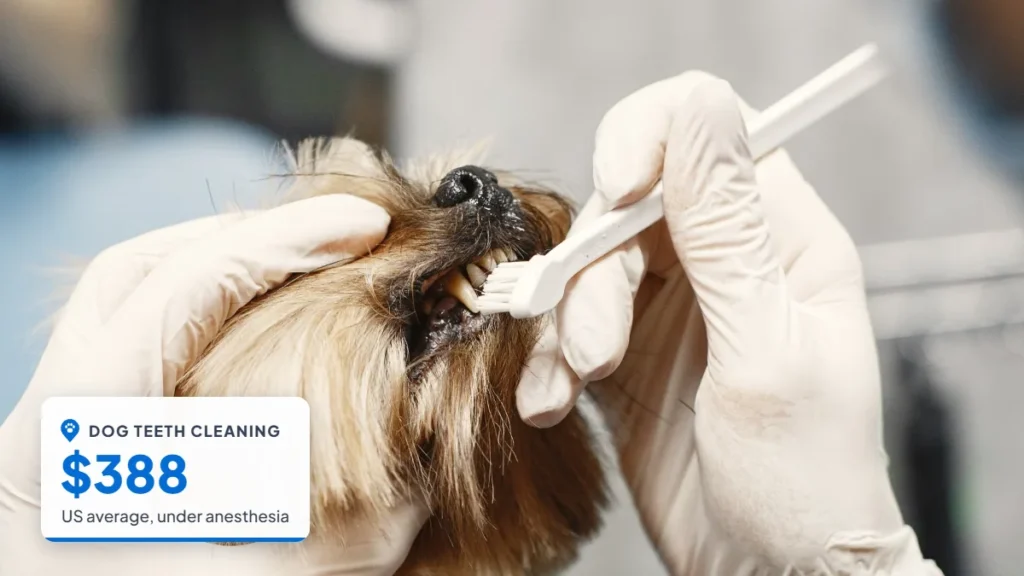
A professional dog teeth cleaning under anesthesia costs about $388 on average in the U.S. as of 2026, with most averages between $307 and $702. An anesthesia-free cleaning costs roughly $100 to $300, but veterinary dental specialists say it’s cosmetic only and don’t recommend it. Extractions or advanced gum disease can raise the bill to $1,000 to $2,500 or more.
| Type of cleaning | What you’d pay | What it includes |
|---|---|---|
| Anesthetic cleaning, national average | $388 (range $307–$702) | Exam, anesthesia, dental X-rays, scaling above and below the gumline, polishing |
| Mild disease, no extractions | $300–$600 | A routine cleaning on healthy or lightly inflamed gums |
| Moderate disease | $700–$1,300 | Longer anesthesia; extractions become more likely |
| Severe disease | $1,200–$2,500 or more | Many extractions, longer anesthesia, medications |
| Board-certified veterinary dentist | Often $1,000–$3,000 or more | Root canals, oral surgery and complex cases |
| Anesthesia-free cleaning | About $100–$300 | Scraping of the visible tooth surfaces only |
National average from CareCredit (April 2026), based on the 2025 Synchrony national cost study; prices by disease stage, specialist care and anesthesia-free cleanings from Webvet (2026, veterinarian-reviewed).
If your vet has recommended a dental cleaning, or the estimate you received is higher than you expected, this guide explains what’s on the bill, why the anesthesia-free option costs less, what extractions add, and how to pay less.
What a cleaning with anesthesia includes
A proper dental cleaning is a short procedure under general anesthesia, so the bill covers far more than scraping: bloodwork, anesthesia and monitoring, full-mouth X-rays, cleaning below the gumline and medication. Itemized, those lines add up to about $450 to $1,350 before any extractions.
| Line item | Typical cost | Why it’s there |
|---|---|---|
| Pre-anesthetic exam and bloodwork | $80–$200 | Checks that your dog can safely go under |
| IV catheter and fluids | $50–$150 | Keeps blood pressure stable and gives quick access for drugs |
| Anesthesia and monitoring | $100–$300 | Keeps your dog still, pain-free and breathing safely |
| Full-mouth dental X-rays | $100–$300 | Shows roots and bone below the gumline |
| Scaling and polishing | $100–$300 | Removes plaque and tartar above and below the gumline |
| Antibiotics and pain medication | $20–$100 | Only when your vet finds infection or does extractions |
| Extractions, per tooth | $10–$150 or more | Only for damaged or diseased teeth |
Line-item ranges from Webvet (2026). A general vet’s basic cleaning typically runs $350 to $500, according to a board-certified veterinary dentist writing for PetMD (October 2025).
The X-rays are not an optional extra. The American Animal Hospital Association strongly recommends full-mouth dental X-rays for every dental patient, because in one study 28% of dog teeth that looked normal had important problems that showed up only on X-rays. The same guidelines say a complete oral exam is only possible once the patient is anesthetized.
When you compare quotes, check that each includes anesthesia monitoring and full-mouth X-rays. A cheap quote that leaves them out isn’t the same cleaning.
Anesthesia-free cleaning: cheaper, but not a real cleaning
An anesthesia-free cleaning costs about $100 to $300, less than the $388 average for a standard cleaning, but it only scrapes the visible surfaces of the teeth. The main U.S. veterinary groups say it doesn’t meet the standard of care.
| Cleaning under anesthesia | Anesthesia-free cleaning | |
|---|---|---|
| Typical cost | $388 national average | About $100–$300 |
| Cleans below the gumline | Yes | No, not on every tooth |
| Dental X-rays | Yes, full mouth | No |
| Full oral exam | Yes | Limited |
| Can treat problems it finds | Yes, including extractions | No |
| Position of veterinary dental specialists | Recommended | Not recommended |
Costs from CareCredit and Webvet; comparison based on the positions below.
What the experts say:
- The American Veterinary Dental College states that cleaning below the gumline of every tooth is impossible in an awake dog, and that removing tartar from the visible surfaces “has little effect on a pet’s health, and provides a false sense of accomplishment. The effect is purely cosmetic.”
- The same statement warns that even slight head movement can injure the mouth, and that the person cleaning may be bitten.
- AAHA’s guidelines call cleaning a pet’s teeth without general anesthesia “unacceptable and below the standard of care,” as reported by JAVMA News, and AVMA policy says dental scaling should be done under anesthesia.
Providers of anesthesia-free cleanings argue that their service is a complement to regular veterinary cleanings, not a replacement, according to the same JAVMA News report. The practical risk is the one the AVDC names: whiter teeth can hide disease under the gumline until it needs costly extractions.
If you worry about anesthesia because your dog is older or has a health condition, ask your vet about the pre-anesthetic bloodwork and monitoring they use rather than skipping anesthesia.
How gum disease and extractions change the price
The further gum disease has progressed, the more the cleaning costs: about $300 to $600 for gingivitis, rising to $1,200 to $2,500 or more for advanced disease that needs several extractions. Periodontal disease is common: up to 80% of dogs have some level of it by age 2, according to the Merck Veterinary Manual.
| Stage | What it means | Usual treatment | Typical cost |
|---|---|---|---|
| Stage 1: gingivitis | Inflamed gums, no bone loss | Scaling, polishing and home care | $300–$600 |
| Stage 2: early periodontitis | Less than 25% loss of the tooth’s attachment | Stage 1 care plus antibiotics applied to the gums | $400–$800 |
| Stage 3: established periodontitis | 25%–50% attachment loss | Extraction if daily home care isn’t possible | $700–$1,300 |
| Stage 4: advanced periodontitis | More than 50% attachment loss | Extraction or periodontal surgery | $1,200–$2,500 or more |
Stages and treatments from AAHA’s dental guidelines; costs from Webvet (2026). Your vet can only stage the disease under anesthesia with X-rays, so the final bill may differ from the first estimate.
What extractions add
A simple extraction averages $78 per tooth and a complex one $130, per CareCredit (February 2026). Simple extractions range from $63 in Mississippi to $140 in Hawaii. At national averages, a cleaning with two simple extractions comes to about $544, and one with four complex extractions about $908.
Because extractions are decided during the procedure, ask your vet to call you before removing teeth, or agree in advance on a price cap. See our guide to dog tooth extraction costs for per-tooth details.
Dog teeth cleaning cost by state
State averages for a standard cleaning run from $310 in Mississippi to $696 in Hawaii, more than double. Nineteen states average under $350, while five states (Alaska, California, Hawaii, Massachusetts and New York) and Washington, D.C., average $450 or more.
| State | Average dog teeth cleaning | Compared with the $388 national average |
|---|---|---|
| Alabama | $324 | $64 less |
| Alaska | $461 | $73 more |
| Arizona | $400 | $12 more |
| Arkansas | $321 | $67 less |
| California | $518 | $130 more |
| Colorado | $391 | $3 more |
| Connecticut | $416 | $28 more |
| Delaware | $380 | $8 less |
| District of Columbia | $524 | $136 more |
| Florida | $382 | $6 less |
| Georgia | $340 | $48 less |
| Hawaii | $696 | $308 more |
| Idaho | $380 | $8 less |
| Illinois | $353 | $35 less |
| Indiana | $336 | $52 less |
| Iowa | $333 | $55 less |
| Kansas | $322 | $66 less |
| Kentucky | $347 | $41 less |
| Louisiana | $344 | $44 less |
| Maine | $408 | $20 more |
| Maryland | $430 | $42 more |
| Massachusetts | $543 | $155 more |
| Michigan | $337 | $51 less |
| Minnesota | $354 | $34 less |
| Mississippi | $310 | $78 less |
| Missouri | $330 | $58 less |
| Montana | $384 | $4 less |
| Nebraska | $348 | $40 less |
| Nevada | $376 | $12 less |
| New Hampshire | $421 | $33 more |
| New Jersey | $427 | $39 more |
| New Mexico | $346 | $42 less |
| New York | $458 | $70 more |
| North Carolina | $364 | $24 less |
| North Dakota | $344 | $44 less |
| Ohio | $352 | $36 less |
| Oklahoma | $317 | $71 less |
| Oregon | $417 | $29 more |
| Pennsylvania | $354 | $34 less |
| Rhode Island | $418 | $30 more |
| South Carolina | $356 | $32 less |
| South Dakota | $344 | $44 less |
| Tennessee | $338 | $50 less |
| Texas | $344 | $44 less |
| Utah | $385 | $3 less |
| Vermont | $427 | $39 more |
| Virginia | $374 | $14 less |
| Washington | $427 | $39 more |
| West Virginia | $313 | $75 less |
| Wisconsin | $359 | $29 less |
| Wyoming | $353 | $35 less |
State averages from CareCredit (April 2026), based on the 2025 Synchrony national cost study. They reflect a routine cleaning; extractions and advanced disease add to them. For cats, the national average is $375; see our guide to cat dental cleaning costs, and our guide to cat tooth extraction costs if teeth need to come out.
Dog teeth cleaning cost by type of clinic
A cleaning can cost about $440 at a nonprofit clinic, $600 or more at a chain with published prices, $800 or more at a big-city private practice and over $2,000 at a university dental service. Specialist care costs more but includes advanced imaging and treats complex problems.
| Where you go | What a cleaning costs | Real-world example |
|---|---|---|
| Nonprofit or humane society clinic | Often below the national average | Lehigh Valley Humane Society (Pennsylvania): $395 plus a $43 consultation beforehand |
| General practice | $350–$500 for a basic cleaning; $388 national average | Typical range cited by a board-certified veterinary dentist on PetMD |
| Chain with published prices | From $601; from $1,047 with extractions | Modern Animal (California, Texas, Colorado, Arizona), full-mouth X-rays included |
| Private practice in a high-cost city | $800–$1,200 for mild disease; $2,000–$2,700 for severe disease | The Neighborhood Vet (Brooklyn, New York) |
| University dentistry service | From $2,050; from $2,678 with extractions | CSU Veterinary Health (Colorado): lab work, anesthesia, 3D dental scan and full-mouth X-rays included; $237 consultation |
Clinic prices as published on each clinic’s website, checked September 2026. Compare what each price includes: the university and chain prices bundle X-rays, while a lower quote may not.
Most dogs don’t need a specialist. Your general vet can refer you to a board-certified veterinary dentist for root canals, jaw fractures, oral tumors or other complex work.
How often your dog needs a cleaning
AAHA recommends a first full cleaning with X-rays by age 1 for small and medium dogs and by age 2 for larger breeds, an awake mouth check every 6 months, and cleanings under anesthesia as often as your vet finds they’re needed. There’s no fixed schedule: how often depends on what your vet finds at those checks.
Daily home care is what stretches the time between cleanings, and it’s the cheapest dental care there is:
- Brush daily. AAHA says brushing “needs to be done daily to be of benefit,” because plaque hardens into tartar within about 2 days, according to the Merck Veterinary Manual.
- Wipe if you can’t brush. Merck suggests wiping the teeth with gauze at least every second day for dogs that won’t tolerate a brush.
- Choose products with the VOHC seal. AAHA notes that only chews, diets and rinses accepted by the Veterinary Oral Health Council have met its standards for reducing plaque or tartar.
- Don’t brush sore gums. Brushing inflamed gums hurts and can make your dog resist brushing; have your vet treat the inflammation first.
Brushing removes plaque but not tartar that has already formed, so it won’t replace a cleaning your dog already needs. Recommendations from the 2019 AAHA Dental Care Guidelines.
Does pet insurance cover teeth cleaning?
Standard accident-and-illness policies don’t pay for routine cleanings; some cover treatment for dental disease, and most cover broken teeth from accidents. A wellness or preventive care add-on is the usual way to get help with the cleaning itself. Dental coverage differs a lot between insurers, so read the dental section of your policy.
| Insurer | Routine cleaning | Gum disease and its extractions | Broken tooth from an accident |
|---|---|---|---|
| Embrace | Not covered; can be paid through its optional Wellness Rewards plan | Covered up to $1,000 per policy year | Covered up to the policy’s annual maximum |
| MetLife Pet | Covered only with its Preventive Care add-on | Extractions for disease, including periodontal disease, are covered | Covered |
| Healthy Paws | Not covered | Not covered when it’s due to dental disease or a lack of preventive care | Covered |
| Trupanion | Not covered | Excludes dental problems that arise from missed routine cleanings | Not addressed on its exclusions page |
Coverage as described on each insurer’s website, checked September 2026. Pre-existing dental conditions are excluded across the board: if your vet noted tartar or gum disease before the policy started, treatment for it won’t be covered.
Two practical points follow. First, a policy with dental illness coverage is worth more for toy breeds, which are at higher risk of periodontal disease, per the Merck Veterinary Manual. Second, keeping up with cleanings can protect your coverage, since some insurers exclude disease caused by skipped preventive care. See how pet insurance works and our guide to pre-existing conditions.
How to pay less for your dog’s teeth cleaning
The biggest saving is catching gum disease early: a cleaning for gingivitis costs about $300 to $600, while advanced disease with extractions can pass $2,500. After that, compare itemized quotes and look at nonprofit clinics and wellness plans.
- Brush daily and use VOHC-accepted products. It’s the cheapest dental care there is and can stretch the time between cleanings.
- Don’t put off a recommended cleaning. Disease that moves from stage 1 to stage 3 or 4 can double or triple the bill.
- Compare itemized quotes. Check that each includes bloodwork, anesthesia monitoring and full-mouth X-rays, so you compare like with like.
- Check nonprofit clinics. One in Pennsylvania charges $395 plus a $43 consultation.
- Agree on extractions in advance. Ask your vet to call you before removing teeth, or set a price cap you’re comfortable with.
- Use a wellness plan or preventive care add-on if you have one. Standard insurance doesn’t pay for a routine cleaning; see what pet insurance covers for dental care. Embrace’s Wellness Rewards and MetLife’s Preventive Care add-on can help pay for routine cleanings.
- Ask about seasonal discounts. February is the AVMA’s National Pet Dental Health Month, and some clinics offer dental promotions then.
Skipping anesthesia to save money isn’t a real saving: the AVDC calls anesthesia-free cleaning purely cosmetic, and disease left under the gumline costs more to treat later.
If you need help paying
| Option | How it works | Watch out for |
|---|---|---|
| CareCredit | No interest if paid in full in 6, 12, 18 or 24 months on purchases of $200 or more | Miss the deadline and 32.99% APR is charged back to the purchase date |
| Scratchpay | Payment plans over 12 to 24 months for $200 to $10,000; checking doesn’t affect your credit score | APR from 0% to 36%, plus late fees |
| Wellness plans | Monthly payments that include routine care at some clinics | Check whether dental cleaning is included or only discounted |
| Charity grants | Help with urgent treatment | RedRover can’t fund routine care such as a cleaning |
Compare these options in our guides to vet financing, CareCredit for vet bills and financial help for vet bills.
The bottom line
Budget about $388 for a routine cleaning under anesthesia, $300 to $700 depending on your state, and $1,000 to $2,500 or more if your dog has advanced gum disease or needs several extractions. Anesthesia-free cleaning costs less but only whitens the visible surfaces, so it isn’t a substitute.
The cheapest path is daily brushing, a first cleaning by age 1 or 2, and treating gum disease early. If your dog isn’t insured yet, compare dental coverage in our guide to the best pet insurance for dogs.
Dog teeth cleaning cost: frequently asked questions
How much does it cost to get a dog’s teeth cleaned?
About $388 on average in the U.S. for a cleaning under anesthesia, according to CareCredit, with state averages from $310 to $696. Extractions and advanced gum disease can raise the bill to $1,000 to $2,500 or more.
Is anesthesia-free teeth cleaning worth it for dogs?
It costs less, about $100 to $300, but veterinary dental specialists don’t recommend it. It can’t clean below the gumline of every tooth or include X-rays, so the American Veterinary Dental College calls it purely cosmetic.
Why is a dog dental cleaning so expensive?
Because it’s a procedure under general anesthesia. The price covers bloodwork, an IV line, anesthesia monitoring, full-mouth X-rays, cleaning below the gumline and any medication.
How much do tooth extractions add?
About $78 per tooth for a simple extraction and $130 for a complex one on average. Four complex extractions add about $520 to the cleaning.
How often should a dog get a professional teeth cleaning?
AAHA recommends a first cleaning with X-rays by age 1 for small and medium dogs and by age 2 for larger breeds, then as often as your vet finds necessary at regular mouth checks. Daily brushing stretches the time between cleanings.
Does pet insurance pay for dog teeth cleaning?
Not under a standard accident-and-illness policy. Some insurers cover treatment for dental disease and accidental tooth injuries, and wellness plans or preventive care add-ons can help pay for routine cleanings.
How we researched dog teeth cleaning costs
We based national and state averages on the veterinary cost data CareCredit publishes from the Synchrony Average Procedural Cost Study (ASQ360° Market Research), then checked them against prices published by a nonprofit clinic, a private practice, a clinic chain and a university veterinary hospital. We added a 2026 veterinarian-reviewed cost guide, pet insurers’ dental coverage pages, and clinical guidance from AAHA, the American Veterinary Dental College and the Merck Veterinary Manual. We checked every figure in September 2026. Prices vary by clinic and by how much disease your dog has, so your vet’s written estimate is the only exact figure. This article is general information, not veterinary advice.
Sources
- CareCredit: Cat and dog teeth cleaning cost and dog tooth extraction cost
- Webvet: Dog teeth cleaning cost
- PetMD: How much does dog teeth cleaning cost?
- AAHA: 2019 Dental Care Guidelines for Dogs and Cats and periodontal disease staging
- American Veterinary Dental College: Dental scaling without anesthesia
- JAVMA News: Below the surface of anesthesia-free dentistry
- AVMA: National Pet Dental Health Month
- Merck Veterinary Manual: Periodontal disease in small animals
- Lehigh Valley Humane Society: Clinic services and pricing
- Modern Animal: Pricing
- The Neighborhood Vet: Pricing
- CSU Veterinary Health: Dentistry and oral surgery
- Embrace: Dental illness coverage
- MetLife Pet Insurance: Dog tooth extraction cost
- Healthy Paws: Dental coverage and exclusions
- Trupanion: What isn’t covered
- NerdWallet: CareCredit card terms
- Scratchpay: How it works
- RedRover: Urgent Care grants