
Cost guide, not veterinary advice. Prices are typical US ranges from public sources and vary by clinic and region. Last reviewed October 14, 2026. How we research
In this guide
- Dog tooth extraction cost at a glance
- Dog tooth extraction cost per tooth
- Estimates for several teeth or a full mouth
- What a proper extraction includes
- Dog tooth extraction cost by state
- General vet, veterinary dentist or a root canal?
- Recovery and costs after the extraction
- Does pet insurance cover tooth extractions?
- How to pay less for your dog’s extractions
- The bottom line
- Dog tooth extraction cost: frequently asked questions
- How we researched dog tooth extraction costs
Dog tooth extraction cost at a glance
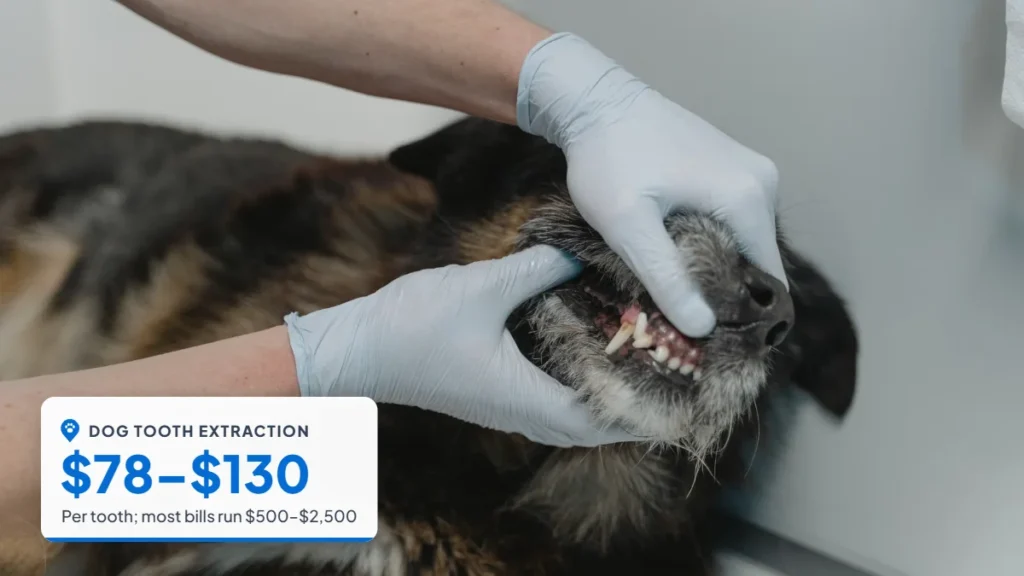
Pulling a dog’s tooth costs about $78 per tooth for a simple extraction and $130 for a complex one on average in the U.S. as of 2026, but that’s only one line of the bill. Once anesthesia, dental X-rays and the cleaning are added, most owners pay $500 to $2,500, and full-mouth cases at a specialist can pass $3,000.
| What you’re paying for | Typical cost | What it covers |
|---|---|---|
| Simple extraction, per tooth | $78 average (range $62–$142) | A loose or single-root tooth |
| Complex or surgical extraction, per tooth | $130 average | A firmly rooted tooth that must be sectioned or cut out |
| Surgical extraction of a large tooth | $150–$700 or more per tooth | Canines, premolars and molars, including the carnassial tooth |
| Whole visit, one or a few teeth | $500–$2,500 | Exam, bloodwork, anesthesia, X-rays, cleaning, extractions and medication |
| Full-mouth or advanced surgical case | $3,000–$4,000 or more | Many surgical extractions, often at a board-certified veterinary dentist |
Per-tooth averages from CareCredit (February 2026), based on the 2025 Synchrony national cost study; large-tooth and full-mouth prices from Webvet (2026, veterinarian-reviewed); whole-visit range from MetLife Pet (May 2026).
If your vet has quoted extractions, or you’re expecting some after a dental cleaning, this guide shows what each tooth costs, how full-mouth estimates add up, and how to pay less. If your dog is insured, check whether pet insurance covers dental extractions.
Dog tooth extraction cost per tooth
The tooth decides the price: a loose incisor can cost $50 to $150 to remove, while a canine, premolar or molar that must be removed surgically runs $100 to $700 or more. Bigger teeth with more roots take longer and need oral surgery.
| Tooth | Roots | Usual extraction | Price per tooth |
|---|---|---|---|
| Loose incisor or baby tooth | 1 | Simple | $50–$150 |
| Incisor or other small single-root tooth | 1 | Simple | $60–$200 |
| Premolar | 1–3 | Often surgical | $100–$400 |
| Canine (fang) | 1, long | Surgical | $150–$600 |
| Molar or carnassial (upper 4th premolar) | 1–3 | Surgical | $150–$700 or more |
| Retained baby tooth or fractured root | — | Surgical | $200–$700 or more |
Prices from Webvet (2026). Root counts from a board-certified veterinary dentist writing for dvm360: incisors and canines have one root, while the upper 4th premolar and the upper 1st and 2nd molars have three.
These prices sit above CareCredit’s national averages of $78 for a simple extraction and $130 for a complex one because they include surgical work on the largest teeth. Use CareCredit’s averages for a typical tooth and Webvet’s ranges for canines and molars.
Why surgical extractions cost more
A multi-rooted tooth is cut into sections so each root can come out separately, and a canine is usually removed by opening a flap of gum, taking out bone and stitching the gum closed afterward. Vets take a dental X-ray before a difficult extraction to see the roots, per the same dvm360 article.
Retained baby teeth
Adult canine teeth normally come in by about 6 months of age. When a baby tooth stays in place as the adult tooth comes in, veterinary dentist Jan Bellows advises removing it as soon as the adult tooth is seen erupting in the same spot, to avoid crowding the adult tooth out of position (dvm360). It’s especially common in small breeds such as Maltese, Yorkshire terriers, Pomeranians and miniature schnauzers. If your puppy is going under anesthesia for a spay or neuter, ask whether it can be done at the same time.
Estimates for several teeth or a full mouth
At national average prices, a cleaning with four extractions comes to about $700 to $900, and one with 12 extractions to about $1,300 to $1,950; real itemized bills with surgical extractions run higher, around $3,300 for eight surgical teeth. Each tooth adds a fixed fee, but the anesthesia, X-rays and cleaning are paid once, so a multi-tooth visit costs less per tooth.
| Teeth extracted | All simple ($78 each) | All complex ($130 each) |
|---|---|---|
| 1 | $466 | $518 |
| 2 | $544 | $648 |
| 4 | $700 | $908 |
| 8 | $1,012 | $1,428 |
| 12 | $1,324 | $1,948 |
Each total adds CareCredit’s $388 average dental cleaning, which includes anesthesia and dental X-rays, to its per-tooth averages (cleaning, extractions). They’re a floor, not a quote: a single hospital’s bill will include its own fees.
Two itemized bills
| Line item | One loose incisor | Eight surgical teeth |
|---|---|---|
| Exam | $60 | $60 |
| Bloodwork | $120 | $160 |
| Anesthesia and monitoring | $250 | $450 |
| Dental X-rays | $180 | $300 |
| Cleaning and polish | $150 | $300 |
| IV fluids | $90 | $120 |
| Extraction fees | $90 | $1,600 |
| Nerve blocks and pain relief | $60 | $180 |
| Take-home medication | $40 | $110 |
| Total | $1,040 | $3,280 |
Example estimates from Webvet (2026). In the one-tooth bill, the extraction fee is $90 of $1,040: as Webvet puts it, the extraction itself “is often the smallest part of the bill.”
Published clinic prices land in the same range. Modern Animal lists a cleaning with extractions from $1,047, The Neighborhood Vet in Brooklyn charges $2,000 to $2,700 for severe dental disease, and CSU Veterinary Health‘s dentistry service starts extractions at $2,678.
What a proper extraction includes
A tooth extraction done to current standards includes general anesthesia, dental X-rays before and after, a local nerve block, stitches for most sockets and pain medication; a quote without them isn’t a cheaper version of the same care. Dental X-rays alone average $187, according to CareCredit.
The 2019 AAHA Dental Care Guidelines set out what that care involves:
- X-rays before and after: “At a minimum, pre- and postextraction intraoral dental radiographs are essential,” so the vet can see the roots and confirm none are left behind.
- Nerve blocks: anyone doing oral surgery should know dental nerve blocks, which provide pain relief and let your dog stay under lighter anesthesia.
- Stitches: sockets wider than 1 mm should be closed with absorbable stitches to keep the clot in and food out.
- Pain control: before, during and after the procedure, usually with more than one kind of pain medication.
- A licensed vet: surgical extractions “must be performed only by trained, licensed veterinarians.”
When you compare estimates, ask whether each includes these items. The line-by-line bills in the previous section show what each typically costs.
Dog tooth extraction cost by state
A simple extraction averages from $63 per tooth in Mississippi and West Virginia to $140 in Hawaii, and a complex one from $104 in Mississippi to $234 in Hawaii. Eighteen states average under $70 for a simple extraction; California, Massachusetts, Hawaii and Washington, D.C., average $100 or more.
| State | Simple extraction, per tooth | Complex extraction, per tooth |
|---|---|---|
| Alabama | $65 | $109 |
| Alaska | $92 | $155 |
| Arizona | $81 | $134 |
| Arkansas | $65 | $108 |
| California | $104 | $174 |
| Colorado | $79 | $132 |
| Connecticut | $84 | $139 |
| Delaware | $76 | $127 |
| District of Columbia | $106 | $177 |
| Florida | $77 | $127 |
| Georgia | $69 | $114 |
| Hawaii | $140 | $234 |
| Idaho | $76 | $127 |
| Illinois | $71 | $117 |
| Indiana | $68 | $112 |
| Iowa | $67 | $111 |
| Kansas | $65 | $108 |
| Kentucky | $69 | $115 |
| Louisiana | $69 | $115 |
| Maine | $82 | $136 |
| Maryland | $87 | $144 |
| Massachusetts | $109 | $182 |
| Michigan | $68 | $113 |
| Minnesota | $71 | $119 |
| Mississippi | $63 | $104 |
| Missouri | $66 | $110 |
| Montana | $77 | $128 |
| Nebraska | $70 | $116 |
| Nevada | $76 | $126 |
| New Hampshire | $84 | $140 |
| New Jersey | $86 | $143 |
| New Mexico | $69 | $116 |
| New York | $92 | $153 |
| North Carolina | $74 | $122 |
| North Dakota | $68 | $115 |
| Ohio | $71 | $118 |
| Oklahoma | $64 | $107 |
| Oregon | $83 | $139 |
| Pennsylvania | $71 | $118 |
| Rhode Island | $84 | $140 |
| South Carolina | $72 | $118 |
| South Dakota | $69 | $115 |
| Tennessee | $68 | $113 |
| Texas | $69 | $115 |
| Utah | $77 | $128 |
| Vermont | $85 | $143 |
| Virginia | $75 | $125 |
| Washington | $85 | $143 |
| West Virginia | $63 | $105 |
| Wisconsin | $72 | $121 |
| Wyoming | $71 | $119 |
State averages from CareCredit (February 2026), based on the 2025 Synchrony national cost study. They cover the extraction itself; anesthesia, X-rays and the cleaning are extra. For whole-visit costs by state, see our guide to dog teeth cleaning costs.
General vet, veterinary dentist or a root canal?
General vets can handle most extractions; a board-certified veterinary dentist costs more but handles difficult teeth and can save a broken tooth with a root canal, which usually costs $1,500 to $3,000 or more. Extraction is almost always the cheapest way to end the pain.
| Option | Typical cost | When it makes sense |
|---|---|---|
| Extraction of a large broken tooth by a general vet | $500–$1,000 | The usual choice for a painful, infected or broken tooth |
| Extraction by a veterinary dentist | Often $1,000–$3,000 or more | Difficult surgical extractions and complex cases |
| Root canal | $1,500–$3,000 or more; up to $6,000 for a large dog’s canine | Saving an important tooth, such as a canine or carnassial |
| Vital pulp therapy | Quoted by the specialist | A tooth broken within the last 48 hours |
Costs from Embrace and Webvet; uses from Dr. Amy Somrak, a board-certified veterinary dentist, writing for the University of Illinois College of Veterinary Medicine. CSU’s university dentistry service, for comparison, starts root canals at $3,090.
Dr. Somrak puts the case for extraction plainly: “Extraction is never wrong. The problem is eliminated.” Saving a canine or 4th premolar can matter for working dogs, such as police dogs, or for a young, energetic dog who won’t tolerate activity restrictions after an extraction. A root canal also needs follow-up X-rays 4 to 6 months later and then yearly.
What a broken tooth shouldn’t do is wait: a tooth with an exposed pulp is painful and can become infected, whichever option you choose.
Recovery and costs after the extraction
Recovery usually takes one to two weeks, and the costs after the procedure are small: take-home pain medication, sometimes antibiotics, and a recheck visit, about $135 to $205 in total. Plan for a few days of soft food.
| After the extraction | Typical cost | Notes |
|---|---|---|
| Take-home medication | $40–$110 | Pain relief, plus antibiotics when there was infection |
| Recheck exam | About $95 | The vet checks that the gums are healing |
| Soft or pre-moistened food | Your usual food, softened | For the first days after surgery |
Medication from Webvet‘s itemized bills; recheck cost is CareCredit’s average regular exam; recovery time and recheck from CareCredit.
AAHA’s guidelines advise written home-care instructions that include soft or pre-moistened food right after surgery and no tooth brushing until the gums have healed. Call your vet if your dog stops eating or seems to be in pain despite the medication. If you also have a cat, see our guide to cat tooth extraction costs.
Once the mouth has healed, restart daily brushing to protect the teeth that are left: see how often your dog needs a cleaning.
Does pet insurance cover tooth extractions?
It depends on why the tooth comes out: a tooth broken in an accident is covered by most accident-and-illness policies, while extractions for gum disease are covered by some insurers, capped by others and excluded by others. Routine cleanings aren’t covered without a wellness or preventive add-on.
| Insurer | Tooth broken in an accident | Extractions for gum disease | Routine care |
|---|---|---|---|
| Embrace | Covered up to the policy’s annual maximum | Covered up to $1,000 per policy year | Through its optional Wellness Rewards plan |
| MetLife Pet | Covered | Covered, including periodontal disease | Routine extractions and cleanings with its Preventive Care add-on |
| Healthy Paws | Covered, including extractions after an accident | Not covered | Not covered |
| Trupanion | Not addressed on its exclusions page | Excluded when caused by missed routine cleanings | Not covered |
Coverage as described on each insurer’s website, checked September 2026. Pre-existing dental problems are excluded, so disease your vet noted before the policy started won’t be covered.
What you’d get back on an extraction bill
| Policy | $1,040 bill for one tooth | $3,280 bill for eight teeth |
|---|---|---|
| $250 deductible, 90% reimbursement | Insurance pays $686; you pay $354 | Insurance pays $2,702; you pay $578 |
| Same policy, dental illness capped at $1,000 a year | Insurance pays $686; you pay $354 | Insurance pays $1,000; you pay $2,280 |
The table uses the two itemized bills above, applies the percentage before the deductible (as Healthy Paws and Lemonade do) and assumes the deductible hasn’t been met and the whole bill counts as covered. The second row shows how an annual dental cap, like Embrace’s, changes a large gum-disease bill; it doesn’t apply when a tooth breaks in an accident. Learn more in how pet insurance works and pre-existing conditions.
How to pay less for your dog’s extractions
Because anesthesia, X-rays and the cleaning usually cost more than a few extractions, the best savings come from treating problems early and dealing with every bad tooth in one visit.
- Don’t wait on gum disease. A cleaning for early disease costs about $300 to $600; advanced disease with many extractions can pass $2,500.
- Treat all problem teeth under one anesthesia. A second procedure means paying for anesthesia, bloodwork and X-rays again.
- Agree on extractions in advance. Your vet only sees the roots on X-rays once your dog is under, so ask them to call you before extracting, or set a price cap.
- Compare itemized quotes that include pre- and post-extraction X-rays, nerve blocks and pain relief, so you compare the same care.
- Weigh extraction against a root canal for a broken tooth. Extraction by a general vet costs about $500 to $1,000; a root canal $1,500 or more.
- Remove retained baby teeth early, as soon as the adult tooth appears; if a spay or neuter is scheduled around then, ask about doing both at once.
- Insure your dog before problems start, and check the policy’s dental illness terms and any annual dental cap.
If you need help paying
| Option | How it works | Watch out for |
|---|---|---|
| CareCredit | No interest if paid in full in 6, 12, 18 or 24 months on purchases of $200 or more | Miss the deadline and 32.99% APR is charged back to the purchase date |
| Scratchpay | Payment plans over 12 to 24 months for $200 to $10,000; checking doesn’t affect your credit score | APR from 0% to 36%, plus late fees |
| Nonprofit clinics | Lower prices for dental care; Lehigh Valley Humane Society charges $395 for a cleaning | Extractions extra; income limits or waiting lists at some clinics |
| Wellness plans and preventive add-ons | Spread routine dental costs over the year | Usually cover cleanings, not treatment for disease |
Compare these options in our guides to vet financing, CareCredit for vet bills and financial help for vet bills.
The bottom line
Expect about $78 to $130 per tooth for the extraction itself, and $500 to $2,500 for the whole visit once anesthesia, X-rays and the cleaning are included; many surgical extractions or a specialist can push it past $3,000. Get an itemized quote, agree in advance on how extractions will be handled, and treat gum disease before it spreads to more teeth.
If your dog isn’t insured yet, compare dental illness coverage and annual dental caps in our guide to the best pet insurance for dogs.
Dog tooth extraction cost: frequently asked questions
How much does it cost to pull a dog’s tooth?
About $78 per tooth for a simple extraction and $130 for a complex one on average in the U.S. With anesthesia, dental X-rays and a cleaning, a visit for one or a few teeth usually comes to $500 to $2,500.
Why is a single tooth extraction so expensive?
Because the extraction fee is a small part of the bill. In one itemized example, removing a loose incisor cost $90 of a $1,040 total; the rest paid for bloodwork, anesthesia, X-rays, the cleaning and pain relief.
How much does it cost to extract a dog’s canine tooth?
A canine is removed surgically and typically costs $150 to $600 for the extraction itself, plus anesthesia, X-rays and medication.
How much do full-mouth extractions cost for a dog?
One itemized estimate for eight surgical extractions totals about $3,280, and advanced full-mouth cases at a veterinary dentist can reach $3,000 to $4,000 or more.
Is a root canal better than extracting a dog’s tooth?
Both end the pain. A root canal, at $1,500 to $3,000 or more, can save an important tooth such as a canine; extraction is cheaper and, as one veterinary dentist puts it, “never wrong.”
Will pet insurance pay for my dog’s tooth extraction?
Usually if the tooth broke in an accident. Extractions for gum disease are covered by some insurers, capped by others and excluded by others, and pre-existing dental problems aren’t covered.
How we researched dog tooth extraction costs
We based per-tooth national and state averages on the veterinary cost data CareCredit publishes from the Synchrony Average Procedural Cost Study (ASQ360° Market Research), then added a 2026 veterinarian-reviewed cost guide with itemized estimates, prices published by clinics and a university dentistry service, pet insurers’ dental coverage pages, and clinical guidance from AAHA and board-certified veterinary dentists. We checked every figure in September 2026. Prices vary with the tooth, the clinic and how much disease your dog has, so your vet’s written estimate is the only exact figure. This article is general information, not veterinary advice.
Sources
- CareCredit: Dog tooth extraction cost and teeth cleaning cost
- Webvet: Dog tooth extraction cost
- MetLife Pet Insurance: Dog tooth extraction cost
- GoodRx: How much does tooth extraction for dogs cost?
- AAHA: 2019 Dental Care Guidelines for Dogs and Cats
- dvm360: Decision making and extraction techniques in dogs and retained deciduous teeth
- University of Illinois College of Veterinary Medicine: Treatment options for fractured teeth
- Embrace: Complicated dental fractures and dental illness coverage
- Healthy Paws: Dental coverage and exclusions
- Trupanion: What isn’t covered
- Modern Animal: Pricing, The Neighborhood Vet: Pricing and CSU Veterinary Health: Dentistry and oral surgery
- Lehigh Valley Humane Society: Clinic services and pricing
- NerdWallet: CareCredit card terms
- Scratchpay: How it works
Correction (October 14, 2026): We recalculated the insurance payout examples so the reimbursement percentage is applied before the deductible, the way Healthy Paws and Lemonade calculate claims. Some “you pay” amounts changed.