
Cost guide, not veterinary advice. Prices are typical US ranges from public sources and vary by clinic and region. Last reviewed October 14, 2026. How we research
In this guide
- Dog X-ray cost at a glance
- Dog X-ray cost by body part
- Dog X-ray cost by clinic type
- Dog X-ray cost by state
- What’s on a dog X-ray bill
- When your dog needs an X-ray, and when another scan is better
- Does pet insurance cover dog X-rays?
- How to pay less for your dog’s X-rays
- The bottom line
- Dog X-ray cost: frequently asked questions
- How we researched dog X-ray costs
Dog X-ray cost at a glance
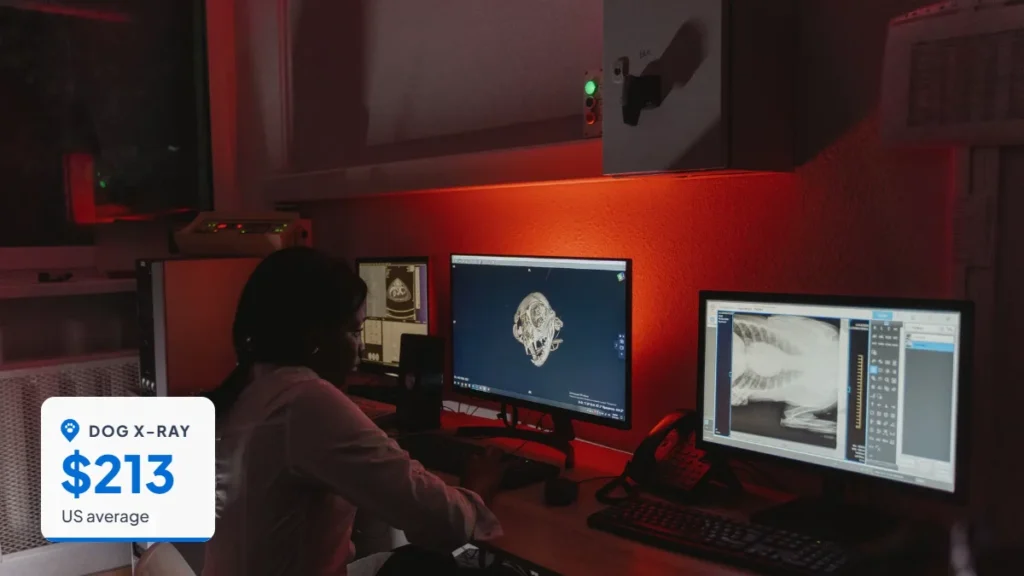
A dog X-ray costs about $213 on average in the U.S. as of 2026, and a standard set of two to three views averages $172. Plan on roughly $250 to $500 for the whole visit once the exam and any sedation are added. An emergency visit, or a large dog that needs sedation, can push the bill to $700 or more.
| Price level | What you’d pay | What it usually covers |
|---|---|---|
| Standard study, national average | $172 | Two to three views; the exam and sedation are extra |
| Average dog X-ray, national | $213 (range $169–$237) | State averages run from $171 to $383 |
| Typical range quoted by insurers | $150–$250 | The X-rays; $75–$500 at the extremes |
| Sedation, if your dog needs it | Adds $31–$444 | Depends on your dog’s size and the drugs used |
| Emergency hospital | $150–$400, plus a $100–$300 exam | X-rays at an ER, before any treatment |
National averages, state range and sedation from CareCredit (June 2026) and its veterinary cost table, both based on the Synchrony national cost study; insurer ranges from MetLife Pet and Embrace; emergency costs from Healthy Paws (November 2025).
If your vet has recommended X-rays for a limp, a cough, vomiting or a hip screening, this guide shows what they cost by body part, type of clinic and state, what the bill includes, and how to pay less.
Dog X-ray cost by body part
Most single-area X-rays cost $100 to $500; the body part matters mainly because it sets how many views your vet needs and whether your dog must be sedated. A calm dog with a sore paw costs less to X-ray than a dog who needs a full spine study under sedation.
| Body part | Views usually taken | Reported price range | What can add to it |
|---|---|---|---|
| Chest (heart and lungs) | 3: both sides plus one from above or below | $150–$400 | A radiologist’s reading if the images are unclear |
| Abdomen (belly) | 3 is best practice | $150–$450 | A contrast (barium) study for a suspected blockage, $200–$500 |
| Leg, paw or joint | At least 2, at right angles | $100–$400 | Sedation if the leg is painful |
| Hips and pelvis | 1 to 3, depending on the purpose | $150–$400 | Sedation for correct positioning |
| Spine | At least 2 per section | $150–$500 | Sedation; a CT or MRI if a disc problem is suspected |
| Skull, jaw or nose | Several | $150–$400 | Sedation or anesthesia; a CT scan shows the skull in more detail |
| Teeth | A full-mouth set | $40–$150 per image | General anesthesia, usually with a cleaning |
| Pregnancy (puppy count) | Usually 1 side view | About $80–$150 per image | A second view if the count is unclear |
Price ranges span the figures in two cost guides, Vety (2024) and Webvet (2026). Neither is a national survey, so use them to compare body parts, not as a quote. Views from the Merck Veterinary Manual, Today’s Veterinary Nurse and Today’s Veterinary Practice; per-image prices from Vetster (2024); skull imaging from Hallmarq.
Dental X-rays
The American Animal Hospital Association (AAHA) strongly recommends full-mouth dental X-rays for every dog having dental treatment. In one study it cites, 28% of dog teeth that looked normal had important problems that showed up only on X-rays.
Dental X-rays are taken under general anesthesia, so most clinics bill them as part of a cleaning rather than on their own. At Modern Animal, for example, a dog dental cleaning starts at $601 and includes full-mouth X-rays. See our guide to dog teeth cleaning costs.
Hip X-rays for OFA and PennHIP screening
Breeders and owners of large breeds often screen a dog’s hips for dysplasia. There are two main methods, and they’re priced differently:
- OFA: one hip-extended X-ray, graded by board-certified veterinary radiologists. Your dog must be at least 24 months old for certification; preliminary readings are available from 4 months. The OFA charges $45 to evaluate hips, or $50 for hips and elbows together, on top of your vet’s bill.
- PennHIP: three X-rays taken under required sedation, possible from about 16 weeks of age. It costs more: it needs three images instead of one, plus a PennHIP analysis fee.
At Riverside Pet Care in Saratoga Springs, Utah, an OFA hip screening comes to $306 to $389 before the OFA’s fee: a $64 exam, a $100 hip X-ray, $107 to $190 for weight-based sedation and a $35 paperwork fee. PennHIP at the same clinic comes to $663 to $746, plus $54 if your dog needs a microchip. Etowah Veterinary Hospital quotes $400 to $900 for PennHIP.
OFA fees and ages from the OFA (fees in effect since January 2022) and its FAQs; PennHIP requirements from Cornell Road Veterinary Clinic and Etowah Veterinary Hospital.
Pregnancy X-rays (puppy counts)
An X-ray is the most reliable way to count puppies before birth. A board-certified veterinary radiologist writing in Today’s Veterinary Practice advises a single side view on or about day 55 after ovulation, once the puppies’ skeletons show up, and notes that ultrasound is a poor way to count them. The radiation from one view is small and carries little risk that late in pregnancy.
Ultrasound is still the tool for confirming a pregnancy early, from about day 25 after ovulation, according to Village Center Veterinary Care. Because a puppy count is usually one image, ask your clinic for its single-view price. Pet insurance won’t help here: Spot, for example, says X-rays for breeding or pregnancy monitoring can’t be covered.
Dog X-ray cost by clinic type
The same X-rays can cost about $110 at a nonprofit clinic, $170 to $215 at a typical vet and $350 or more at a private clinic in an expensive city; an emergency hospital adds a bigger exam fee on top. Private clinics and specialty hospitals generally charge more than low-cost or nonprofit clinics, and clinics in cities with a higher cost of living charge more, according to GoodRx.
| Where you go | What the X-rays cost | Real-world example |
|---|---|---|
| Nonprofit or humane society clinic | Can be well below average | Lehigh Valley Humane Society (Pennsylvania): $110 for multiple views |
| Regular vet (general practice) | $172 average for two to three views; $213 average X-ray | Plus an exam, which averages $95 |
| Private clinic in a high-cost city | $350 or more | The Neighborhood Vet (Brooklyn, New York): $350 for two to six X-rays with a written report, or $450–$600 with sedation, plus a $110 exam |
| Emergency hospital | $150–$400 | Plus an emergency exam, which averages $135 and can run $100–$300 |
| Emergency or specialty hospital, one clinic’s estimate | $200–$400 | River Valley Veterinary Hospital (Pittsburgh area), 2024 |
Averages and exam fees from CareCredit; emergency X-ray and exam ranges from Healthy Paws, based on its 2022–2024 claims and hospital price data. Clinic prices as published on each clinic’s website in 2026; The Neighborhood Vet notes its prices may rise by up to 10%.
If your dog’s problem can safely wait for a weekday appointment, your regular vet is usually the cheaper place to start. When it can’t, go to the ER: see what an emergency visit costs in our guide to emergency vet costs.
When a radiologist reads the X-rays
For harder cases, your clinic may send the images to a board-certified veterinary radiologist over the internet. Teleradiology services charge clinics about $75 to $125 to read a routine X-ray study and $135 to $350 for a rush reading, according to Golden Hour, a teleradiology provider (February 2026). Ask whether your quote includes this reading or adds it as a separate line.
Dog X-ray cost by state
Where you live can more than double the price: state averages run from $171 in Mississippi and West Virginia to $297 in Massachusetts and $383 in Hawaii. Twenty-six states average under $200, while five states (Alaska, California, Hawaii, Massachusetts and New York) and Washington, D.C., average $250 or more.
| State | Average dog X-ray cost | Compared with the $213 national average |
|---|---|---|
| Alabama | $179 | $34 less |
| Alaska | $252 | $39 more |
| Arizona | $221 | $8 more |
| Arkansas | $177 | $36 less |
| California | $284 | $71 more |
| Colorado | $216 | $3 more |
| Connecticut | $228 | $15 more |
| Delaware | $210 | $3 less |
| District of Columbia | $289 | $76 more |
| Florida | $209 | $4 less |
| Georgia | $187 | $26 less |
| Hawaii | $383 | $170 more |
| Idaho | $208 | $5 less |
| Illinois | $193 | $20 less |
| Indiana | $185 | $28 less |
| Iowa | $182 | $31 less |
| Kansas | $176 | $37 less |
| Kentucky | $190 | $23 less |
| Louisiana | $190 | $23 less |
| Maine | $222 | $9 more |
| Maryland | $236 | $23 more |
| Massachusetts | $297 | $84 more |
| Michigan | $185 | $28 less |
| Minnesota | $195 | $18 less |
| Mississippi | $171 | $42 less |
| Missouri | $181 | $32 less |
| Montana | $210 | $3 less |
| Nebraska | $190 | $23 less |
| Nevada | $208 | $5 less |
| New Hampshire | $230 | $17 more |
| New Jersey | $234 | $21 more |
| New Mexico | $191 | $22 less |
| New York | $252 | $39 more |
| North Carolina | $200 | $13 less |
| North Dakota | $188 | $25 less |
| Ohio | $192 | $21 less |
| Oklahoma | $174 | $39 less |
| Oregon | $228 | $15 more |
| Pennsylvania | $196 | $17 less |
| Rhode Island | $229 | $16 more |
| South Carolina | $196 | $17 less |
| South Dakota | $189 | $24 less |
| Tennessee | $185 | $28 less |
| Texas | $189 | $24 less |
| Utah | $212 | $1 less |
| Vermont | $232 | $19 more |
| Virginia | $206 | $7 less |
| Washington | $234 | $21 more |
| West Virginia | $171 | $42 less |
| Wisconsin | $199 | $14 less |
| Wyoming | $196 | $17 less |
State averages from CareCredit (June 2026), based on the 2025 Synchrony Average Procedural Cost Study by ASQ360° Market Research. Each figure averages many clinics, so a single clinic can charge much more or less, as the examples in the previous section show. The $213 national average is from the same CareCredit data; its separate veterinary cost table puts a standard two-to-three-view study at $172.
Live near a state line or outside a big city? Clinics a short drive away may charge less, so when your dog’s problem isn’t urgent, it can pay to call two or three for a quote.
What’s on a dog X-ray bill
A quote for “X-rays” can mean two images or a complete study; the exam, sedation, extra views and a specialist’s reading are often separate lines on the bill. Ask for an itemized estimate so you can compare clinics fairly.
| Line item | Typical cost | Notes |
|---|---|---|
| Exam or office visit | $95 average; $135 at an emergency hospital | Charged before any tests |
| X-rays, two to three views | $172 average | Some clinics charge per image instead |
| Each extra view | $90–$100 | When the first views don’t show enough |
| Sedation | $31–$444 | Depends on your dog’s size and the drugs used |
| General anesthesia, if needed instead | $200–$400 | Usually with pre-anesthesia blood tests, $100–$200 |
| Radiologist’s reading | $75–$125 routine; $135–$350 rush | What teleradiology services charge clinics |
| Contrast study (such as a barium series) | $200–$500 | Outlines the digestive tract, for example when a blockage is suspected |
Exam fees, the two-to-three-view average and sedation from CareCredit and its veterinary cost table; extra views and anesthesia from Vetster (2024); blood tests from GoodRx; radiologist fees from Golden Hour (2026); contrast studies from Vety (2024) and the Merck Veterinary Manual.
Sedation isn’t padding. Positioning a dog correctly is hard, and the Merck Veterinary Manual notes that sedation or short-acting anesthesia is often necessary and usually desirable when your dog’s health allows it. Clear images the first time can save you from paying for repeat views.
Three example bills
| Situation | How it adds up | Total |
|---|---|---|
| Regular vet, calm dog | $95 exam + $172 X-rays | About $267 |
| Regular vet, dog needs sedation | $95 exam + $172 X-rays + $31–$444 sedation | About $298–$711 |
| Emergency hospital | $135 exam + $150–$400 X-rays | About $285–$535 |
These totals use the national averages and ranges above, so your own bill will differ. They also stop at the diagnosis: if the X-rays show a swallowed object or a torn knee ligament, treatment costs far more. See our guides to foreign body surgery costs and TPLO surgery costs.
When your dog needs an X-ray, and when another scan is better
X-rays are usually the first and cheapest scan for bones, the chest and the belly. An ultrasound, CT or MRI costs about 2 to 11 times as much and is used when X-rays can’t answer your vet’s question.
Vets commonly X-ray dogs for:
- Limping, suspected broken bones and joint problems; the bones of the limbs and spine are routinely X-rayed
- Coughing or trouble breathing, since the outline of the heart, large blood vessels and fluid in the chest show up
- Vomiting or a suspected swallowed object, because foreign bodies and trapped gas in the intestines can often be seen
- Dental disease hidden below the gumline, such as abscesses and damaged roots
- Hip and elbow screening, and counting puppies late in pregnancy
Uses from VCA Animal Hospitals and the sources in the body-part section above.
[embed: node/eb07cf7a-0a5a]
| Scan | Best for | Keep in mind |
|---|---|---|
| X-ray | Bones, the chest, swallowed objects, puppy counts | Can’t show brain tissue, and shows little detail inside the heart and other organs |
| Ultrasound | Organs in the belly, the heart’s inner structure, early pregnancy | Prices often exclude sedation; a poor way to count puppies |
| CT scan | Fine bone detail, the skull, lungs and many joints, surgery planning | Needs sedation or anesthesia and uses radiation |
| MRI | Brain, spinal cord and discs | Needs general anesthesia; the most expensive option |
Strengths and limits from VCA Animal Hospitals, CareCredit, Today’s Veterinary Practice and Hallmarq. For details, see our guide to dog MRI costs.
If your vet suggests a bigger scan after X-rays, ask what it could show that the X-rays didn’t, and whether the answer would change your dog’s treatment.
Does pet insurance cover dog X-rays?
Accident-and-illness policies usually cover X-rays that diagnose a new injury or illness; routine, breeding and pre-existing-condition X-rays usually aren’t covered. On a bill of a few hundred dollars, your deductible often matters more than your reimbursement rate.
- Diagnostics for accidents and illnesses are covered. Embrace says an X-ray needed for an unexpected accident or illness is likely to be covered, with your deductible and limits applied, and a Lemonade policy helps pay for diagnostics for eligible injuries.
- Pre-existing conditions are excluded. Trupanion won’t reimburse conditions diagnosed or showing signs before coverage began, and other insurers have similar rules.
- Routine and breeding X-rays usually aren’t covered. Embrace says X-rays taken as part of a wellness check might not be covered, and Spot says X-rays for breeding or pregnancy monitoring can’t be.
- The exam fee depends on your policy. Trupanion doesn’t cover exam fees, Lemonade covers vet visits only with its vet visit add-on, and Embrace offers exam fee coverage as an optional add-on on some policies, per its coverage FAQ.
- Waiting periods apply. Trupanion covers injuries after 5 days and illnesses after 30 days; Embrace covers illnesses after 14 days.
What you’d get back on a $400 X-ray visit
| Policy | If you haven’t met your deductible yet | If you’ve already met it |
|---|---|---|
| $250 deductible, 90% reimbursement | Insurance pays $110; you pay $290 | Insurance pays $360; you pay $40 |
| $500 deductible, 80% reimbursement | Insurance pays $0; you pay $400 | Insurance pays $320; you pay $80 |
The table assumes the whole bill is covered; if your policy excludes exam fees, subtract the exam first. X-rays are often just the first step, and the treatment they lead to, such as surgery for a swallowed object or a torn ligament, is where insurance pays off most. Learn how deductibles and reimbursement work in how pet insurance works, and check the rules on pre-existing conditions and waiting periods before you buy.
How to pay less for your dog’s X-rays
Most of the savings come from where you go and knowing what the price includes, so get an itemized estimate before the X-rays are taken. Work through these steps:
- Ask what the quote includes: how many views, whether sedation is needed and priced in, whether a radiologist will read the images, and the exam fee. One Brooklyn clinic’s $350 price covers two to six images and a written report; elsewhere, a quote may cover only two or three views.
- See your regular vet when it’s safe to wait. An emergency exam averages $135 versus $95 for a regular exam, and ER X-rays add $150 to $400. If your dog can’t breathe normally, has been hit by a car or can’t stand, go to the ER.
- Check nonprofit and humane society clinics. One in Pennsylvania charges $110 for multiple views. Some limit services by income or have waiting lists, so call ahead.
- Ask whether your dog needs sedation, and which kind. Sedation adds $31 to $444, depending on your dog’s size and the drugs used. Don’t skip it when your vet recommends it; blurry images that must be retaken cost more.
- Ask for copies of the images. If you see a specialist or want a second opinion, digital copies may spare you from paying for the same X-rays twice.
- Combine procedures under one sedation. If your dog is already going under for a dental cleaning or surgery, ask whether other X-rays you’ve been planning, such as a hip screening, can be taken at the same time.
If you still need help paying
| Option | How it works | Watch out for |
|---|---|---|
| CareCredit | No interest if paid in full in 6, 12, 18 or 24 months on purchases of $200 or more | Miss the deadline and 32.99% APR is charged back to the purchase date |
| Scratchpay | Payment plans over 12 to 24 months for $200 to $10,000; checking doesn’t affect your credit score | APR from 0% to 36%, plus late fees |
| Nonprofit clinics | Lower prices for the same X-rays | Income limits or waiting lists at some clinics |
| Charity grants | Help with urgent treatment | RedRover‘s Urgent Care grants don’t pay for diagnostic tests such as X-rays |
Compare these options in our guides to vet financing, CareCredit for vet bills and financial help for vet bills.
The bottom line
Budget about $170 to $215 for the X-rays themselves and $250 to $500 for the whole visit, and ask for an itemized estimate before the images are taken. Where you go matters most: state averages range from $171 to $383, a nonprofit clinic may charge about $110, and a private clinic in an expensive city $350 or more.
If your dog isn’t insured yet, remember that insurance only covers problems that start after the policy does. Compare plans in our guide to the best pet insurance for dogs.
Dog X-ray cost: frequently asked questions
How much does a dog X-ray cost?
About $213 on average in the U.S., and $172 for a standard set of two to three views, according to CareCredit’s national cost data. Once you add the exam and any sedation, expect about $250 to $500 for the whole visit.
Does my dog need to be sedated for X-rays?
Not always. Calm dogs can often be X-rayed awake, but sedation or short anesthesia is often needed for painful injuries, hip and spine X-rays and anxious dogs. It adds $31 to $444 to the bill.
How many X-rays does a dog need?
At least two views at right angles for a bone or joint, and usually three for the chest or belly. Clinics often price a set of two to three views, then charge about $90 to $100 for each extra view.
Where can I get cheap X-rays for my dog?
Try nonprofit and humane society clinics; one in Pennsylvania charges $110 for multiple views. A regular vet during business hours usually costs less than an emergency hospital, and state averages range from $171 to $383.
Will pet insurance pay for my dog’s X-rays?
Usually, when they’re needed to diagnose a new accident or illness after your waiting periods end. X-rays for pre-existing conditions, routine checkups or breeding usually aren’t covered, and your deductible applies first.
How much does an OFA hip X-ray cost?
The OFA charges $45 to evaluate hips, or $50 for hips and elbows, on top of your vet’s fee for the X-rays and sedation. At one Utah clinic, that vet visit comes to $306 to $389. PennHIP screening costs more, about $400 to $900.
Can a pregnant dog have X-rays?
Yes, late in pregnancy. Vets usually take one side view on or about day 55 after ovulation to count the puppies, once their skeletons show up. The radiation from one view carries little risk at that stage.
How we researched dog X-ray costs
We based national and state averages on the veterinary cost data CareCredit publishes from the Synchrony Average Procedural Cost Study (ASQ360° Market Research), then checked them against prices that clinics publish on their own websites: a nonprofit clinic, a private clinic, a clinic offering hip screening and a chain of transparent-price clinics. We added 2024–2026 cost guides from pet insurers and consumer sites, claims-based emergency costs from an insurer, and imaging guidance from the Merck Veterinary Manual, VCA Animal Hospitals, AAHA and veterinary journals. We checked every figure in September 2026. Prices vary by clinic and region, so your clinic’s written estimate is the only exact figure. This article is general information, not veterinary advice.
Sources
- CareCredit: How much does a dog X-ray cost?, veterinary exam and procedure costs, dog ultrasound cost and dog MRI cost
- Merck Veterinary Manual: Radiography of animals
- VCA Animal Hospitals: Radiographs (X-rays) for dogs
- AAHA: 2019 Dental Care Guidelines for Dogs and Cats
- Today’s Veterinary Practice: Fetal count radiology
- Today’s Veterinary Nurse: Radiographic soft tissue positioning
- Orthopedic Foundation for Animals: Fees and FAQs
- Riverside Pet Care: OFA and PennHIP testing
- Etowah Veterinary Hospital: Hip dysplasia testing
- Cornell Road Veterinary Clinic: PennHIP evaluation
- Lehigh Valley Humane Society: Clinic services and pricing
- The Neighborhood Vet: Pricing
- Modern Animal: Pricing
- Village Center Veterinary Care: Pregnancy ultrasound and puppy count X-rays
- Healthy Paws: Common pet emergencies and their costs
- River Valley Veterinary Hospital: Emergency vet care costs
- Golden Hour: Cost of veterinary teleradiology
- Vetster: How much do pet X-rays cost?
- Vety: Dog X-ray cost and Webvet: Dog X-ray cost
- GoodRx: How much does a dog X-ray cost?
- MetLife Pet Insurance: Dog X-ray cost
- Spot Pet Insurance: Dog X-ray cost
- Embrace: Does pet insurance cover X-rays?, coverage FAQ and waiting periods
- Trupanion: What isn’t covered and when coverage begins
- Lemonade: TPLO surgery cost (diagnostics and vet visit add-on)
- Hallmarq Veterinary Imaging: Veterinary CT vs. MRI
- NerdWallet: CareCredit card terms
- Scratchpay: How it works
- RedRover: Urgent Care grants
Correction (October 14, 2026): We recalculated the insurance payout examples so the reimbursement percentage is applied before the deductible, the way Healthy Paws and Lemonade calculate claims. Some “you pay” amounts changed.