
Cost guide, not veterinary advice. Prices are typical US ranges from public sources and vary by clinic and region. Last reviewed October 14, 2026. How we research
In this guide
- Quick answer
- What bloat (GDV) is and why it can’t wait
- Where the money goes: a GDV bill, step by step
- What affects survival
- Preventive gastropexy: cost and who should consider it
- Does pet insurance cover bloat surgery?
- How to pay for emergency bloat surgery
- The bottom line
- Frequently asked questions
- How we researched this
- Sources
Quick answer
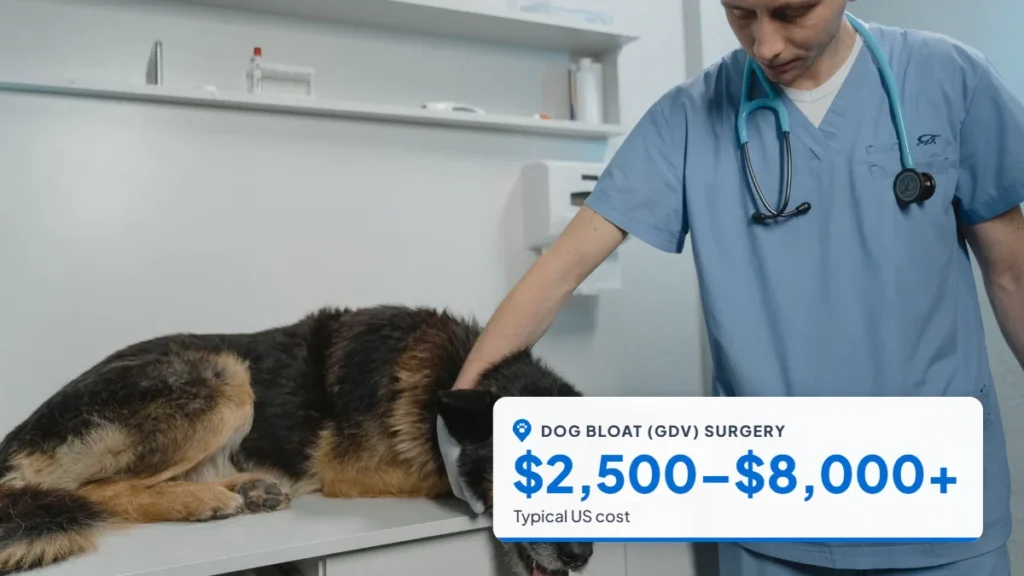
Emergency surgery for bloat (gastric dilatation-volvulus, or GDV) usually costs $2,500 to $8,000 or more in the U.S., and most dogs that reach surgery go home. Insurers and vet sites publish ranges from about $1,500 to $7,500+, with $3,000 to $6,000 the most common quote. Nonprofit and general-practice clinics charge less for the operation itself. 24-hour emergency and specialty hospitals charge more, mostly for monitoring and ICU care. In published studies, 10% to 28% of dogs treated with surgery die, so roughly 72% to 90% survive.
| Scenario | Typical cost | Where the number comes from |
|---|---|---|
| Surgery only, nonprofit clinic (San Diego) | From $2,338 | ANICIRA price page |
| Surgery day only, general practice (Maryland) | $1,800–$2,500 | Howard County Animal Hospital price list |
| Full emergency treatment, typical range | $2,500–$8,000+ | Healthy Paws, Nov 2025 |
| Real insured bill, New York | $5,900 | MetLife claim example |
| Example ER bill with 3 days of ICU | $7,725 | Healthy Paws, Nov 2025 |
| Preventive gastropexy (planned, not an emergency) | $300–$400 added to a spay or neuter; $800–$3,000 on its own | Embrace |
| Survival after surgery | About 72%–90% | Today’s Veterinary Practice (10%–28% mortality) |
Sources: ANICIRA, Howard County Animal Hospital, Healthy Paws, MetLife Pet Insurance, Embrace Pet Insurance, Today’s Veterinary Practice. Published prices, not quotes; the surgery-only prices leave out X-rays, lab work and hospital stays.
Time matters more than money. GDV can kill a dog within hours, and survival drops the longer a dog waits. If your dog is retching without bringing anything up and its belly looks swollen, go to the nearest open vet or emergency hospital now and sort out payment there.
What bloat (GDV) is and why it can’t wait
In GDV, a dog’s stomach fills with gas and then twists on itself, trapping the gas and cutting off blood flow to the stomach and sometimes the spleen. Simple bloat (gastric dilatation) is a swollen stomach that hasn’t twisted. Volvulus is the twist. Your vet needs an X-ray to tell them apart, so treat any sign of bloat as an emergency. Without surgery, a twisted stomach is almost always fatal.
The Merck Veterinary Manual lists these early signs:
- Retching or trying to vomit with nothing coming up
- Drooling
- Restlessness
- A belly that swells and feels tight
Later, a dog can go into shock: weak pulse, fast heart rate, pale gums, and lying down unable to get up.
Large, deep-chested breeds carry most of the risk. Great Danes, German Shepherds, Standard Poodles, Weimaraners, Irish and Gordon Setters, Saint Bernards, Doberman Pinschers and Basset Hounds show up again and again in the research. Risk also rises with age, a close relative who bloated, a lean body, eating one meal a day and eating fast. One study estimated that a Great Dane has about a 37% chance of GDV over its lifetime.
| Risk factor | What the research says |
|---|---|
| Breed and chest shape | Deep, narrow chests; Great Danes top the list |
| Great Dane lifetime risk | 36.7% (Ward, Patronek and Glickman, 2003) |
| Age | Risk rises as dogs get older |
| Family history | A relative with GDV raises risk |
| Feeding | One meal a day and fast eating raise risk |
Sources: Merck Veterinary Manual; Today’s Veterinary Practice; Ward MP, Patronek GJ, Glickman LT, Preventive Veterinary Medicine, 2003.
Where the money goes: a GDV bill, step by step
Most of a GDV bill comes from two things: the operation and the days of hospital care afterward. The ER visit and tests that come first are the smaller part.
- Exam and triage. The vet checks heart rate, gums and belly.
- Stabilization. Before surgery, the team treats shock with fast IV fluids and lets gas out of the stomach with a tube or needle.
- Diagnostics. X-rays confirm the twist. Blood work and lactate help judge how sick the dog is, and an ECG checks for heart rhythm problems.
- Surgery. The surgeon untwists the stomach, checks the stomach and spleen for dead tissue, and stitches the stomach to the body wall (gastropexy) so it can’t twist again. Removing the spleen or part of the stomach adds time and cost.
- Hospital stay. Most dogs stay one to several days on IV fluids, pain control and heart monitoring.
- Home care and recheck. Pain medicine, small bland meals, 10 to 14 days of rest, and an incision check at about two weeks.
| Line item | Typical cost | Source |
|---|---|---|
| Emergency exam | $135 average ($100–$300 range) | CareCredit; Healthy Paws |
| Emergency X-rays | $334 average | CareCredit |
| Blood work (CBC + chemistry) | $268 average | CareCredit ($104 + $164) |
| IV catheter and fluids | $130 average | CareCredit |
| Surgery (derotation + gastropexy) | $1,800–$2,500 general practice; about $5,000 at an ER | Howard County Animal Hospital; Healthy Paws example |
| Hospitalization | $619 per night average | CareCredit |
| ICU care | $500–$2,000 per day | Healthy Paws |
Sources: CareCredit national cost data (Synchrony / ASQ360° study); Healthy Paws, Nov 2025; Howard County Animal Hospital price list.
Add CareCredit’s averages and you get about $2,100 before the surgeon is paid. That’s the exam, X-rays, blood work, IV fluids and two nights in the hospital ($867 + $1,238). Add a general-practice surgery fee and the total lands near $3,900 to $4,600. With an ER surgery fee of about $5,000, it’s closer to $7,100. These are our sums of averages, not a real invoice.
Here is a real example bill that Healthy Paws published:
| Item | Cost |
|---|---|
| Emergency exam | $150 |
| X-rays | $200 |
| Blood work | $275 |
| Emergency surgery | $5,000 |
| 3 days of ICU care | $2,100 |
| Total | $7,725 |
Source: Healthy Paws Pet Insurance, “The Most Common Pet Emergencies and Their Real Costs,” Nov 2025.
What pushes the bill up:
- Dead stomach tissue or a damaged spleen. Removing part of the stomach or the spleen means a longer surgery and usually more ICU days.
- Heart rhythm problems. Arrhythmias mean ECG monitoring and extra drugs.
- Where you go. A 24-hour ER or specialty hospital costs more than a general practice or nonprofit clinic that can take the case.
- Your dog’s size. Giant dogs need more fluids, drugs and anesthetic.
- Where you live. Prices vary by region; MetLife’s New York example came to $5,900.
What affects survival
How fast a dog gets to surgery, and whether part of the stomach has already died, matter most. Most studies report that 10% to 28% of dogs treated with surgery don’t survive. The Merck Veterinary Manual puts it at about 20%. In a 2025 Italian study of 130 dogs treated with surgery, 86.4% of those with follow-up data survived.
| Factor | What the research found |
|---|---|
| Time before treatment | Signs lasting more than 6 hours before the exam are linked to more deaths |
| Dead stomach tissue (necrosis) | Part of the stomach is removed in about 13%–20.5% of cases; linked to lower survival |
| Spleen removal | Needed in about 16%–22% of cases; linked to lower survival |
| Heart rhythm problems | Present in up to 40% of dogs before surgery; linked to lower survival |
| Lactate on arrival | 99% survived at 6.0 mmol/L or less vs. 58% above it (de Papp, 1999) |
| Lactate on arrival, higher cutoff | 46% died above 9 mmol/L vs. 10% at or below it (Zacher, 2010) |
| Lactate after fluids | A drop of more than 40%–50% points to a better chance, whatever the starting value |
| Problems during the stay | Low blood pressure, peritonitis, sepsis or a clotting disorder (DIC) |
Sources: Today’s Veterinary Practice; Merck Veterinary Manual; Clinician’s Brief; Veterinary Evidence knowledge summary on lactate; Olimpo et al., Animals, 2025.
Lactate is a rough guide, not a verdict. Lactate is a blood marker of poor oxygen delivery to tissues. Survivors and non-survivors overlap a lot, and the 2025 Italian study found no significant link to death at all. A review in Veterinary Evidence advises surgery whatever the lactate level. If your vet quotes a number, ask how your dog responds to fluids.
Survival figures only count dogs that had surgery. In a UK study of 497 dogs seen at private emergency clinics, 26% were euthanized at admission and 4.4% died at admission. Among the dogs that went to surgery, 17.9% died before discharge. If you are weighing that choice, our guide to what it costs to put a dog down explains the options and prices.
What you can control:
- Go now. Don’t wait to see whether the retching stops.
- Know your nearest 24-hour ER before you need it, especially with a high-risk breed.
- Approve stabilization right away. Ask the team to start fluids and decompression while they prepare the full estimate.
- Ask about gastropexy for the future. Without it, GDV comes back in 55% to 75% of dogs.
Preventive gastropexy: cost and who should consider it
A planned gastropexy stitches the stomach to the body wall before trouble starts, and it costs a fraction of emergency surgery. It doesn’t stop the stomach from filling with gas, but it keeps it from twisting. After a gastropexy done well, GDV comes back in under 5% of dogs. Simple bloat without a twist still happens in about 5% to 11%.
| Option | Typical cost | Source |
|---|---|---|
| Added to a spay or neuter | $300–$400+ | Embrace |
| On its own, open or laparoscopic | $800–$3,000 (laparoscopic toward the top) | Embrace |
| On its own, typical range | $800–$2,500 | GreatPetCare (vet-written) |
| Laparoscopic gastropexy with a spay or neuter, one owner’s bill (2022) | $1,400 | GoodRx |
| Emergency GDV surgery, for comparison | $2,500–$8,000+ | Healthy Paws |
Sources: Embrace Pet Insurance; GreatPetCare (Rhiannon Koehler, DVM); GoodRx Health; Healthy Paws. Published ranges, not quotes.
Doing it with the spay or neuter saves money, because your dog goes under anesthesia once. Laparoscopic (keyhole) gastropexy uses small incisions. Clinics that offer it point to less pain and a faster recovery, often with same-day or next-day discharge.
The case is strongest for Great Danes and other high-risk breeds. A 2003 analysis estimated that preventive gastropexy cut the risk of dying from GDV about 30-fold in Great Danes and about 2-fold in Rottweilers. For Great Danes it also saved money over a lifetime, but those figures used 2003 prices. Talk to your vet if your dog:
- is a Great Dane, Standard Poodle, Weimaraner, Setter, German Shepherd, Saint Bernard or another deep-chested breed
- has a parent or littermate who bloated
- is getting spayed or neutered soon anyway
Preventive gastropexy doesn’t replace fast action. If a dog that has had one shows signs of bloat, it still needs to see a vet right away.
Does pet insurance cover bloat surgery?
Accident-and-illness plans usually cover emergency GDV surgery, as long as your dog’s waiting periods are over and bloat isn’t a pre-existing condition. Planned, preventive gastropexy is usually not covered by standard plans. Here is what that looks like on the $7,725 example bill:
| Bill | Deductible | Reimbursement | Insurer pays | You pay |
|---|---|---|---|---|
| $7,725 | $250 | 90% | $6,702.50 | $1,022.50 |
| $7,725 | $500 | 80% | $5,680 | $2,045 |
| $7,725 | $500 | 70% | $4,907.50 | $2,817.50 |
| $5,900 (real MetLife claim, New York) | $250 | 80% | More than $4,650 | About $1,250 |
Sources: our math on the Healthy Paws example bill, with the percentage applied before the deductible (as Healthy Paws and Lemonade calculate it), assuming every line is covered and no annual limit is reached; MetLife Pet Insurance claim example.
Check these points in your policy before you need it:
- Waiting periods. Trupanion waits 5 days for injuries and 30 days for illnesses; Embrace waits 14 days for illnesses. Ask which one your insurer applies to bloat.
- Pre-existing conditions. If your dog bloated before coverage started, a repeat episode will likely be excluded.
- Exam fees. Some plans leave them out; Trupanion doesn’t cover exams, so the ER exam fee would be yours.
- Paying upfront. Most insurers pay you back after a claim. Some hospitals, such as BluePearl, can bill Trupanion directly.
- Preventive gastropexy. Wellness add-ons, such as Embrace Wellness Rewards, can help you budget for routine care, but check whether they include gastropexy.
If you own a high-risk breed, insurance bought while your dog is young and healthy is what protects you from a $5,000+ night. See our guides to how pet insurance works, pre-existing conditions and waiting periods.
How to pay for emergency bloat surgery
Emergency hospitals often ask for a deposit before surgery, so plan for the first few thousand dollars. Policies we found range from 50% of the estimate (Animal Medical Center, New York) to 50% of the high end (AES, Kirkland, WA) to 100% of the low end (NC State Veterinary Hospital). On a $4,000 to $8,000 estimate, 50% is $2,000 to $4,000.
| Option | How it works | Watch out for |
|---|---|---|
| CareCredit | No interest if paid in full in 6, 12, 18 or 24 months, on charges of $200 or more | 32.99% APR charged back to the purchase date if you don’t pay in full in time |
| Scratchpay | Loans of $200 to $10,000 | APR from 0% to 36% |
| RedRover Urgent Care grant | Averages about $250 | Not for gaps of $500 or more; household income of $60,000 or less; excludes diagnostics |
| Hospital payment plan | Ask the billing team | Not every hospital offers one |
| Nonprofit or general-practice surgery | ANICIRA (San Diego) from $2,338; Howard County Animal Hospital $1,800–$2,500 for surgery day | Only if they take emergencies and your dog is stable enough |
Sources: CareCredit; Scratchpay; RedRover; hospital deposit policies (AMC New York, AES Kirkland, NC State); ANICIRA; Howard County Animal Hospital.
Ways to pay less without losing time:
- Ask for a written estimate with a low and high end, and what stabilization, surgery and each hospital day cost on their own.
- Ask whether a lower-cost option is safe. A stable dog might be transferred to a daytime clinic or nonprofit. A dog in shock should not be moved, so let your vet make that call.
- Apply for financing from the waiting room. Both CareCredit and Scratchpay take applications online.
- Plan ahead if you own a high-risk breed. Preventive gastropexy at the spay or neuter, plus insurance bought early, costs far less than an emergency.
More help: vet financing options, using CareCredit for vet bills, financial assistance for vet bills and what an ER visit costs.
The bottom line
Budget $2,500 to $8,000 or more for emergency bloat surgery, and don’t let the estimate slow you down. Most dogs that reach surgery in time go home. Speed and the state of the stomach matter more to survival than anything you can control at the counter. If you own a Great Dane or another high-risk breed, the cheapest protection is a preventive gastropexy at the spay or neuter, plus insurance bought early.
Frequently asked questions
How much does bloat surgery cost for a dog?
Usually $2,500 to $8,000 or more for full emergency treatment. Nonprofit and general-practice clinics list the surgery itself from about $1,800 to $2,500, but X-rays, lab work and hospital days come on top. One real ER example came to $7,725.
What is the survival rate for dogs with GDV?
Studies report that about 72% to 90% of dogs treated with surgery survive. The odds are lower when signs have lasted more than 6 hours, when part of the stomach has died or the spleen has to be removed, and when the dog has heart rhythm problems.
Can a dog survive bloat without surgery?
A twisted stomach is almost always fatal without surgery. Simple bloat without a twist can sometimes be treated by letting the gas out, but it tends to come back: GDV recurs in 55% to 75% of dogs that don’t get a gastropexy.
How much does preventive gastropexy cost?
About $300 to $400 extra when it’s done during a spay or neuter, or roughly $800 to $3,000 on its own. Laparoscopic gastropexy usually costs more than the open version.
Will pet insurance pay for bloat surgery?
Most accident-and-illness plans cover emergency GDV surgery once waiting periods are over, unless bloat is a pre-existing condition. Preventive gastropexy usually isn’t covered by standard plans.
Which dogs are most at risk of bloat?
Large, deep-chested breeds, led by Great Danes, which one study put at about a 37% lifetime risk. German Shepherds, Standard Poodles, Weimaraners, Setters, Saint Bernards and Basset Hounds are also at higher risk, and risk rises with age.
How long does recovery take after bloat surgery?
Most dogs spend one to several days in the hospital, then about 10 to 14 days of rest at home with pain medicine and small, bland meals. The incision is usually checked at 10 to 14 days.
How we researched this
Line-item averages come from CareCredit’s national cost data (a Synchrony study run with ASQ360°). Total-cost ranges and example bills come from insurers’ official pages (Healthy Paws, MetLife, Embrace, Figo) and vet-written guides. Clinic prices come from published price pages (ANICIRA in San Diego, Howard County Animal Hospital in Maryland). Survival figures come from peer-reviewed studies and veterinary references: the Merck Veterinary Manual, Today’s Veterinary Practice, Clinician’s Brief and Veterinary Evidence. Our “sum of averages” bill adds CareCredit averages together; it is an estimate, not a real invoice. Prices were checked in September 2026 and change often, so ask your hospital for a written estimate.
Sources
- Healthy Paws: The Most Common Pet Emergencies and Their Real Costs (Nov 2025)
- MetLife Pet Insurance: Bloat in Dogs
- Embrace Pet Insurance: Gastropexy
- Figo: Gastric Dilatation-Volvulus (Bloat) in Dogs
- GreatPetCare: Dog Bloat Surgery: Cost and What to Expect
- Vety: Dog Stomach Flip Surgery Cost
- GoodRx Health: Is Gastropexy Surgery for Your Dog Worth It?
- ANICIRA: Dog GDV (Bloat) Surgery in San Diego
- Howard County Animal Hospital: Surgery Price List
- CareCredit: Veterinary cost data
- Merck Veterinary Manual: Gastric Dilation and Volvulus in Small Animals
- Today’s Veterinary Practice: Gastric Dilatation and Volvulus: Stabilization and Surgery
- Clinician’s Brief: Gastric Dilatation-Volvulus in Dogs
- dvm360: Gastric dilatation-volvulus: The twisted truth
- Veterinary Evidence: Knowledge summary on lactate in canine GDV
- Ward, Patronek & Glickman (2003), Benefits of prophylactic gastropexy for dogs at risk of GDV, Preventive Veterinary Medicine
- Olimpo et al. (2025), Gastric Dilatation-Volvulus in Dogs: Analysis of 130 Cases, Animals
- Todd, Dunning & Firth (2013), Mortality rates of GDV in private emergency practice in the UK
- Gambrills Veterinary Center: Laparoscopic Gastropexy
Correction (October 14, 2026): We recalculated the insurance payout examples so the reimbursement percentage is applied before the deductible, the way Healthy Paws and Lemonade calculate claims. Some “you pay” amounts changed.