
Cost guide, not veterinary advice. Prices are typical US ranges from public sources and vary by clinic and region. Last reviewed October 15, 2026. How we research
In this guide
- Emergency vet cost at a glance
- The emergency exam fee: what you pay just to be seen
- Emergency vet cost by type of emergency
- What a night in the hospital costs
- A night at the ER, line by line
- ER, urgent care or your regular vet?
- Estimates, deposits and what to do if you can’t pay
- Does pet insurance cover emergency vet visits?
- How to pay less for an emergency vet visit
- The bottom line
- Emergency vet cost: frequently asked questions
- How we researched emergency vet costs
Emergency vet cost at a glance
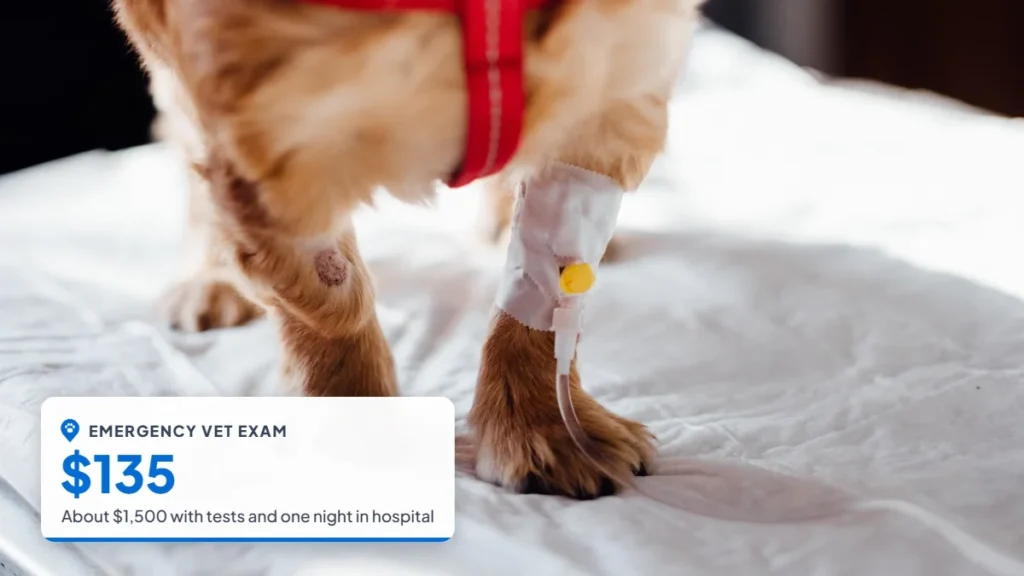
Walking into an emergency vet costs about $135 for a dog and $143 for a cat on average in the U.S. as of 2026, before any tests or treatment. Add bloodwork, X-rays, IV fluids and one night in the hospital, and a typical bill reaches about $1,500. Emergency surgery or intensive care can push it past $5,000.
| What you get | Typical cost | What it usually covers |
|---|---|---|
| Emergency exam only | $135 for dogs ($107–$246); $143 for cats ($113–$260) | The vet’s assessment; no tests or treatment |
| Exam plus basic tests | About $737 | Exam, two blood panels and emergency X-rays |
| One night in the hospital | About $1,486 | The above, plus an IV catheter, fluids and one night of hospital care |
| Emergency surgery | $1,500–$5,000 or more | The operation; the exam, tests and hospital stay are extra |
| Intensive care | $500–$2,000 per day | Round-the-clock monitoring and treatment |
| Serious emergencies, all-in | Often $5,000–$8,000 | Real example bills for bloat and trauma |
Exam fees and procedure prices from CareCredit (May 2026), based on the 2025 Synchrony national cost study; the middle rows add its dog averages together. Surgery, intensive care and all-in examples from Healthy Paws (November 2025), based on its 2022–2024 claims and hospital price data.
If your pet needs care tonight, go now and read this later. If you’re budgeting for an emergency, deciding between the ER and your regular vet, or looking at an estimate you didn’t expect, this guide explains each part of the bill and how to lower it. For non-emergency care, from checkups to planned surgery, see our US vet price list.
The emergency exam fee: what you pay just to be seen
The exam fee averages $135 for a dog nationally, about $40 more than a regular vet exam, and it ranges from $108 in Mississippi to $241 in Hawaii. It pays for the vet’s assessment and treatment plan; every test and treatment is billed on top.
Insurers quote higher figures than the national average: Healthy Paws puts emergency exams at $100 to $300, often more after hours or on weekends, and MetLife Pet (August 2026) at $200 or more. Fees vary widely from one hospital to the next, so if you have time, call ahead and ask what the exam costs.
| State | Average emergency exam, dogs | Compared with the $135 national average |
|---|---|---|
| Alabama | $114 | $21 less |
| Alaska | $160 | $25 more |
| Arizona | $139 | $4 more |
| Arkansas | $112 | $23 less |
| California | $180 | $45 more |
| Colorado | $137 | $2 more |
| Connecticut | $146 | $11 more |
| Delaware | $132 | $3 less |
| District of Columbia | $183 | $48 more |
| Florida | $133 | $2 less |
| Georgia | $118 | $17 less |
| Hawaii | $241 | $106 more |
| Idaho | $132 | $3 less |
| Illinois | $122 | $13 less |
| Indiana | $117 | $18 less |
| Iowa | $116 | $19 less |
| Kansas | $113 | $22 less |
| Kentucky | $120 | $15 less |
| Louisiana | $119 | $16 less |
| Maine | $142 | $7 more |
| Maryland | $150 | $15 more |
| Massachusetts | $188 | $53 more |
| Michigan | $117 | $18 less |
| Minnesota | $123 | $12 less |
| Mississippi | $108 | $27 less |
| Missouri | $115 | $20 less |
| Montana | $135 | Same |
| Nebraska | $121 | $14 less |
| Nevada | $131 | $4 less |
| New Hampshire | $146 | $11 more |
| New Jersey | $148 | $13 more |
| New Mexico | $121 | $14 less |
| New York | $159 | $24 more |
| North Carolina | $127 | $8 less |
| North Dakota | $119 | $16 less |
| Ohio | $122 | $13 less |
| Oklahoma | $111 | $24 less |
| Oregon | $144 | $9 more |
| Pennsylvania | $124 | $11 less |
| Rhode Island | $146 | $11 more |
| South Carolina | $125 | $10 less |
| South Dakota | $120 | $15 less |
| Tennessee | $117 | $18 less |
| Texas | $120 | $15 less |
| Utah | $134 | $1 less |
| Vermont | $149 | $14 more |
| Virginia | $131 | $4 less |
| Washington | $148 | $13 more |
| West Virginia | $109 | $26 less |
| Wisconsin | $125 | $10 less |
| Wyoming | $124 | $11 less |
State averages for dogs from CareCredit (May 2026), based on the 2025 Synchrony national cost study; the $95 regular exam average is from CareCredit’s X-ray cost data. For cats, the national ER exam average is $143. See how regular visits compare in our guide to vet visit costs.
Emergency vet cost by type of emergency
What went wrong matters more than anything else on the bill: a bite wound is often treated for under $2,000, while bloat, seizures or heatstroke can run past $7,000 once surgery or intensive care is needed.
[embed: node/82428bda-eb64]
The example bills are real cases Healthy Paws itemizes, and every range can run higher. The bloat and trauma examples sit near the top of their ranges, a reminder that the high end is real.
Average prices for common emergency treatments
| Treatment | Dogs | Cats |
|---|---|---|
| Scrape or abrasion wound care | $182 | $118 |
| Upset stomach treatment | $390 | $234 |
| Upper respiratory infection treatment | $649 | $192 |
| Puncture wound treatment | $857 | $173 |
| Pyometra (infected uterus) surgery | $1,218 | $2,116 |
| Severe diarrhea treatment | $1,455 | $945 |
| Oxygen therapy, per visit | $1,528 (large dog) | $1,861 |
| Stomach blockage surgery | $2,217 | $2,367 |
| Bladder stone surgery | $2,331 | $2,096 |
National averages from CareCredit (May 2026), based on the 2025 Synchrony national cost study. They cover the treatment; the exam, tests and hospital stay are usually billed on top. Stomach blockage surgery is CareCredit’s emergency figure; surgery on the intestines to remove a swallowed object averages $4,383 (see our foreign body surgery guide).
If your pet swallowed something toxic, call a pet poison hotline on the way: the ASPCA Animal Poison Control Center (888-426-4435) or Pet Poison Helpline (855-764-7661). Both charge a consultation fee, $95 and $89 respectively as of 2024 according to GoodRx, and both answer 24 hours a day.
For full breakdowns, see our guides to bloat surgery costs and foreign body surgery costs.
What a night in the hospital costs
One night of hospital care averages about $620 for a dog, and intensive care can cost $500 to $2,000 a day, so an overnight stay often doubles the bill. Fluids, oxygen and medication are usually charged on top of the nightly rate.
| Overnight item | Typical cost | Notes |
|---|---|---|
| Hospitalization, per night | $619 average for dogs, $582 for cats | Standard ward care and monitoring |
| Hospitalization, range quoted by insurers | $200–$600 a day; up to $1,500 a night | Depends on the hospital and how sick your pet is |
| Intensive care (ICU) | $500–$2,000 a day | Round-the-clock monitoring and dedicated staff |
| IV catheter and first bag of fluids | $130 for dogs, $121 for cats | Most hospitalized pets get one |
| IV fluids after that | $50–$200 a day | For dehydration, shock or toxin flushing |
| Oxygen therapy | $1,528 per visit for a large dog; $800–$3,000 quoted by insurers | For breathing problems, often in an oxygen cage |
| Medications | $50–$300 | Pain relief, anti-nausea drugs, antibiotics |
Averages from CareCredit (May 2026); ranges from Healthy Paws (November 2025) and MetLife Pet (August 2026); what intensive care includes from BluePearl.
Ask each morning how the bill compares with the estimate. BluePearl notes that costs can be revisited as care goes on, and each extra night adds about $620 at the average rate, before fluids and medication.
A night at the ER, line by line
A dog admitted overnight for vomiting comes to about $1,500 to $1,800 at national average prices; if the X-rays show a blockage that needs surgery, the same visit runs about $4,900 to $5,100. Here is how each bill adds up.
| Line item | Treated overnight, home next day | Blockage found, surgery and a second night |
|---|---|---|
| Emergency exam | $135 | $135 |
| Blood tests (CBC and chemistry panel) | $268 | $268 |
| Emergency X-rays, 2–3 views | $334 | $334 |
| Abdominal ultrasound | — | $483 |
| IV catheter and fluids | $130 | $130 |
| Stomach blockage surgery | — | $2,217 |
| Hospitalization | $619 (one night) | $1,238 (two nights) |
| Medications | $50–$300 | $50–$300 |
| Total | $1,536–$1,786 | $4,855–$5,105 |
All prices except medications are CareCredit’s national averages for dogs (May 2026); medications from Healthy Paws. Real bills vary with your hospital, your dog’s size and how the night goes, but the pattern holds: the exam is the smallest line, and the hospital stay and any surgery are the biggest. If the blockage is in the intestines rather than the stomach, CareCredit’s average for that surgery is $4,383, which would bring this bill to about $7,000 to $7,300.
When you get an estimate, check that it lists every line above that applies to your pet. For two tests that appear on almost every ER bill, see our guides to dog X-ray costs and dog blood work costs. If your pet is referred on for advanced imaging after a seizure or a sudden back or neck problem, see dog MRI costs.
ER, urgent care or your regular vet?
For a true emergency, go straight to the ER; for a problem that needs same-day care but isn’t life-threatening, an urgent care clinic or your regular vet usually costs less. Emergency hospitals charge more because they staff vets around the clock and keep equipment such as ultrasound, oxygen cages and CT scanners ready, according to WebMD (reviewed by a veterinarian, 2024).
| Where you go | Exam fee | Best for |
|---|---|---|
| Regular vet | $95 on average | Problems that can wait for an appointment |
| Urgent care clinic | $100–$200 | Same-day problems such as limping, mild vomiting or diarrhea without blood, minor wounds and skin or ear infections |
| Emergency hospital | $135 on average; $150–$300 at many hospitals | Life-threatening problems, overnight care, surgery and intensive care |
Averages from CareCredit; urgent care and emergency ranges from Veterinary Healthcare Associates, a Florida hospital that runs both. Urgent care clinics usually keep evening and weekend hours but aren’t set up for intensive, hospital-level treatment, so a very sick pet may still be sent on to the ER.
Go to the ER now for these signs
The American Veterinary Medical Association lists these as emergencies that need a vet right away:
- Trouble breathing, choking or collapse
- Bleeding that doesn’t stop with pressure, or signs of internal bleeding such as pale gums or blood from the nose, mouth or rectum
- Seizures that last more than 5 minutes, or more than one seizure in 24 hours
- Eating something poisonous, especially with seizures, weakness or trouble breathing
- Heatstroke, burns, snake bites or eye injuries
- Signs of shock: a weak pulse, shallow breathing and a dazed look
List from the AVMA. If you’re not sure, call the nearest emergency hospital; the staff can tell you whether to come in now. Cost should never delay care for these signs: the options in the next sections can help you pay afterward.
Estimates, deposits and what to do if you can’t pay
Expect a written estimate after the exam and a deposit before your pet is admitted, often half the estimate or more; the rest is usually due when your pet goes home. BluePearl, a national chain of emergency and specialty hospitals, says the bill is due in full at the time of the visit in most cases.
| Hospital | Deposit before admission |
|---|---|
| Animal Medical Center, New York | 50% of the estimate for day or overnight hospital care |
| Animal Emergency & Specialty, Kirkland, Washington | 50% of the high end of the estimate |
| NC State Veterinary Hospital, Raleigh | 100% of the low end of the estimate |
Deposit policies as published on each hospital’s website, checked September 2026.
If the estimate is more than you can pay
- Say so right away. Asking for an estimate, discussing your budget and prioritizing care within it “is not only acceptable — it’s the goal,” according to Texas A&M’s veterinary college. BluePearl advises the same: if your pet is in distress, come in and explain your situation.
- Ask for a second treatment plan. Ask which items are essential tonight and which could wait or be done by your regular vet.
- Apply for financing before you sign. BluePearl, for example, lists both CareCredit and Scratchpay, and you can apply from the waiting room (see the payment table below).
- Ask about in-house payment plans. A few hospitals offer them: Animal Emergency in Raleigh, North Carolina, works with Vetbilling, which asks for a deposit of at least 25% of the total or the high end of the estimate.
- Call your insurer or check your app. Some hospitals bill certain insurers directly; BluePearl, for example, bills Trupanion at checkout, so you pay only your share.
Does pet insurance cover emergency vet visits?
Yes: accident-and-illness policies cover emergency tests, treatment, surgery and hospital stays for new problems once your waiting periods are over. The ER is where insurance pays off most, because the bills are large enough to clear the deductible.
- What’s covered: diagnostics, treatment and surgery for eligible accidents and illnesses, as Embrace and Lemonade describe their coverage. MetLife Pet reports a dog whose GI surgery near San Jose cost more than $10,000; the family was reimbursed more than $8,800.
- Pre-existing conditions are excluded. Trupanion won’t reimburse conditions diagnosed or showing signs before coverage began, and other insurers have similar rules.
- The exam fee may not be covered. Trupanion excludes exam fees, Lemonade covers vet visits only with its vet visit add-on, and Embrace offers exam fee coverage as an optional add-on on some policies, per its coverage FAQ.
- Waiting periods apply. Trupanion covers injuries after 5 days and illnesses after 30 days; Embrace covers illnesses after 14 days. An emergency during a waiting period isn’t covered.
- You usually pay first. Most hospitals collect payment at checkout and give you the paperwork to file a claim. Some bill an insurer directly: BluePearl does this for Trupanion.
What you’d get back on two emergency bills
| Policy | $1,500 overnight stay | $5,000 emergency surgery |
|---|---|---|
| $250 deductible, 90% reimbursement | Insurance pays $1,100; you pay $400 | Insurance pays $4,250; you pay $750 |
| $500 deductible, 80% reimbursement | Insurance pays $700; you pay $800 | Insurance pays $3,500; you pay $1,500 |
The table assumes the deductible hasn’t been met yet and the whole bill is covered; if your policy excludes exam fees, subtract the exam first. Learn how deductibles work in how pet insurance works, and check the rules on pre-existing conditions and waiting periods before you buy.
How to pay less for an emergency vet visit
Most savings come before the emergency, by insuring your pet or setting money aside, and during it, by asking for an itemized estimate and a plan that fits your budget. Never let these steps delay care for a true emergency.
- Insure your pet or build an emergency fund now. Insurance only covers problems that start after the policy and its waiting periods, and a single ER night with basic tests comes to about $1,500 at average prices.
- Know your options before you need them. Save the numbers of the nearest 24-hour ER and urgent care clinic. Exam fees vary by more than $100 between states and from one hospital to the next.
- Call a poison hotline first if your pet ate something toxic. For a fee of about $90 to $95, a veterinary team advises you by phone on what to do next, day or night.
- Ask for an itemized estimate and a prioritized plan before treatment starts, and ask which items could safely wait.
- Move rechecks to your regular vet. Follow-up visits cost less there: a regular exam averages $95 versus $135 at the ER.
- Ask for copies of test results and X-rays so your regular vet or a specialist doesn’t have to repeat them.
If you need help paying
| Option | How it works | Watch out for |
|---|---|---|
| CareCredit | No interest if paid in full in 6, 12, 18 or 24 months on purchases of $200 or more | Miss the deadline and 32.99% APR is charged back to the purchase date |
| Scratchpay | Payment plans over 12 to 24 months for $200 to $10,000; checking doesn’t affect your credit score | APR from 0% to 36%, plus late fees |
| Hospital payment plans | Some ERs work with plan providers such as Vetbilling | A deposit, such as 25% or more at one Raleigh ER |
| RedRover Urgent Care grants | About $250 on average toward urgent treatment | Only if you’re short by less than $500, household income is $60,000 or less, and not for tests such as X-rays |
| Crowdfunding | Friends, family and online fundraisers | Takes time; useful for paying off a bill, not the deposit |
Compare these options in our guides to vet financing, CareCredit for vet bills and financial help for vet bills.
If an emergency ends with saying goodbye, see how much it costs to put a dog down, including cremation and cheaper options at humane societies.
The bottom line
Plan on about $135 just to be seen, around $1,500 for tests and one night in the hospital, and $5,000 or more if your pet needs surgery or intensive care. Ask for an itemized estimate, say so early if it’s beyond your budget, and move follow-up care to your regular vet.
The best time to prepare is before the emergency: insurance only covers problems that start after the policy does. Compare plans in our guide to the best pet insurance for dogs.
Emergency vet cost: frequently asked questions
How much does an emergency vet visit cost?
The exam alone averages $135 for a dog and $143 for a cat. With basic tests, fluids and one night in the hospital, expect about $1,500; surgery or intensive care can push the bill past $5,000.
Why is the emergency vet so expensive?
Emergency hospitals pay vets and staff to work nights, weekends and holidays, and keep equipment such as ultrasound, oxygen cages and CT scanners ready around the clock.
Do emergency vets require payment upfront?
Usually. Many ask for a deposit before admitting your pet, often half the estimate, and payment in full when your pet goes home. Ask about financing such as CareCredit or Scratchpay if you can’t pay it all at once.
How much does it cost to keep a dog overnight at the emergency vet?
About $619 a night on average for hospital care alone, or $500 to $2,000 a day in intensive care. With tests and fluids, a typical overnight stay comes to about $1,500.
Is urgent care cheaper than the emergency vet?
Usually. Urgent care exams run about $100 to $200, and these clinics suit same-day problems that aren’t life-threatening. For trouble breathing, collapse, seizures or poisoning, go straight to the ER.
Will pet insurance pay for an ER visit?
Accident-and-illness plans cover emergency tests, treatment and surgery for new problems after the waiting periods. Pre-existing conditions are excluded, and some policies don’t cover the exam fee.
What happens if I can’t afford the emergency vet?
Tell the staff right away and ask for a plan that fits your budget. Financing, hospital payment plans and small grants such as RedRover’s can help, and your regular vet may handle follow-up care for less.
How we researched emergency vet costs
We based national and state averages on the veterinary cost data CareCredit publishes from the Synchrony Average Procedural Cost Study (ASQ360° Market Research), then checked them against claims-based ranges from pet insurers, deposit and payment policies published by emergency and teaching hospitals, and emergency guidance from the AVMA. We checked every figure in September 2026. Prices vary by hospital, region and your pet’s condition, so the hospital’s written estimate is the only exact figure. This article is general information, not veterinary advice; in an emergency, contact a vet right away.
Sources
- CareCredit: How much does an emergency vet visit cost? and How much does a dog X-ray cost?
- Healthy Paws: The most common pet emergencies and their real costs
- MetLife Pet Insurance: How much is an emergency vet visit?
- WebMD: What to know about costs of emergency veterinary care
- Veterinary Healthcare Associates: How much is an urgent vet?
- AVMA: Emergencies that require immediate veterinary care
- BluePearl: What to expect from your pet’s emergency vet bill, What if I can’t afford my emergency vet bill? and pet owner FAQs
- Animal Medical Center: Payment policy
- Animal Emergency & Specialty: Payment options
- NC State Veterinary Hospital: Billing and payments
- Animal Emergency (Raleigh): Payment options
- Texas A&M College of Veterinary Medicine: The price of pet care
- ASPCA Animal Poison Control Center and GoodRx: Pet poison helplines
- Embrace: Does pet insurance cover X-rays?, coverage FAQ and waiting periods
- Trupanion: What isn’t covered and when coverage begins
- Lemonade: Diagnostics and vet visit add-on
- NerdWallet: CareCredit card terms
- Scratchpay: How it works
- RedRover: Urgent Care grants
Corrections: On October 14, 2026, we recalculated the insurance payout examples so the reimbursement percentage is applied before the deductible, the way Healthy Paws and Lemonade calculate claims; some “you pay” amounts changed. On October 15, 2026, we added what the bill can reach when a swallowed object is in the intestines rather than the stomach.