
Cost guide, not veterinary advice. Prices are typical US ranges from public sources and vary by clinic and region. Last reviewed October 22, 2026. How we research
In this guide
- TPLO surgery cost at a glance
- What TPLO surgery is and when dogs need it
- TPLO cost breakdown: what’s on the bill
- What makes TPLO surgery cost more or less
- TPLO vs. TTA vs. lateral suture: cost compared
- Does pet insurance cover TPLO surgery?
- How to pay for TPLO surgery
- Recovery and follow-up costs to budget for
- The bottom line
- TPLO surgery cost: frequently asked questions
- How we researched TPLO costs
TPLO surgery cost at a glance
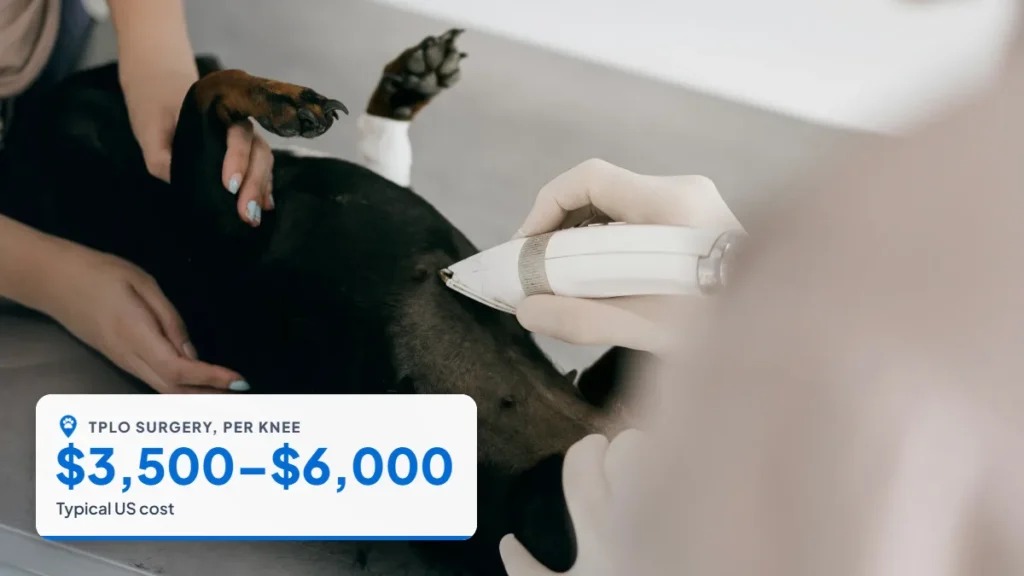
TPLO surgery for dogs typically costs $3,500 to $6,000 per knee in the U.S. as of September 2026. Clinics with all-inclusive pricing start around $3,500, while urban specialty hospitals often charge $6,000 to $10,000 per knee.
| Price level | Cost per knee | What you’re usually paying for |
|---|---|---|
| Low end | $3,500–$4,500 | All-inclusive fixed prices, often outside big coastal metros |
| Typical | $3,500–$6,000 | Experienced or board-certified surgeon, standard implants, one night in the hospital |
| High end | $6,000–$10,000 | Urban specialty hospitals, itemized billing, extra care or complications |
| Both knees in one surgery | About $6,000 and up | One anesthesia and one hospital stay instead of two |
If your vet just diagnosed a torn cranial cruciate ligament (the dog version of a torn ACL), this guide shows what a TPLO bill includes, what pushes the price up or down, whether pet insurance pays, and how to finance the rest.
Price ranges combine published clinic prices, insurer examples and 2025–2026 cost guides, listed at the end.
What TPLO surgery is and when dogs need it
The cranial cruciate ligament (CCL) is one of the main stabilizers of a dog’s knee. When it tears, the shin bone slides forward with every step, which causes pain, limping and, over time, arthritis. The American College of Veterinary Surgeons calls CCL rupture one of the most common reasons for hind-limb lameness in dogs.
Common signs your vet will look for:
- Limping on a back leg, from mild to severe
- Trouble getting up from a sit
- Thigh muscle loss
- Reduced range of motion and pain in the knee
TPLO stands for tibial plateau leveling osteotomy. The surgeon makes a curved cut at the top of the shin bone, rotates it to flatten the slope, and fixes it with a bone plate and screws. With the slope leveled, the knee stays stable without the torn ligament, as VCA Animal Hospitals explains.
The ACVS notes that surgery is the only way to permanently control the knee’s instability, and that 85% to 90% of dogs improve significantly after surgery. TPLO is the procedure ACVS surgeons most often recommend for dogs over 60 pounds, according to a review in Today’s Veterinary Practice. Large breeds such as Labradors, Rottweilers, Newfoundlands and Mastiffs are at higher risk.
TPLO cost breakdown: what’s on the bill
Most of a TPLO bill is the surgery itself and the implants; diagnostics, anesthesia, hospitalization and medication add another $1,000 to $2,300. The table shows typical line items when a clinic bills them separately.
| Line item | Typical cost | Notes |
|---|---|---|
| Orthopedic consultation | $75–$200 | Specialist consults often run about $200 |
| Pre-surgery X-rays | $150–$400 | Used to measure the slope and plan the cut |
| Pre-anesthetic bloodwork | $75–$200 | Checks that your dog can handle anesthesia |
| General anesthesia and monitoring | $300–$600 | Longer surgeries cost more |
| Surgery, plate and screws | $2,000–$4,000 | The largest single cost |
| Post-surgery X-rays | $100–$200 | Confirms the plate and cut are in place |
| Hospital stay (usually one night) | $200–$500 | Pain control and monitoring |
| Pain medication | $50–$150 | Take-home prescriptions |
| Anti-inflammatory medication | $30–$60 | Prescribed for the first weeks at home |
| Cone (e-collar) | $10–$25 | Keeps your dog off the incision |
| Itemized total | About $3,000–$6,300 | Before rehab or complications |
Line-item ranges come from 2026 invoice data compiled by VetReceipt, with the specialist consult fee from Mission Veterinary Emergency & Specialty.
What all-inclusive TPLO prices look like
More clinics now publish one flat TPLO price. These are real published prices we checked in September 2026:
| Clinic (location) | Published TPLO price | What the price includes |
|---|---|---|
| Mission Veterinary Emergency & Specialty (Mission, KS) | $3,500 one knee; $6,000 both knees in one surgery; $200 consult | Board-certified surgeon, bloodwork and X-rays before and after, anesthesiologist, implants, hospitalization and ICU, pain management; same price for any dog size |
| CVETS (Columbia, SC) | $4,000 | Everything from the first exam through surgery and follow-up visits; extra only for added anesthesia screening or non-standard implants |
| Oakdale Veterinary Group (Oakdale, CA) | $4,450 for most dogs; up to $5,950 with a jumbo plate for dogs over 100 lb | Epidural, 72-hour local anesthetic, overnight stay, all recheck visits and X-rays (price page last updated July 2024) |
Before you approve any estimate, ask five questions:
- Does the price include recheck exams and follow-up X-rays?
- Are take-home medications and the cone included?
- Is there an extra charge for a larger plate or a heavier dog?
- What happens to the bill if there is a complication, such as an infection?
- How much is the deposit, and when is the balance due?
What makes TPLO surgery cost more or less
Who operates, where you live and how the clinic bills explain most of the gap between a $3,500 and a $10,000 TPLO. Your dog’s size and whether both knees need surgery matter too.
| Factor | Usually costs less | Usually costs more |
|---|---|---|
| Surgeon | Experienced general-practice surgeon | Board-certified surgeon at a referral hospital |
| Location | Midwest, Southeast, smaller cities | Large coastal metros |
| Billing | One all-inclusive price | Itemized bill where extras add up |
| Dog size | Clinics with one price for every size | Clinics that charge by plate size (up to $5,950 for dogs over 100 lb at one California clinic) |
| Knees | Both knees in one surgery ($6,000 at one Kansas clinic, versus $3,500 per knee) | Two separate surgeries months apart |
| Complications | Smooth recovery | Infection or implant problems that need more treatment |
Surgeon expertise, location, diagnostics and aftercare are the main cost drivers listed by Heron Lakes Animal Hospital, which notes that urban clinics charge more than rural ones.
Complications are the cost you can’t see on the estimate. VCA reports average complication rates of roughly 10% to 30% after TPLO, with infection the most common, and fewer problems in smaller dogs. Keeping 10% to 20% of the estimate aside as a cushion is a sensible habit.
TPLO vs. TTA vs. lateral suture: cost compared
Lateral suture repair is the cheapest option at roughly $1,500 to $3,000, while TPLO and TTA both start around $3,000. Price alone shouldn’t decide it: your dog’s size, activity level and knee anatomy matter more.
| Repair | Typical cost | How it works | What the evidence says |
|---|---|---|---|
| Lateral suture (extracapsular) | $1,500–$3,000, up to $5,000 | A heavy suture outside the joint takes over the ligament’s job | Improvement in 85% to 94% of dogs |
| TTA (tibial tuberosity advancement) | $3,000–$6,500 | A straight cut lets the surgeon move the front of the shin bone forward | In one long-term study, fewer dogs reached full function than after TPLO |
| TPLO | $3,000–$6,000 typical, up to $10,000 | A curved cut levels the top of the shin bone | Most recommended by ACVS surgeons for dogs over 60 lb; higher owner satisfaction than lateral suture at 1 year in a randomized trial |
| No surgery (brace, rest, rehab) | Brace $1,000 or more, plus rehab and medication | Activity restriction, pain control, rehab and bracing | Doesn’t permanently stabilize the knee |
Costs from Heron Lakes Animal Hospital (2025) and Lemonade (2026); outcomes from the ACVS and Today’s Veterinary Practice.
If your surgeon offers more than one option, ask which one they would choose for a dog of your dog’s weight and lifestyle, and why. Our full comparison of TPLO vs. TTA vs. lateral suture covers recovery and success rates in more detail.
Does pet insurance cover TPLO surgery?
Usually yes, if the knee problem started after your waiting periods ended and neither knee showed signs before the policy began. Those two conditions are where most TPLO claims succeed or fail.
Waiting periods for knee problems range from days to a full year
| Insurer | Waiting period that applies to cruciate injuries |
|---|---|
| Lemonade | 30 days for orthopedic conditions |
| Trupanion | 30 days for illnesses, 5 days for injuries |
| Embrace | 180 days for cruciate ligament injury in dogs; can be shortened with an orthopedic exam in some states |
| Nationwide | 12 months for cruciate or meniscal damage on its main plans |
Waiting periods can change by state and plan version, so read the sample policy before you buy. Our guide to pet insurance waiting periods compares more insurers.
The “other knee” problem
The ACVS reports that 40% to 60% of dogs with cruciate disease in one knee develop it in the other, usually within 12 to 18 months. Insurers know this, so many treat both knees as one condition:
- Trupanion treats cruciate problems in the same or the opposite leg during the 18 months before your policy starts as pre-existing.
- MetLife Pet typically won’t cover the second knee if the first one showed symptoms before coverage started.
The practical lesson: insure a dog while both knees are healthy. Once one knee is diagnosed, the other is usually excluded as a pre-existing condition.
What you’d actually get back
Reimbursement depends on your deductible, your reimbursement rate and your annual limit. On a $5,000 TPLO bill:
| Policy | You pay | Insurance pays |
|---|---|---|
| $500 deductible, 80% reimbursement | $1,500 | $3,500 |
| $250 deductible, 90% reimbursement | $750 | $4,250 |
| $500 deductible, 80% reimbursement, $3,000 annual limit | $2,000 | $3,000 |
Real claims land in the same range. Trupanion lists a cruciate tear treated with surgery and medication at $5,439, and MetLife Pet describes a 7-year-old dog whose owner got back more than $5,500 on a bilateral cruciate bill of about $6,150.
Check two extras before you rely on coverage: exam fees and physical therapy. Some policies, including Lemonade’s, only cover them through add-ons. See whether your policy covers the full procedure in does pet insurance cover TPLO?, or compare premiums in how much pet insurance costs per month.
How to pay for TPLO surgery
If you have no insurance, the realistic options are a medical credit card, a vet payment plan or a clinic with lower fixed pricing; charity grants rarely cover more than a few hundred dollars. Compare the true cost of each option before you sign.
| Option | How it works | Watch out for |
|---|---|---|
| CareCredit | Credit card accepted by many vets; no interest if paid in full in 6, 12, 18 or 24 months on purchases of $200 or more | Deferred interest: miss the payoff date and interest at 32.99% APR is charged back to the purchase date |
| Scratchpay | Payment plans over 12, 18 or 24 months for $200 to $10,000; checking eligibility doesn’t affect your credit score | APR from 0% to 36%, depending on your credit; late fees |
| Clinic payment plan | Some hospitals split the bill or take a deposit and the balance later | Terms vary; get them in writing |
| Charity grants | Help with urgent, life-threatening care | RedRover‘s average grant is about $250, and it can’t help if you need $500 or more |
How deferred interest bites: CareCredit itself gives the example of a $2,000 charge on a 12-month plan. If $100 is still unpaid when the promotion ends, about $300 of interest is added. To avoid it, divide the bill by the number of months minus one and pay that amount every month.
Five ways to lower the bill
- Get two or three quotes. Published TPLO prices ranged from $3,500 to $5,950 at the three clinics above, and specialty hospitals can charge up to $10,000.
- Look for all-inclusive pricing, so rechecks, X-rays and medication don’t show up as surprise charges.
- Ask about doing both knees at once if both are affected. At one Kansas clinic, one surgery for both knees costs $6,000 instead of $7,000 for two.
- Ask whether a different repair fits your dog. For some dogs, a lateral suture repair costs roughly half as much.
- Don’t skip the recheck visits, even to save money: they are how your vet catches problems such as infection early.
More options are in our guides to vet financing, CareCredit for vet bills and financial help for vet bills.
Recovery and follow-up costs to budget for
Plan for four to six months of recovery and a few hundred dollars in follow-up costs, or several thousand if the other knee also needs surgery. All-inclusive quotes cover part of this; itemized ones usually don’t.
A typical TPLO recovery, according to VCA Animal Hospitals:
- First 24 hours: about half of dogs start putting weight on the leg.
- Two weeks: most dogs bear moderate to full weight on it.
- Ten weeks: most dogs no longer limp.
- Four months: most dogs walk and play normally, with only the most stressful activities restricted.
- Six months: full activity usually resumes.
| Follow-up cost | Typical price | In the three all-inclusive quotes above? |
|---|---|---|
| Recheck exams and follow-up X-rays | $100–$200 per set of X-rays | Mostly |
| Take-home pain and anti-inflammatory medication | $80–$210 | Partly |
| Physical rehab evaluation | About $180 | No |
| Rehab sessions | About $58–$98 per session | No |
| Surgery on the other knee, if needed | Another $3,500–$10,000 | No |
Rehab prices come from CareCredit’s 2026 physical therapy cost guide; X-ray and medication ranges from the invoice data above. Your surgeon will set the number of rehab sessions, and some pet insurance policies only pay for rehab through an add-on.
The biggest follow-up risk is the second knee. With 40% to 60% of affected dogs developing the same problem on the other side within 12 to 18 months, it’s worth setting money aside or checking your coverage now.
The bottom line
Budget $3,500 to $6,000 per knee for TPLO surgery, plus a cushion for rehab, medication and possible complications. Compare two or three written, all-inclusive quotes, check your insurance for waiting periods and the “other knee” exclusion, and use 0% financing only if you can clear it before the promotion ends.
If your dog isn’t insured yet, the best time is before the first limp: once one knee is diagnosed, both are usually excluded. Compare plans in our guide to the best pet insurance for dogs, or see whether coverage pays off for you in is pet insurance worth it?
TPLO surgery cost: frequently asked questions
Is TPLO surgery worth the cost?
For many medium and large dogs, it’s the repair surgeons recommend most. The ACVS says surgery is the only way to permanently control the knee’s instability and that 85% to 90% of dogs improve significantly. In a randomized trial, TPLO dogs had better limb use and higher owner satisfaction at one year than dogs treated with lateral suture. Your vet will weigh your dog’s age, weight and health.
Why is TPLO surgery so expensive?
It’s bone surgery. The price covers a surgeon trained in the technique, a metal plate and screws, general anesthesia with monitoring, X-rays before and after, pain control and usually a night in the hospital.
Is it cheaper to do both knees at the same time?
Often, yes, because your dog needs one anesthesia and one hospital stay. One Kansas clinic charges $6,000 for both knees in a single surgery versus $3,500 per knee. Not every dog is a candidate for bilateral surgery, so your surgeon has the final say.
How long is recovery after TPLO?
Most dogs stop limping by about 10 weeks, walk and play normally around four months and return to full activity by six months, according to VCA. Expect several weeks of strict activity restriction at the start.
Can I get pet insurance after my dog tears a cruciate ligament?
You can buy a policy, but the injured knee will be excluded as pre-existing, and many insurers exclude the other knee too. Trupanion, for example, excludes cruciate problems in either leg that appeared in the 18 months before coverage started.
How we researched TPLO costs
We compiled published TPLO prices from three U.S. clinics (checked September 2026), 2025–2026 cost guides from insurers and veterinary hospitals, insurer policy pages and veterinary references. Prices change often and vary by clinic, so your surgeon’s written estimate is the only exact figure. This article is general information, not veterinary advice.
Sources
- American College of Veterinary Surgeons: Cranial cruciate ligament disease
- VCA Animal Hospitals: Tibial plateau leveling osteotomy (TPLO)
- Today’s Veterinary Practice: Canine cranial cruciate disease, an evidence-based look at current treatment modalities
- Mission Veterinary Emergency & Specialty: TPLO pricing
- CVETS: TPLO surgery fixed pricing
- Oakdale Veterinary Group: TPLO cost FAQ
- Heron Lakes Animal Hospital: The cost of ACL surgery for dogs
- Lemonade: TPLO surgery for dogs cost and dog ACL surgery cost
- VetReceipt: Dog TPLO surgery cost
- Lemonade: Pet insurance waiting periods
- Trupanion: When does coverage start, cruciate surgeries and claims examples
- Embrace: Waiting period for orthopedic conditions
- Nationwide: Plan restrictions
- MetLife Pet Insurance: Bilateral conditions
- NerdWallet: CareCredit card terms
- CareCredit: Deferred interest promotional financing and dog physical therapy costs
- Scratchpay: How it works
- RedRover: Urgent Care grants
Corrections: On October 14, 2026, we recalculated the insurance payout examples so the reimbursement percentage is applied before the deductible, the way Healthy Paws and Lemonade calculate claims; some “you pay” amounts changed. On October 22, 2026, we changed the budget in “The bottom line” from $4,000–$6,000 to $3,500–$6,000 per knee, to match the typical range at the top of this guide.