
Cost guide, not veterinary advice. Prices are typical US ranges from public sources and vary by clinic and region. Last reviewed October 14, 2026. How we research
In this guide
- TPLO vs. TTA vs. lateral suture at a glance
- How each surgery works
- How much each surgery costs
- What the research says about results
- Which repair fits your dog
- Recovery time and aftercare costs by repair
- Insurance and payment: how the choice changes your bill
- How to decide: seven questions for your surgeon
- The bottom line
- Dog ACL surgery options: frequently asked questions
- How we researched this comparison
TPLO vs. TTA vs. lateral suture at a glance
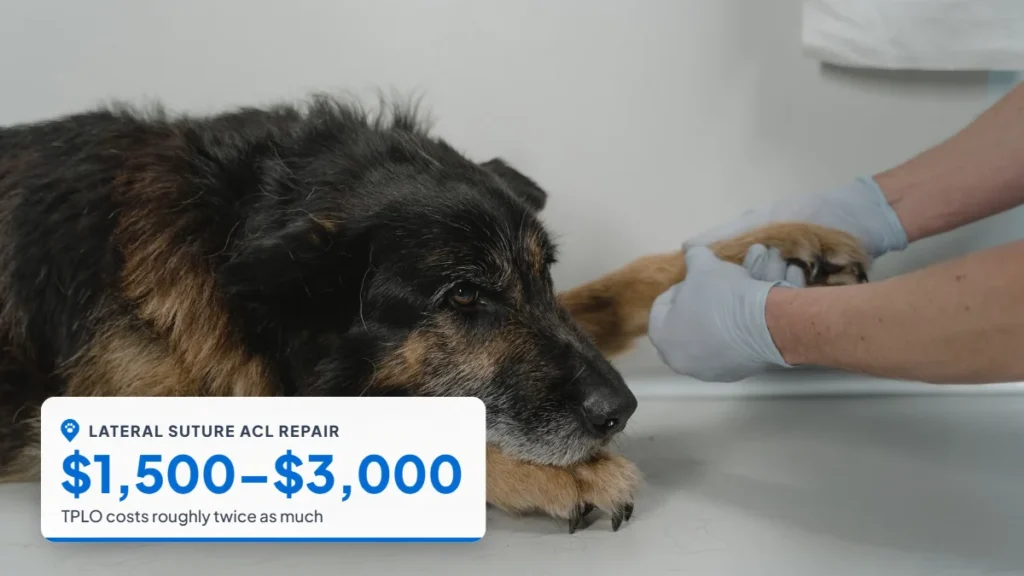
Lateral suture repair is the cheapest option at about $1,500 to $3,000 and works best in smaller dogs. TPLO costs roughly twice as much but has the strongest evidence for large, active dogs. TTA costs about the same as TPLO and has a weaker track record in comparison studies.
| Lateral suture (incl. TightRope) | TTA | TPLO | |
|---|---|---|---|
| Typical total cost per knee | $1,500–$3,000 | $3,000–$6,500 | $3,500–$6,000; up to $10,000 at urban specialty hospitals |
| Usually recommended for | Small to medium dogs (often under 35 lb) and cats | Medium to large dogs with a normal knee slope | Medium to large, active dogs; also steep knee slopes |
| Strict activity restriction | About 6–8 weeks | Several weeks; full activity around 6 months | Several weeks; full activity around 6 months |
| Dogs that improve | At least 85%–90% of smaller dogs | 85%–95% overall | 85%–95% overall |
| Main drawback | The suture can loosen or fail in heavy, active dogs | More late complications and meniscal tears than TPLO in several studies | Highest price at the top end; bone cut and metal plate |
If your vet has already recommended one of these surgeries, this guide explains what each one costs, how the results compare in published studies, and which questions to ask before you choose. For the full line-by-line bill of the most common option, see our TPLO surgery cost breakdown.
How each surgery works
All three surgeries stop the knee from sliding after the cranial cruciate ligament tears, but they do it in two different ways: lateral suture replaces the ligament’s job with a strong suture, while TPLO and TTA reshape the shin bone so the knee no longer needs the ligament. That difference drives most of the gap in cost, recovery and suitability.
Lateral suture (extracapsular repair)
The surgeon loops a heavy, artificial-ligament suture around the outside of the joint, from behind the knee to the front of the shin bone, to mimic the torn ligament. No bone is cut, although the surgeon drills small channels to pass the suture. VCA Animal Hospitals describes it as a good fit for most small to medium dogs and for cats.
TightRope
TightRope is a newer variation of the suture repair. Instead of looping around the joint, a special suture runs through small tunnels drilled in the thigh bone and the shin bone and is held with anchors. It is still a suture technique, so it is usually priced closer to lateral suture than to TPLO.
TTA (tibial tuberosity advancement)
The surgeon cuts the front part of the shin bone and moves it forward, holding it in place with a spacer and other implants. This changes the angle of the tendon below the kneecap so the shin bone stops sliding forward. According to a dvm360 surgical review, TTA can’t be used when the top of the shin bone is excessively sloped.
TPLO (tibial plateau leveling osteotomy)
The surgeon makes a curved cut at the top of the shin bone, rotates it to flatten the slope and fixes it with a bone plate and screws. With a level surface, the shin bone no longer slides forward under the thigh bone when the dog puts weight on the leg. TPLO can also be used in dogs with a steep slope (over 30 degrees) or crooked limbs, according to Today’s Veterinary Practice.
How much each surgery costs
At most U.S. clinics, expect about $1,500 to $3,000 for lateral suture, $3,000 to $6,500 for TTA and $3,500 to $6,000 for TPLO, including diagnostics, anesthesia and a night in the hospital. Surgeon fees quoted on their own look much lower, so always compare total estimates.
| Repair | Procedure fee only | Typical total bill | Notes |
|---|---|---|---|
| Lateral suture | $750–$1,000 | $1,500–$3,000, up to $5,000 | Cheapest; no bone cut |
| TightRope | $1,000–$2,000 | Few published totals | Priced between lateral suture and the bone-cutting repairs |
| TTA | $3,000–$6,000 | $3,000–$6,500 | Similar to TPLO |
| TPLO | $3,000–$8,000 | $3,500–$6,000; up to $10,000 at urban specialty hospitals | National average of $3,525, from $2,793 to $6,417 depending on location |
Procedure-only fees from GoodRx (2023), which excludes anesthesia, X-rays, medication and follow-up visits. Total bills from Heron Lakes Animal Hospital (2025), Lemonade (2026) and CareCredit (April 2026).
Why bone-cutting surgeries cost about twice as much
- Implants: TPLO needs a bone plate and screws, and TTA a spacer and fixation implants. A suture repair needs only the suture and, for TightRope, small anchors.
- Surgeon: advanced procedures carry higher fees, and board-certified surgeons charge more than general practitioners.
- Imaging: TPLO and TTA are planned on X-rays taken before surgery and checked with X-rays afterwards.
- Location: urban clinics charge more than rural ones for the same repair.
The cheapest repair isn’t always the cheapest outcome. In heavy, active dogs a suture repair is more likely to run into problems, and a second surgery on the same knee would erase the savings. Your surgeon can tell you how likely that is for your dog.
What the research says about results
Most dogs improve after any of the three repairs, but TPLO has the strongest evidence for getting larger dogs back to full function with less arthritis progression, while TTA shows more late complications in several studies. Lateral suture does well in small dogs.
| Outcome | Lateral suture | TTA | TPLO |
|---|---|---|---|
| Dogs that improve | 85%–94% | 85%–95% | 85%–95% |
| Return to normal function at a trot (Krotscheck, 2016) | Not reached | Not reached | Reached, the only group that did |
| Limb use, measured on a force plate (Gordon-Evans, 2013) | 5%–11% less force on the leg than TPLO | — | More force than after lateral suture |
| Arthritis progression (Lazar, 2005; Beer, 2018) | More than TPLO over 3+ years | More than TPLO | Less than either, in these studies |
| Major complications (Beer, 2018) | — | 13.2% | 5.2% |
| Meniscal tears after surgery (Hans, 2017; Christopher, 2013) | — | Highest | Lower than TTA |
Improvement rates from Today’s Veterinary Practice; study results as summarized by BoneVet Orthopaedics, an Australian referral practice. A dash means the comparison wasn’t reported for that repair.
Two more findings are worth knowing:
- Owners notice the difference. In a randomized trial, dogs that had TPLO put more weight on the leg and their owners were more satisfied at one year than after lateral suture.
- Surgeons mostly choose TPLO for bigger dogs. It’s the repair ACVS surgeons most often recommend for dogs over 60 pounds, and in one survey 71% of them recommended it for medium-sized dogs with a complete tear.
Complication rates depend on the study
VCA reports overall complication rates of 5% to 8% for suture repairs in smaller dogs, about 26% for TTA and roughly 10% to 30% for TPLO. Definitions and patients vary, so compare with care.
A Swedish study of 287 knees found raw rates of severe complications of 22% after lateral suture, 25% after TTA and 31% after TPLO. The dogs differed in weight and age, though: after adjusting for both, TPLO carried a significantly lower risk than lateral suture, and risk rose with body weight (Engdahl et al., 2021).
Which repair fits your dog
Weight, activity level and the slope of the shin bone decide most cases. Small dogs often do well with a suture repair, while heavier or athletic dogs, and dogs with a steep slope, are usually steered toward TPLO.
| Your dog | Usually discussed | Why |
|---|---|---|
| Under about 35 lb, moderately active | Lateral suture or TightRope; TPLO is also an option | Suture repairs succeed in more than 90% of smaller patients, and some hospitals don’t offer them above 35 lb |
| Over 60 lb or very active | TPLO, sometimes TTA | TPLO is the repair ACVS surgeons most often recommend at this size; suture repairs may do worse in larger dogs |
| Steep shin-bone slope (over about 30 degrees) or a crooked leg | TPLO | TTA can’t be used with an excessive slope; TPLO can |
| Hard to keep calm or confined | Talk it through before choosing | Bone-cutting repairs need strict confinement while the bone heals; suture repairs also need about six weeks of restriction |
| A cat | Suture repair | Suture techniques work well in cats |
| Older or with other health problems | Ask about anesthesia risk and non-surgical care | Rest, pain control, rehab and bracing are the alternatives; they work best in dogs under about 33 lb (15 kg) |
Sources: MedVet (35 lb guideline and success rate), VCA (small dogs and cats), Today’s Veterinary Practice (60 lb and steep slopes), dvm360 (TTA limits, confinement and non-surgical care) and the ACVS (non-surgical options).
Weight matters for a simple reason: the heavier the dog, the more load the repair has to hold. In the Swedish study above, the risk of a severe complication rose with every extra kilogram of body weight, whichever technique was used.
Recovery time and aftercare costs by repair
Suture repairs need about six to eight weeks of strict restriction, while TPLO and TTA dogs usually stop limping by about 10 weeks and return to full activity around six months. Aftercare costs look similar for all three: rechecks, medication and optional rehab.
| Stage | Lateral suture or TightRope | TPLO or TTA |
|---|---|---|
| Hospital stay | Usually one night | Usually one night |
| Strict restriction | About 6 weeks: short leash walks only, no stairs, slippery floors, running or jumping | Several weeks of strict confinement while the bone heals |
| Walking without a limp | Varies with the dog; checked at the 6-week visit | Most dogs by about 10 weeks |
| Full activity | Gradual return after the restriction period | Around 6 months |
| Follow-up visits | Stitch removal and a 6-week re-check | Re-checks with X-rays to confirm the bone has healed |
Suture-repair timeline from MedVet; TPLO and TTA milestones from VCA’s TPLO and TTA guides.
Aftercare costs to add to any estimate
| Item | Typical price |
|---|---|
| Re-check X-rays | $100–$200 per set |
| Take-home pain and anti-inflammatory medication | $80–$210 |
| Rehab evaluation | About $180 |
| Rehab sessions | About $58–$98 each |
For example, a rehab plan with eight sessions adds roughly $640 to $970 including the evaluation. Rehab prices come from CareCredit’s 2026 physical therapy guide; the other ranges are explained in our TPLO surgery cost guide.
Whatever repair you choose, keep the other knee in your budget. The ACVS reports that 40% to 60% of dogs with cruciate disease in one knee develop it in the other, usually within 12 to 18 months.
Insurance and payment: how the choice changes your bill
None of the insurer cruciate rules we reviewed depend on the technique; they depend on timing. Waiting periods, pre-existing conditions and the “other knee” exclusion decide whether you’re covered, whichever repair your surgeon recommends.
Waiting periods for cruciate problems range from 5 to 30 days at Trupanion and Lemonade to 180 days at Embrace and 12 months at Nationwide. Our TPLO cost guide explains these rules and the “other knee” exclusion in detail.
Insurance shrinks the price gap between repairs
With a $500 deductible and 80% reimbursement, the difference between a suture repair and TPLO drops from $2,500 to $500:
| Repair | Total bill | You pay with insurance | You pay without insurance |
|---|---|---|---|
| Lateral suture | $2,500 | $1,000 | $2,500 |
| TPLO | $5,000 | $1,500 | $5,000 |
If your dog is insured and sits near the size limit for a suture repair, that math can make the repair with the stronger evidence easier to afford. Check your annual limit first: a low cap can leave you paying the rest.
Paying without insurance
The main options are the same for every repair: a medical credit card such as CareCredit (no interest if paid in full within 6 to 24 months on purchases of $200 or more, or 32.99% APR backdated if you miss the deadline), a vet payment plan such as Scratchpay (12 to 24 months, 0% to 36% APR) or a clinic payment plan. Compare them in our guides to vet financing and CareCredit for vet bills, and see does pet insurance cover TPLO? for claim tips.
How to decide: seven questions for your surgeon
The right repair is the one that fits your dog’s size, activity and knee shape at a price you can finish paying. These questions get you the facts to judge both:
- Which repair do you recommend for my dog, and why? Ask for your dog’s shin-bone slope as measured on the X-rays.
- How many of these surgeries do you perform a year, and what is your complication rate?
- Will you check the meniscus during surgery, and is treating a tear included in the price?
- What does the estimate include? X-rays before and after, anesthesia, the overnight stay, medication, re-checks and rehab.
- What happens, and what does it cost, if the repair fails or gets infected?
- If money is tight, is a suture repair reasonable for my dog, and what results should I expect with it?
- What’s the plan if the other knee tears later?
A second opinion is worth it when the quote is far above the ranges in this guide, or when the recommended repair doesn’t match your dog’s size and lifestyle. Bring the X-rays, so you don’t pay for them twice.
The bottom line
Choose by dog first, then by price. For small dogs, a suture repair often gives excellent results for about half the cost of TPLO. For larger or active dogs, TPLO’s extra cost buys the strongest evidence, and TTA rarely saves money over it.
Get a full written estimate for each option your surgeon offers. If your dog is insured, compare what you’d actually pay: the gap is often much smaller than the sticker prices suggest. If your dog isn’t insured yet, compare plans in our guide to the best pet insurance for dogs before any knee problem shows up.
Dog ACL surgery options: frequently asked questions
Which is better, TPLO or lateral suture?
It depends on the dog. For larger, active dogs, TPLO has better evidence for return to full function, less arthritis progression and owner satisfaction. For small dogs, lateral suture succeeds in more than 90% of cases at roughly half the price.
Is TTA cheaper than TPLO?
Not usually. TTA typically costs $3,000 to $6,500 and TPLO $3,500 to $6,000. TTA can’t be used when the shin bone is steeply sloped, and several studies found more late complications and meniscal tears after TTA than after TPLO.
Can a large dog have lateral suture surgery?
Some surgeons do it, but some hospitals, such as MedVet, don’t offer suture repairs above about 35 pounds. Larger dogs may have worse results with a suture repair, and the risk of complications rises with body weight.
What is TightRope surgery and how much does it cost?
TightRope is a suture repair that runs a special suture through small tunnels in the thigh and shin bones, held with anchors. GoodRx lists $1,000 to $2,000 for the procedure alone; ask for a full estimate that includes anesthesia, X-rays and aftercare.
How long is recovery for each type of surgery?
Suture repairs need about six to eight weeks of strict restriction. After TPLO or TTA, most dogs stop limping by about 10 weeks and return to full activity around six months.
Can a dog’s torn ACL heal without surgery?
Not fully: the ACVS says surgery is the only way to permanently control the knee’s instability. Rest, pain control, rehab and a brace (often $1,000 or more) can manage symptoms, and they work best in dogs under about 33 pounds.
How we researched this comparison
We combined 2023–2026 cost data from a veterinary hospital, a consumer health site, an insurer and a medical credit company with published veterinary guidance and peer-reviewed studies. Where studies disagree or define complications differently, we say so. Prices vary widely by clinic and region, so your surgeon’s written estimate is the only exact figure. This article is general information, not veterinary advice.
Sources
- American College of Veterinary Surgeons: Cranial cruciate ligament disease
- VCA Animal Hospitals: Extracapsular repair and TightRope procedure, TTA and TPLO
- MedVet: Extracapsular lateral suture stabilization
- Today’s Veterinary Practice: Canine cranial cruciate disease, an evidence-based look at current treatment modalities
- dvm360: Choosing cruciate rupture repair methods
- BoneVet Orthopaedics: TPLO vs TTA vs ECR, a review of scientific studies (summarizes Krotscheck 2016, Gordon-Evans 2013, Lazar 2005, Beer 2018, Hans 2017, Christopher 2013 and Duerr 2014)
- Engdahl et al., Preventive Veterinary Medicine, 2021: Risk factors for severe postoperative complications in dogs with cranial cruciate ligament disease
- GoodRx: Dog ACL surgery cost
- CareCredit: Dog ACL surgery cost, dog physical therapy costs and deferred interest promotional financing
- NerdWallet: CareCredit card terms
- Scratchpay: How it works
- Heron Lakes Animal Hospital: The cost of ACL surgery for dogs
- Lemonade: Dog ACL surgery cost and waiting periods
- Trupanion: When does coverage start
- Embrace: Waiting period for orthopedic conditions
- Nationwide: Plan restrictions
Correction (October 14, 2026): We recalculated the insurance payout examples so the reimbursement percentage is applied before the deductible, the way Healthy Paws and Lemonade calculate claims. Some “you pay” amounts changed.