
Cost guide, not veterinary advice. Prices are typical US ranges from public sources and vary by clinic and region. Last reviewed October 29, 2026. How we research
In this guide
- What pyometra is, and why surgery can’t wait
- Pyometra surgery cost by type of clinic
- What’s on a pyometra surgery bill
- What makes pyometra surgery cost more
- Is outpatient surgery at a low-cost clinic safe?
- Pyometra surgery vs. a planned spay
- Can pyometra be treated without surgery?
- Does pet insurance cover pyometra surgery?
- How to pay for pyometra surgery
- The bottom line
- Frequently asked questions
- How we researched this
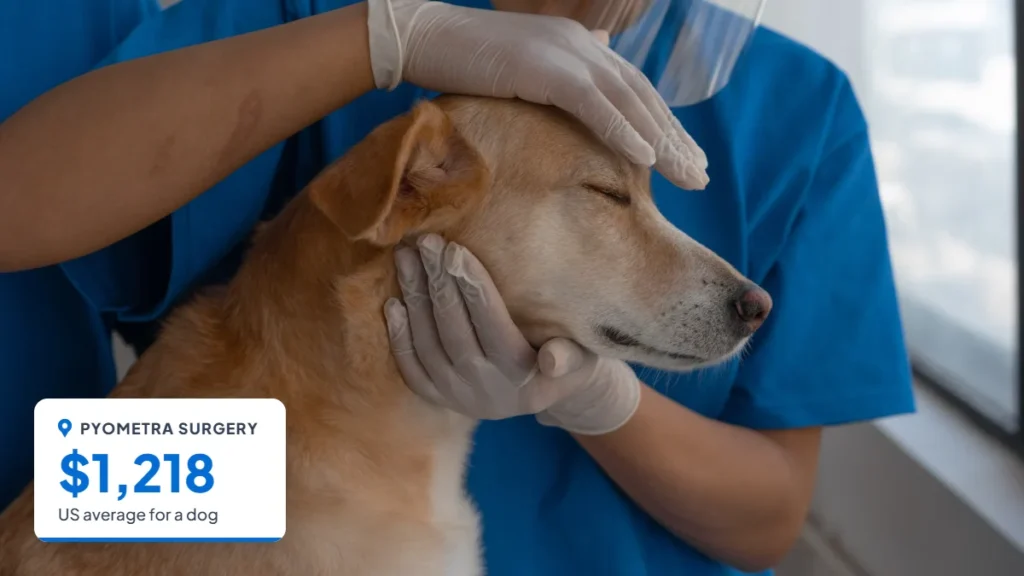
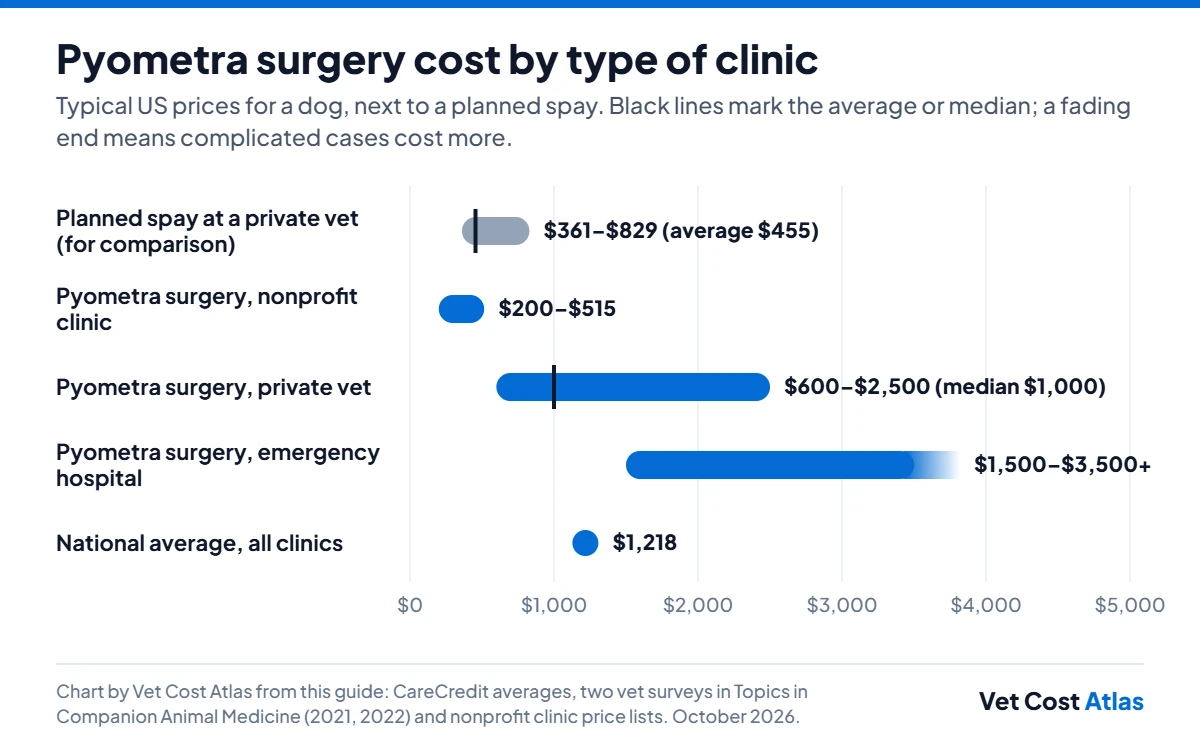
Pyometra surgery costs about $1,218 for a dog and $2,116 for a cat on average in the US, according to CareCredit’s figures from a 2025 national cost study, but the type of clinic changes the bill more than anything else. Nonprofit spay/neuter clinics charge roughly $200 to $515 for a medium-sized dog, private vets $600 to $2,500 and emergency hospitals $1,500 to $3,500, with complicated cases passing $5,000. Pet insurance usually covers it as an illness if your pet was insured before any signs appeared.
| Where the surgery is done | Dog | Cat |
|---|---|---|
| Nonprofit or high-volume spay/neuter clinic | About $200–$515 | About $125–$315 |
| Private vet practice | $600–$2,500 (median $1,000) | Median $750 |
| Emergency hospital | $1,500–$3,500; $5,000+ with complications | Not reported separately |
| National average, all clinics | $1,218 | $2,116 |
If your vet has just found pyometra, surgery is usually needed the same day, so this guide starts with what each type of clinic charges. Below: what’s on the bill, why prices vary, whether a low-cost clinic is a safe option, what insurance pays and how to cover the rest.
What pyometra is, and why surgery can’t wait
Pyometra is a bacterial infection that fills the uterus with pus. It affects females that haven’t been spayed, usually in the two to eight weeks after a heat cycle, and middle-aged and older pets are most at risk, according to Lemonade. Pasado’s Safe Haven, a Washington animal welfare group, says up to 1 in 4 unspayed female dogs will develop it.
There are two forms. In open pyometra, the cervix stays open and you may see a discharge. In closed pyometra, the pus has no way out, the signs are easier to miss and the uterus can rupture, so it tends to be more dangerous. Signs to watch for include lethargy, drinking and urinating more, vomiting, a swollen belly and, in open cases, a vaginal discharge.
The standard treatment is an emergency spay (ovariohysterectomy): removing the infected uterus and the ovaries. The Merck Veterinary Manual recommends surgery in all cases except when the owner strongly wants to breed the female. Published studies put the death rate after surgery at 3% to 20%, depending on how sick the pet is, which is why vets don’t like to wait. If you see these signs in an unspayed female, call your vet or an emergency hospital the same day.
Pyometra surgery cost by type of clinic
The same operation can cost five times as much depending on where it’s done. Two surveys of US vets in Topics in Companion Animal Medicine give the clearest picture. High-volume spay/neuter clinics reported a median of $200 for a medium-sized dog and $125 for a cat (2021). Private practices reported a median of $1,000 for a dog and $750 for a cat (2022). Emergency hospitals were estimated at $1,500 to $3,500 for a dog.
| Clinic | Dog | Cat | What’s included |
|---|---|---|---|
| People for Animals, Hillside, NJ (nonprofit) | $515 (medium-sized dog) | $315 | Surgery and anesthesia, fluids, pain relief, anti-nausea drugs and antibiotics; rechecks $20 plus treatment |
| Tree House Humane Society, Chicago (nonprofit) | $175 on top of the $325 dog spay: $500 ($45 more over 50 lb) | $125 on top of the $190 cat spay: $315 | IV catheter, bloodwork, fluids and extra surgical medication |
| Texas Humane Heroes (nonprofit) | $500, spay included | Not listed | Listed with its specialty surgeries |
| Private practices, survey median (2022) | $1,000 | $750 | Varies by clinic; often includes a hospital stay |
| Emergency hospitals, survey estimate (2021) | $1,500–$3,500 | Not reported | Usually includes tests and hospital care |
Why such a gap? Community clinics usually operate as outpatients: the pet goes home the same evening with pain relief and antibiotics and comes back if needed. Private and emergency hospitals usually keep the pet for one or more nights on IV fluids and monitoring, and they run more tests first. In the New York area, clients of one nonprofit clinic reported being quoted $6,000 to $10,000 at emergency hospitals and $2,000 or more at private practices, figures that likely include several days in the hospital. Tree House also charges less to clients who receive government assistance.
What’s on a pyometra surgery bill
A pyometra bill has more lines than a routine spay because the pet is already sick when surgery starts. Expect some or all of these:
- Exam: an emergency exam alone averages about $135 for a dog.
- Blood work and a urine test: to check for infection and kidney damage before anesthesia. See what blood work costs.
- Imaging: X-rays or an ultrasound to see the enlarged uterus and rule out pregnancy. See dog X-ray costs.
- IV fluids and antibiotics: to stabilize the pet before and after surgery.
- Surgery and anesthesia: the ovariohysterectomy itself, often slower than a routine spay because the uterus is swollen and fragile.
- Hospital stay: usually one to several days at a private or emergency hospital, and none at outpatient clinics.
- Take-home medication: antibiotics and pain relief.
CareCredit’s emergency averages show how quickly the extras add up: about $737 for the exam, two blood panels and X-rays, and about $1,486 once an IV catheter, fluids and one night in the hospital are added, before the surgery itself. Our guide to emergency vet costs breaks those figures down.
What makes pyometra surgery cost more
- The type of clinic. It’s the biggest factor, as the tables above show.
- How sick your pet is. Dehydration, sepsis or kidney damage mean more fluids, more tests and a longer stay. Lemonade notes that complications such as kidney damage or sepsis can push the bill higher.
- Closed pyometra. It can get worse faster, and a rupture makes surgery harder and riskier.
- Size. Bigger dogs need more anesthesia, drugs and surgical time; Tree House, for example, adds $45 for dogs over 50 pounds.
- Dog or cat. CareCredit’s average is higher for cats ($2,116) than for dogs ($1,218), while the vet surveys found lower typical prices for cats. Ask for an itemized estimate either way.
Is outpatient surgery at a low-cost clinic safe?
For most pets, the evidence is encouraging. People for Animals, a nonprofit community clinic in Hillside, New Jersey, operated on 447 dogs and cats with pyometra between October 2022 and January 2024 and sent them home the same day. Of the 331 it could follow up, 95.5% were alive 14 days later: 95.3% of dogs and 95.9% of cats. The authors, writing in dvm360, say this is in line with survival reported after traditional surgery.
Access is better than many owners expect. In a 2021 Maddie’s Fund webinar on that research, 83% of high-quality, high-volume spay/neuter clinics surveyed said they would accept emergency pyometra referrals, usually the same day (50%) or the next day (42%).
The catch: very sick pets, such as those in septic shock, may need hospital care first, and not every clinic can take them. Ask your vet whether your pet is stable enough to be referred. Cost decides more outcomes than it should: in the 2022 survey, private vets estimated that when owners declined surgery at their clinic, 48% went on to an emergency hospital, 33% of the pets were euthanized because of a poor outlook and 32% for financial reasons.
Pyometra surgery vs. a planned spay
Pyometra surgery and a routine spay are the same operation, but on a sick pet: the uterus is swollen with pus, anesthesia carries more risk, and the pet often needs fluids, antibiotics and monitoring. That’s why the price gap is so wide. A planned spay costs about $455 at a private vet on average and often $215 to $325 at a nonprofit clinic (see what it costs to spay a dog and cat spay costs), while emergency pyometra surgery averages $1,218 for a dog and can pass $5,000 at an emergency hospital.
Spaying prevents pyometra entirely, because there’s no uterus left to become infected. If your dog or cat isn’t spayed and you don’t plan to breed her, it’s worth asking your vet about spaying while she’s healthy.
Can pyometra be treated without surgery?
Sometimes, but rarely as a way to save money. Medical treatment uses prostaglandins to make the uterus contract and empty, along with antibiotics. The Merck Veterinary Manual reserves it for females whose owners strongly want to breed them, calls for progesterone tests before and during treatment, and advises emergency surgery if the pet hasn’t clearly improved within 48 hours. Lemonade adds that it’s less reliable, carries a higher risk of the infection coming back and isn’t suitable for closed pyometra or very sick pets. Because it needs close monitoring and can fail, it doesn’t always end up cheaper than surgery.
Does pet insurance cover pyometra surgery?
Usually, yes. Pyometra is an illness, so accident-and-illness policies generally cover the tests, surgery and hospital care if it isn’t a pre-existing condition. Lemonade, for example, says its policy can cover pyometra as long as symptoms first appear after its 14-day illness waiting period, and warns that declining a spay your vet specifically and repeatedly recommended can affect a claim. The planned spay itself isn’t covered by the main policy; see whether pet insurance covers spaying.
| Bill | $250 deductible, 80% | $500 deductible, 80% | $250 deductible, 90% |
|---|---|---|---|
| $1,218 (national average, dog) | Insurer pays $724.40; you pay $493.60 | Insurer pays $474.40; you pay $743.60 | Insurer pays $846.20; you pay $371.80 |
| $3,500 (emergency hospital) | Insurer pays $2,550; you pay $950 | Insurer pays $2,300; you pay $1,200 | Insurer pays $2,900; you pay $600 |
How to pay for pyometra surgery
- Ask for a referral. If the estimate is out of reach, ask your vet the same day whether a nonprofit or spay/neuter clinic nearby takes pyometra cases. Many list it with their surgeries.
- Ask for an itemized estimate. It shows what’s essential before surgery and what can wait.
- Finance the bill. Compare vet financing options, and read how CareCredit deferred interest works before you sign.
- Apply for help. Several charities and grants for vet bills cover emergencies; apply while you arrange the surgery, not after.
- Ask about a payment plan. Some clinics split the bill into a few payments, usually with a deposit.
Don’t let the estimate delay the decision by days: closed pyometra can deteriorate quickly. If the first quote is too high, ask for a referral the same day.
The bottom line
Pyometra surgery averages about $1,218 for a dog and $2,116 for a cat, but where you go decides most of the bill: about $200 to $515 at a nonprofit clinic, $600 to $2,500 at a private vet and $1,500 to $3,500 or more at an emergency hospital. Outpatient surgery at community clinics has a good track record, so ask about a referral if cost is a barrier. If your pet was insured before any signs appeared, the policy should pay most of it. And if your female pet isn’t spayed, a planned spay costs far less than the emergency version.
Frequently asked questions
How much does pyometra surgery cost for a dog?
About $1,218 on average, according to CareCredit. Nonprofit clinics charge roughly $200 to $515 for a medium-sized dog, private vets $600 to $2,500 and emergency hospitals $1,500 to $3,500, with complicated cases passing $5,000.
How much does pyometra surgery cost for a cat?
CareCredit’s national average is $2,116. Surveys of vets found lower typical prices: a median of $750 at private practices and $125 at high-volume spay/neuter clinics, and one New Jersey nonprofit charges $315.
Is pyometra surgery the same as a spay?
It’s the same operation, removing the uterus and ovaries, but on a sick pet with an infected, enlarged uterus. It usually needs more tests, IV fluids, antibiotics and monitoring, which is why it costs more than a routine spay.
Does pet insurance cover pyometra?
Generally yes, as an illness, if your pet was insured and past the illness waiting period before any signs appeared. The routine spay itself isn’t covered by standard accident-and-illness policies.
What is the survival rate after pyometra surgery?
Most pets recover. Studies report death rates of 3% to 20% after surgery, depending on how sick the pet is, and a New Jersey nonprofit clinic found that 95.5% of 331 dogs and cats were alive 14 days after outpatient surgery.
How we researched this
National averages come from CareCredit, which draws on the 2025 Synchrony Average Procedural Cost Study. Prices by type of clinic come from two surveys of US veterinarians published in Topics in Companion Animal Medicine (McCallin and colleagues, 2021 and 2022) and from an October 2026 dvm360 report by David Croman, VMD, and Philip A. Bushby, DVM, DACVS, on outpatient pyometra surgery at a New Jersey nonprofit clinic. Clinic prices are those published by Tree House Humane Society and Texas Humane Heroes, checked in October 2026. Treatment information comes from the Merck Veterinary Manual and Lemonade; spay and emergency figures come from our own guides. Insurance figures are our own calculations. Prices vary by clinic and region, so ask your vet for an itemized estimate.
Sources
- CareCredit: How much does an emergency vet visit cost?
- dvm360 (Croman and Bushby, October 2026): Outpatient surgery for animals with pyometra provides good outcome for dogs and cats
- McCallin, Hough and Kreisler (2021): Pyometra management practices in the high quality, high volume spay-neuter environment
- McCallin, Turner and Kreisler (2022): Pyometra management in the private practice setting
- Maddie’s Fund: Increasing access to emergency care for pyometra by leveraging HQHVSN clinics
- Tree House Humane Society: Veterinary Wellness Center prices (January 2025)
- Texas Humane Heroes: Specialty surgeries
- Merck Veterinary Manual: Cystic endometrial hyperplasia–pyometra complex in small animals
- Lemonade: Signs of pyometra in dogs and how it is treated
- Pasado’s Safe Haven: Information about pyometra