
Cost guide, not veterinary advice. Prices are typical US ranges from public sources and vary by clinic and region. Last reviewed November 5, 2026. How we research
In this guide
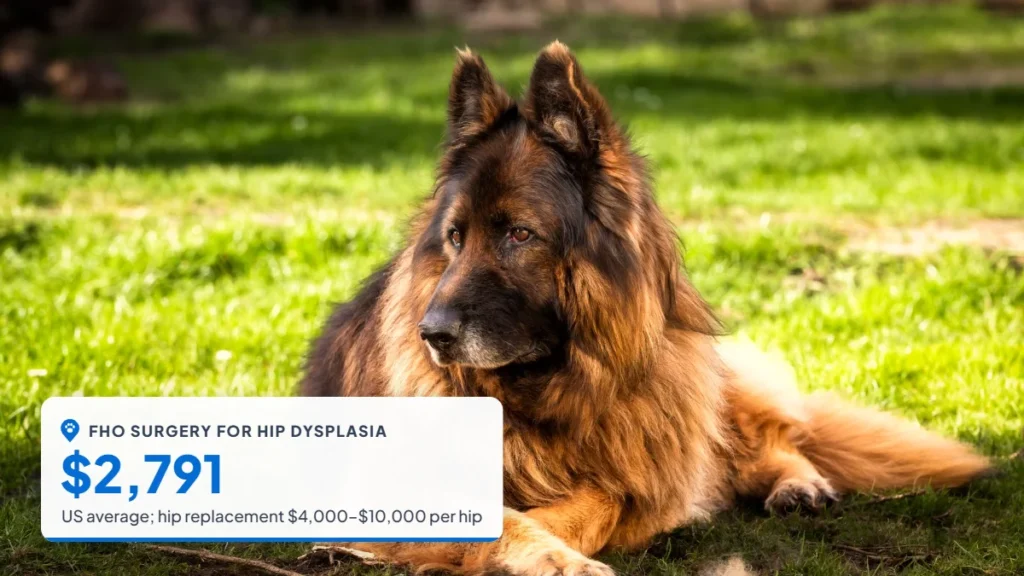
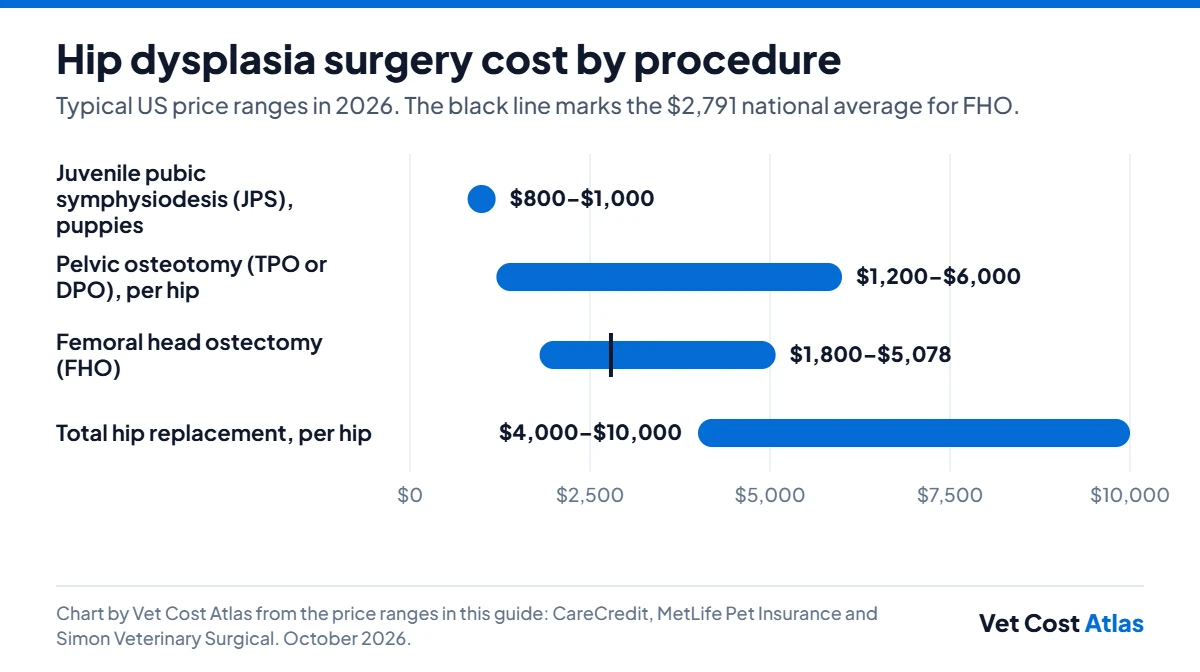
Hip dysplasia surgery for a dog costs about $800 to $1,000 for a juvenile pubic symphysiodesis (JPS) in a young puppy, $2,791 on average for a femoral head ostectomy (FHO), and about $4,000 to $10,000 per hip for a total hip replacement, according to CareCredit. The right surgery depends mostly on your dog’s age and size, and many dogs are managed without surgery for about $50 to $200 a month in medication.
| Treatment | Best suited to | Typical cost |
|---|---|---|
| Juvenile pubic symphysiodesis (JPS) | Puppies under about 18 weeks | $800–$1,000 |
| Pelvic osteotomy (TPO or DPO) | Young dogs, ideally under 8–10 months, without arthritis | $1,200–$6,000 per hip |
| Femoral head ostectomy (FHO) | Any age; dogs under about 60–70 lb | $2,791 national average ($1,800–$5,078); $1,900–$3,600 by weight at one Minneapolis-area hospital (Access Veterinary Care, Oct 2026, surgery and anesthesia only) |
| Total hip replacement (THR) | Mature dogs, at least 1 year old | $4,000–$10,000 per hip |
| Medical management | Older or less active dogs | $50–$200 a month in medication |
Hip dysplasia is a malformed hip joint that loosens and wears as a dog grows. It is most common in large breeds such as German Shepherds, Golden Retrievers and Labrador Retrievers, but it can affect dogs of any size. This guide covers what each treatment costs, what insurance pays and how to pay less.
Hip dysplasia surgery options and what each costs
There are four surgeries, and your dog’s age decides most of the choice: two are only possible while a puppy is still growing, and two are for adult dogs.
JPS: for young puppies
Juvenile pubic symphysiodesis fuses part of the pelvis so the hip sockets grow into a better position. The ACVS says it must be done before about 18 weeks of age, and calls it a relatively minor procedure with a very low risk of complications. CareCredit puts it at about $800 to $1,000. It is the cheapest option, but only if the problem is caught very early, often by screening the hips of a high-risk breed during a puppy visit.
TPO or DPO: for young dogs without arthritis
A triple or double pelvic osteotomy cuts and rotates the pelvis to cover the ball of the hip better. It suits dogs ideally under 8 to 10 months with loose hips but no arthritis yet on X-rays. Published prices vary widely: $1,200 to $2,000 according to MetLife Pet, and $3,000 to $6,000 per hip according to CareCredit. Ask whether a quote covers one hip or both.
FHO: removes the ball of the hip
A femoral head ostectomy removes the ball at the top of the thighbone, and scar tissue forms a false joint. It relieves pain rather than restoring a normal hip, and works best for dogs under about 60 to 70 lb kept at a lean weight, according to the ACVS. CareCredit’s national average is $2,791, with state averages from $2,251 to $5,008. MetLife Pet and a Los Angeles surgical practice quote $1,800 to $2,400.
Total hip replacement: the most complete fix
A total hip replacement swaps the ball and socket for implants and aims for normal, pain-free movement. Dogs must be at least a year old. It is the most expensive option at about $4,000 to $10,000 per hip in CareCredit’s figures; MetLife Pet quotes $5,600 to $6,000 plus $200 to $300 for follow-up visits.
| Part of the bill | Typical cost |
|---|---|
| Diagnostics: consultation, blood work, hip X-rays | $300–$700 |
| Anesthesia and monitoring | $600–$1,200 |
| Surgeon and operating room | $2,000–$4,500 |
| Implant | $800–$1,500 |
| Hospital stay (1–3 days) | $300–$800 |
| Post-operative care and first rehab sessions | $200–$600 |
When both hips need replacing, surgeons usually do one at a time, with three to six months in between, so expect two separate bills.
Prices also vary by state: CareCredit’s FHO averages run from $2,251 in West Virginia to $5,008 in Hawaii, and 34 of 51 state averages sit below the $2,791 national figure. CareCredit’s FHO cost page lists the average for your state.
Treating hip dysplasia without surgery
Many dogs, especially older or less active ones, are managed for years without surgery, but the costs add up: medication alone runs about $50 to $200 a month, or $600 to $2,400 a year, according to PetMD.
- Weight control: the single most useful step, according to the ACVS. Every extra pound loads the hips.
- Controlled exercise: leash walks and swimming rather than running and jumping.
- Anti-inflammatory drugs: prescribed by your vet, with regular blood tests to check the liver and kidneys; see dog blood work costs.
- Physical therapy and omega-3 fatty acids may help. The ACVS notes there is no peer-reviewed evidence that cartilage supplements work.
Over a long life, medical management can cost more than surgery. PetMD’s example of a dog diagnosed at 2 and treated until 10 comes to $4,800 to $19,200 in medication alone.
Does pet insurance cover hip dysplasia surgery?
Usually yes, if the first signs appear after your policy and its orthopedic waiting period start; once a vet has noted hip problems, they are a pre-existing condition. Rules for hips differ more than for most conditions:
| Insurer | Hip dysplasia rule |
|---|---|
| Healthy Paws | Covered only if your dog is enrolled before age 6; 12-month waiting period in most states (30 days in some states, waivable after a full exam) |
| Embrace | 180-day orthopedic waiting period for dogs, shortened if your dog passes an orthopedic exam |
| Fetch | 6-month orthopedic waiting period |
| Trupanion | Lists hip dysplasia among covered hereditary conditions; standard 30-day illness wait |
Hip dysplasia often affects both hips. If either hip showed signs before coverage, ask the insurer how it treats the other one. Full rules are in pre-existing conditions and pet insurance waiting periods, and our best pet insurance for dogs has a section for dogs at risk of hip dysplasia.
What you would get back
| Bill | Policy | Insurer pays | You pay |
|---|---|---|---|
| FHO, $2,791 | $250 deductible, 90% | $2,261.90 | $529.10 |
| FHO, $2,791 | $250 deductible, 80% | $1,982.80 | $808.20 |
| FHO, $2,791 | $500 deductible, 70% | $1,453.70 | $1,337.30 |
| Total hip replacement, $6,000 | $250 deductible, 90% | $5,150 | $850 |
| Total hip replacement, $6,000 | $250 deductible, 80% | $4,550 | $1,450 |
| Total hip replacement, $6,000 | $500 deductible, 70% | $3,700 | $2,300 |
For two hip replacements in the same policy year, the annual limit matters most: on $12,000 of bills, a $5,000 limit leaves you paying $7,000. See how the deductible and reimbursement rate change these numbers.
How to pay less
- Screen high-risk puppies early. JPS before 18 weeks costs a fraction of a hip replacement later; ask your vet about hip checks during puppy visits.
- Ask whether FHO is an option for a smaller dog. It costs much less than a replacement and often gives good comfort in dogs under about 60 to 70 lb.
- Get a written estimate that says one hip or both, and whether follow-up X-rays and rehab are included.
- Compare a general-practice quote with a specialist’s for FHO; for a replacement, a board-certified surgeon is the norm.
- Insure a large-breed puppy early, before any hip signs and, for Healthy Paws, before age 6.
- Spread the cost with vet financing or CareCredit, or look at financial help for vet bills.
The bottom line
Expect about $2,800 for an FHO, $4,000 to $10,000 per hip for a total hip replacement, and less than $1,000 for JPS if your puppy’s hips are caught before about 18 weeks. Older and quieter dogs often do well with weight control and medication at $50 to $200 a month. If you have a large-breed puppy, the cheapest protections are an early hip check and insurance bought before any signs appear.
Frequently asked questions
How much does hip dysplasia surgery cost for a dog?
It depends on the surgery. A femoral head ostectomy (FHO) averages $2,791 in the US, a total hip replacement costs about $4,000 to $10,000 per hip, a pelvic osteotomy (TPO or DPO) about $1,200 to $6,000 per hip, and juvenile pubic symphysiodesis (JPS) for young puppies about $800 to $1,000.
Is FHO or hip replacement better for my dog?
A total hip replacement aims to restore near-normal, pain-free hip function and suits mature dogs of most sizes. FHO removes the ball of the hip to relieve pain; it costs less and works best for dogs under about 60 to 70 lb. Your vet or a surgeon can tell you which fits your dog.
Can hip dysplasia be treated without surgery?
Yes, especially in older or less active dogs. Keeping your dog lean, controlled exercise, anti-inflammatory drugs and physical therapy can manage pain. Medication alone runs about $50 to $200 a month.
Does pet insurance cover hip dysplasia?
Most accident-and-illness policies cover it if signs appear after coverage starts and any orthopedic waiting period ends. Healthy Paws covers it only for dogs enrolled before age 6, after a 12-month wait in most states, and Embrace has a 180-day orthopedic wait for dogs.
Why are both hips sometimes more expensive than double the price?
They usually aren’t done together: surgeons replace one hip, then wait months before doing the second. Each surgery has its own anesthesia, hospital stay and follow-ups, and a low annual limit on your insurance can run out before the second hip.
How we researched hip dysplasia surgery costs
We used CareCredit’s hip dysplasia cost guide (March 2026), whose FHO averages come from the 2025 Synchrony Average Procedural Cost Study, and compared them with MetLife Pet’s cost guide, a Los Angeles surgical practice’s published breakdown and PetMD’s medication estimates. Treatment suitability comes from the American College of Veterinary Surgeons. Insurance rules come from each insurer’s website, checked in October 2026, and payout examples are our own calculations. Prices vary by region and hospital, so ask your vet or surgeon for a written estimate. This guide is general information, not veterinary advice.
Sources
- CareCredit: Dog hip dysplasia surgery cost
- American College of Veterinary Surgeons: Canine hip dysplasia
- MetLife Pet: How much does dog hip dysplasia surgery cost?
- Simon Veterinary Surgical: Understanding canine hip replacement costs
- PetMD: Hip dysplasia in dogs
- Healthy Paws: FAQ
- Embrace: Waiting periods
- Fetch: Waiting period
- Trupanion: Dog insurance