
Insurance guide, not financial advice. Prices and policy terms come from public sources and change often, so check the details of your own policy. Last reviewed October 14, 2026. How we research
In this guide
Quick answer
Pet insurance for accidents, sold as accident-only coverage, costs about a quarter as much as an accident-and-illness plan, but it leaves out most of what pets actually go to the vet for. In Nationwide’s 2025 claims data, only one of the 10 most common dog claims, trauma, was an accident. None of the top 10 for cats was. Accident-only makes sense mainly for older pets that can no longer get full coverage, or as a stopgap when money is tight.
| Accident-only | Accident and illness | |
|---|---|---|
| Average yearly price (2025) | $190 for dogs, $112 for cats | $836 for dogs, $435 for cats |
| Average monthly price | About $16 for dogs, $9 for cats | About $70 for dogs, $36 for cats |
| Covers | Injuries, poisoning, swallowed objects, bites, broken bones | All of that, plus illnesses such as cancer, diabetes, infections and allergies |
| Cruciate ligament (TPLO) surgery | Usually excluded | Usually covered, after any orthopedic waiting period |
| Chronic and hereditary conditions | Not covered | Usually covered if not pre-existing |
| Best for | Senior pets, tight budgets, pets with illness-related pre-existing conditions | Most pets, especially young ones |
Sources: NAPHIA State of the Industry 2026 (prices); Embrace, Pets Best and ASPCA Pet Health Insurance plan pages (coverage), checked October 2026.

What each plan covers
Accident-only plans pay for sudden injuries and emergencies with an outside cause. Everything that develops inside the body, from an ear infection to cancer, is an illness, and they don’t cover it. That’s the catch: illnesses make up most of the common claims.

Here’s how common problems are usually treated:
| Problem | Accident-only | Accident and illness |
|---|---|---|
| Swallowed sock or toy (foreign body) | Covered | Covered |
| Poisoning or toxic ingestion | Covered | Covered |
| Hit by a car, bite wounds, cuts | Covered | Covered |
| Broken bone or broken tooth | Covered | Covered |
| Bloat (GDV) | Covered at Embrace; check other insurers | Covered |
| Torn cruciate ligament (TPLO) | Excluded at Embrace and Pets Best | Covered, after any orthopedic waiting period |
| Ear infection, urinary infection, diarrhea | Not covered | Covered |
| Allergies, arthritis, diabetes, kidney disease | Not covered | Covered if not pre-existing |
| Cancer | Not covered | Covered if not pre-existing |
| Dental disease | Not covered | Depends on the insurer |
Sources: Embrace, Pets Best and ASPCA Pet Health Insurance accident-only plan pages, checked October 2026.
Cruciate tears are the big gap. They’re one of the most expensive common dog surgeries, and Embrace and Pets Best both exclude them from accident-only plans. See does pet insurance cover TPLO?
The price difference
Across all US policies in 2025, accident-only plans cost 23% as much as accident-and-illness plans for dogs, and 26% as much for cats.
| Accident-only | Accident and illness | Difference | |
|---|---|---|---|
| Dogs, per year | $190 | $836 | $646 |
| Dogs, per month | About $16 | About $70 | About $54 |
| Cats, per year | $112 | $435 | $323 |
| Cats, per month | About $9 | About $36 | About $27 |
Source: NAPHIA State of the Industry Report 2026 (2025 averages). Monthly figures are the yearly average divided by 12.
Some plans cost even less. Pets Best advertises its accident-only plan from $9 a month for dogs and $6 for cats in most states. Embrace’s accident-only plan comes with fixed settings: 90% reimbursement, a $100 yearly deductible and up to $5,000 a year.
Accident-only plans are also open to older pets. Embrace says its plan suits pets “no longer eligible for a new full accident and illness policy due to age.” For how full plans are priced by age and breed, see how much pet insurance costs.
The math with real vet bills
Accident-only saves you about $646 a year on a dog. It comes out ahead in a quiet year or an accident year, and far behind the year your dog gets sick. To show the difference in coverage rather than settings, the chart uses the same 80% reimbursement and $250 deductible for both plans, with each plan’s average premium.
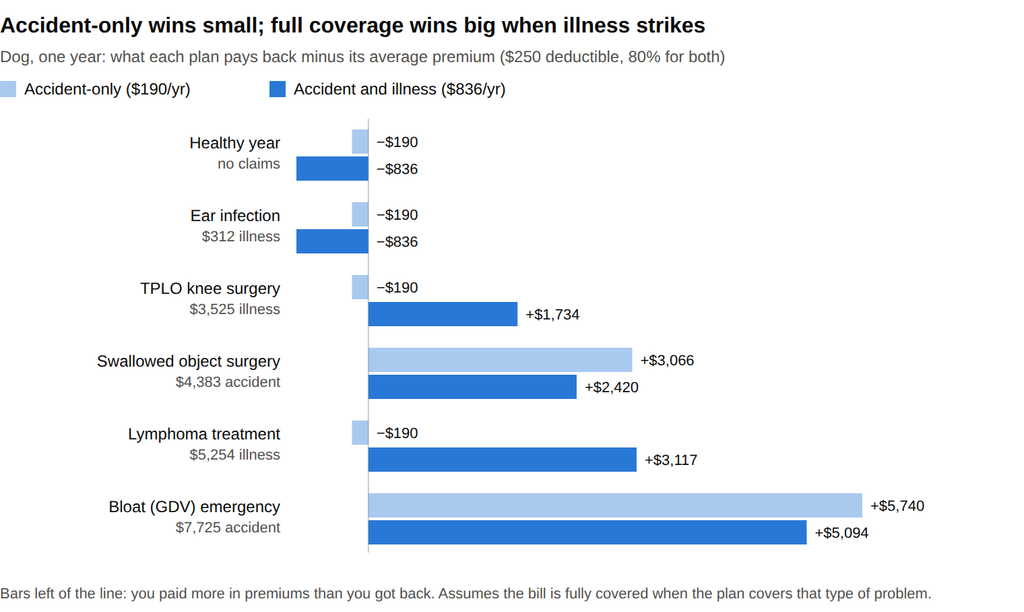
Read the chart in three parts:
- Quiet years and small problems: accident-only loses $190, full coverage loses $836. You keep the $646 difference.
- Accident years: both plans pay the same bill, so accident-only comes out about $646 ahead.
- Illness years: accident-only pays nothing. A torn cruciate ligament or cancer leaves you about $1,900 to $3,300 worse off than with full coverage.
One illness wipes out years of savings. At $646 a year, it would take more than five years of savings to cover the $3,307 gap in the lymphoma example.
Our calculations: 80% of the bill minus a $250 deductible, minus each plan’s average 2025 premium (NAPHIA). Bills: CareCredit national averages (TPLO $3,525, foreign body surgery $4,383, lymphoma $5,254), Nationwide’s 2025 ear infection claim ($312) and Healthy Paws’ bloat example ($7,725). Some accident-only plans cap the yearly payout; Embrace’s, for example, pays up to $5,000. For the full math on accident-and-illness plans, see is pet insurance worth it?
Who should choose accident-only
Accident-only is a good fit in a few specific situations, and a poor substitute for full coverage in most others.
| Accident-only can make sense if… | Choose accident and illness if… |
|---|---|
| Your pet is a senior and can no longer get a new accident-and-illness policy | Your pet is young and healthy, so nothing is excluded yet |
| Your pet already has illness-related pre-existing conditions, so a full policy would exclude most of its likely claims | Your breed is prone to costly illnesses, such as cancer, heart disease or knee problems |
| Money is tight and it’s this or nothing, while you build savings for illnesses | A $3,000 to $5,000 illness bill would be hard for you to pay |
| Your pet is very active or outdoors a lot, so injuries are the main worry | You want the option to treat whatever comes, not just injuries |
Embrace describes its accident-only plan as suited to pets “no longer eligible for a new full accident and illness policy due to age, and those whose pets have illness-related pre-existing conditions.”
If you choose accident-only, pair it with a savings plan. Put the difference, about $54 a month for a dog or $27 for a cat, into a separate account for illnesses. It won’t cover a big illness in the first few years, but it’s better than nothing. See vet financing options for a backup.
Which insurers sell accident-only plans
Several large insurers sell accident-only plans alongside their full coverage. Coverage details differ, so compare the exclusions, not just the price.
| Insurer | Accident-only plan | Worth knowing |
|---|---|---|
| Embrace | Yes | 90% reimbursement, $100 yearly deductible, up to $5,000 a year; covers bloat and swallowed objects; excludes cruciate tears, dental illness and cancer |
| Pets Best | Yes | From $9 a month for dogs and $6 for cats in most states; excludes cruciate ligament injuries |
| ASPCA Pet Health Insurance | Yes | Covers swallowed objects, bites, fractures, broken teeth and toxic ingestion; you choose the reimbursement, deductible and limit |
| Trupanion, Healthy Paws, Fetch, Lemonade | Not among their main plans | These insurers focus on accident-and-illness coverage |
Sources: each insurer’s website, checked October 2026. Availability varies by state.
For how the main accident-and-illness plans compare, see the best pet insurance for dogs.
The upgrade trap: switching to full coverage later
Starting with accident-only and upgrading later sounds sensible, but it has a catch: anything your pet develops in the meantime can be excluded for good.
Here’s an example of how it can play out:
- Your young dog is on an accident-only plan.
- At age 3, the vet notes recurring ear infections and itchy skin. Accident-only doesn’t cover them.
- At age 4, you upgrade to accident and illness. The new coverage treats the ears and skin as pre-existing, so those conditions stay excluded, possibly for life.
- New illness waiting periods also start, and knee problems may face a longer orthopedic wait.
The illnesses most likely to need care are the ones that slip into the records first. Allergies, ear infections and digestive problems were among the most common dog claims in Nationwide’s 2025 data, and they can start at any age.
Before you upgrade, ask the insurer two questions in writing: does the upgrade keep your original start date for pre-existing conditions, and which waiting periods apply? Rules differ by insurer. See pet insurance and pre-existing conditions and pet insurance waiting periods.
The simplest way to avoid the trap is to start with accident and illness while your pet is young, and choose a higher deductible if you need a lower price.
The bottom line
Accident-only is cheap because it skips most of what pets get sick with. It’s a reasonable choice for senior pets, pets with illness-related pre-existing conditions, or as a stopgap on a tight budget. For a young, healthy pet, an accident-and-illness plan with a higher deductible usually protects you better for the money, and avoids the upgrade trap later.
Frequently asked questions
What’s the difference between accident-only and accident and illness pet insurance?
Accident-only covers sudden injuries and emergencies, such as swallowed objects, poisoning and broken bones. Accident and illness covers all of that plus illnesses, such as infections, allergies, diabetes and cancer.
How much cheaper is accident-only pet insurance?
In 2025, accident-only plans averaged $190 a year for dogs and $112 for cats, compared with $836 and $435 for accident-and-illness plans, according to NAPHIA. That’s about a quarter of the price.
Is accident-only pet insurance worth it?
It can be for senior pets that can’t get full coverage, pets with illness-related pre-existing conditions, or owners who can’t afford a full plan. For most young pets, accident and illness covers far more of the likely bills.
Does accident-only insurance cover a torn ACL?
Usually not. Embrace and Pets Best both exclude cruciate ligament injuries from their accident-only plans, even though a tear can happen suddenly.
Does accident-only insurance cover a swallowed object?
Yes. Swallowed objects (foreign bodies) are covered by the accident-only plans from Embrace, Pets Best and ASPCA Pet Health Insurance.
Can I switch from accident-only to accident and illness later?
Often, but conditions that appeared while you had accident-only may be excluded as pre-existing, and new waiting periods may apply. Ask the insurer in writing before you switch.
Are most pet insurance claims accidents or illnesses?
The most common ones are illnesses. In Nationwide’s 2025 claims data, only one of the 10 most common dog claims, trauma, was an accident, and none of the top 10 cat claims was.
How we researched this article
Prices are NAPHIA’s 2025 industry averages for each plan type. Coverage details come from the accident-only plan pages of Embrace, Pets Best and ASPCA Pet Health Insurance, checked in October 2026. The list of common claims comes from Nationwide’s analysis of more than 3.3 million claims in 2025. Payout comparisons are our own calculations with the same reimbursement and deductible for both plan types, applying the percentage first and then the deductible. Plan terms vary by state, so read the sample policy before you buy.
Sources
- NAPHIA: State of the Industry Report 2026 highlights
- Embrace: Accident-only pet insurance
- Pets Best: Accident-only pet insurance
- ASPCA Pet Health Insurance: Accident-only pet insurance
- Nationwide: Chronic conditions dominate this year’s list of most common pet health problems (2026)
- CareCredit: Veterinary procedure costs
- Healthy Paws: Common pet emergencies and costs